Statutes of the Nobel Assembly at Karolinska Institutet approved by the Government of Sweden on the 7th of April, 1994
FUNCTIONS, COMPOSITION AND ORGANIZATION
§ 1
The primary task of the Nobel Assembly at Karolinska Institutet
is to carry out, according to the detailed provisions set out
below, the duties related to the award of the Nobel prize in
Physiology or Medicine which formerly fell to the medical faculty
of Karolinska Institutet under the Statutes of the Nobel
Foundation and the statute comprising special regulations for the
award by the Caroline Medico Chirurgical Institute of prizes from
the Nobel Foundation et al.
The Assembly is also to promote the cause of medical research by
other means.
§ 2
The Assembly consists of 50 elected members.
Only persons holding appointments as professors in medical
subjects at Karolinska Institutet may be elected as
members.
Members retire from the Assembly when they relinquish their
appointments at Karolinska Institutet.
Note: see transitional provisions for the original size of the
Assembly.
§ 3
The business of the Assembly is in the hands of its chairman,
secretary and Nobel Committee.
ELECTION OF MEMBERS
§ 4
If the number of members should fall below the figure established
in § 2, the election of new members shall take place at the
November meeting of the Assembly.
Note: see transitional provisions for the election of the
original members.
CHAIRMAN AND SECRETARY OF THE
ASSEMBLY
§ 5
At the November meeting the Assembly elects a chairman from among
its own members to serve for one year. The chairman may not be
re-elected with immediate effect nor may he also serve as
chairman of the Nobel Committee.
A deputy chairman is elected in the same manner. If both the
chairman and the deputy chairman are unable to be present, the
last member who has served as chairman and who is not prevented
from taking on the task is to serve in their stead.
§ 6
On the recommendation of the Nobel Committee, a secretary is
appointed from among the members of the Assembly for a period of
three years. This post cannot be held for more than four
successive periods.
§ 7
If the chairman, deputy chairman or secretary retires before the
expiry of the period for which he was appointed, a successor is
elected as soon as possible to serve for the remainder of the
period.
ELECTION COMMITTEE
§ 8
The Assembly elects five members of an Election Committee, whose
task is to submit recommendations for the election of new
members, as well as of a chairman and deputy chairman of the
Assembly.
Members of the Election Committee are elected for a period of
three years. Retiring members may be re-elected but no member may
serve more than six consecutive years. The election periods shall
be adjusted in such a manner that no more than two members are
due to retire at the same time. In the same manner a personal
deputy shall be elected for each member. Recommendations for new
members and deputies shall be made jointly by the Election
Committee and the Nobel Committee.
The Assembly appoints one of the members as chairman, and one as
deputy chairman, of the Election Committee.
§ 9
The Nobel Committee to be appointed for the medical prize section
according to § 6 of the Statutes of the Nobel Foundation
shall consist of five members, who are elected by the Assembly on
the recommendation of the Nobel Committee. Elections are for
three years. Retiring members may be re-elected but no one may be
a member for more than six consecutive years. Election periods
are to be adjusted so that no more than two members are due to
retire at the same time.
The Assembly elects one member from among the members of the
Nobel Committee to act as chairman of the Committee and one
member to act as deputy chairman, on the recommendation of the
Nobel Committee and for a period of one year at a time. Such an
appointment may not be held for more than three consecutive
years.
The secretary of the Assembly also serves as secretary of the
Nobel Committee.
If the chairman, deputy chairman, secretary or any member retires
before the expiry of the period for which he was elected, a
successor is elected for the remainder of the period.
If a member is prevented over a long period from taking part in
the evaluation of proposals for awards that year, the Assembly is
entitled to elect another member to replace him.
The chairman and the deputy chairman of the Assembly are entitled
to attend the Committee’s meetings.
§ 10
On a recommendation from the Nobel Committee, the Assembly
appoints ten persons who are particularly well qualified in the
subject-areas concerned to participate as co-opted members in the
deliberations of the Committee and its decisions regarding
adjudication of the proposals for awards that year and related
matters from the 1st of March until the 31st of October.
If a co-opted member retires during this period, the Assembly
appoints a replacement on the recommendation of the Nobel
Committee, if it is considered necessary.
NOBEL PRIZE BUSINESS
§ 11
Persons competent to submit proposals for awards under § 7
of the Statutes of the Nobel Foundation are:
1. members of the Assembly,
2. Swedish and foreign members of the medical class of the Royal
Academy of Sciences,
3. previous recipients of the Nobel prize in Physiology or
Medicine,
4. members of the Nobel Committee not qualified under paragraph 1
above,
5. holders of established posts as professors at the faculties of
medicine in Sweden and holders of similar posts at the faculties
of medicine or similar institutions in Denmark, Finland, Iceland
and Norway,
6. holders of similar posts at no fewer than six other faculties
of medicine selected by the Assembly with a view to ensuring the
appropriate distribution of the task among various countries and
their seats of learning and
7. practitioners of natural sciences whom the Assembly may
otherwise see fit to approach.
Decisions concerning the selection of the persons appointed under
paragraphs 6. and 7. above are taken before the end of May each
year on the recommendation of the Nobel Committee.
§ 12
The Nobel Committee arranges for examination of nominations
received and decides which of the works proposed should be the
subject of a special investigation. The Committee is entitled to
appoint a committee member or outside expert to assist them in
this matter.
Once the Committee’s decision has been conveyed to the
Assembly, the Assembly decides, before the end of May, whether
any works should be added to the list submitted by the Committee
for special investigation.
Submitted proposals for awards lapse if the work does not come up
for special investigation. Proposals for the award of a prize to
an institution or society are not considered.
The Assembly decides the order of procedure of the Nobel
Committee.
§ 13
The Assembly is to take a final decision concerning awards not
later than the month of October, the Nobel Committee having
reported on its endeavours and put forward its proposals for
prize awards.
A member of the Nobel Committee who is not a member of the
Assembly is entitled to take part in the deliberations of the
Assembly concerning awards but may not participate in
decisions.
§ 14
Voting in elections and on awards is by secret ballot. Other
votes in the Assembly shall be open votes. A simple majority is
valid. In the event of a tied vote, the fall of the lot decides
the issue in the case of elections and votes for prize awards,
but the view supported by the chairman prevails in other
cases.
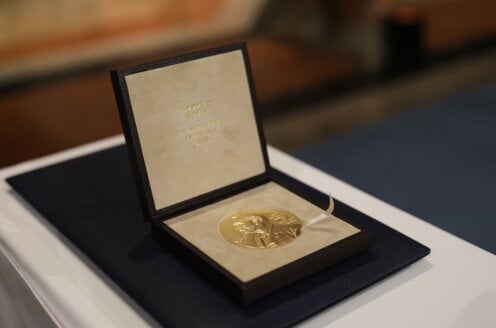
Each member of the Assembly who participates in the final
decision concerning an award receives a gold medal specially
minted for the occasion.
Copyright © The Nobel Foundation 2006
MLA style: "The Nobel Foundation - Special regulations". Nobelprize.org. 25 May 2012 http://www.nobelprize.org/nobel_organizations/nobelfoundation/statutes-ki.html