What do they look like? ……..


|
|
||||||
 |
 |
 |
|
 |
|
 |
|
Photo: L. Falk |
||||||
|
Plastic, rubber, plexiglas, gels and textile fibres such as nylon and polyester are all synthetic materials made of polymer molecules.
|
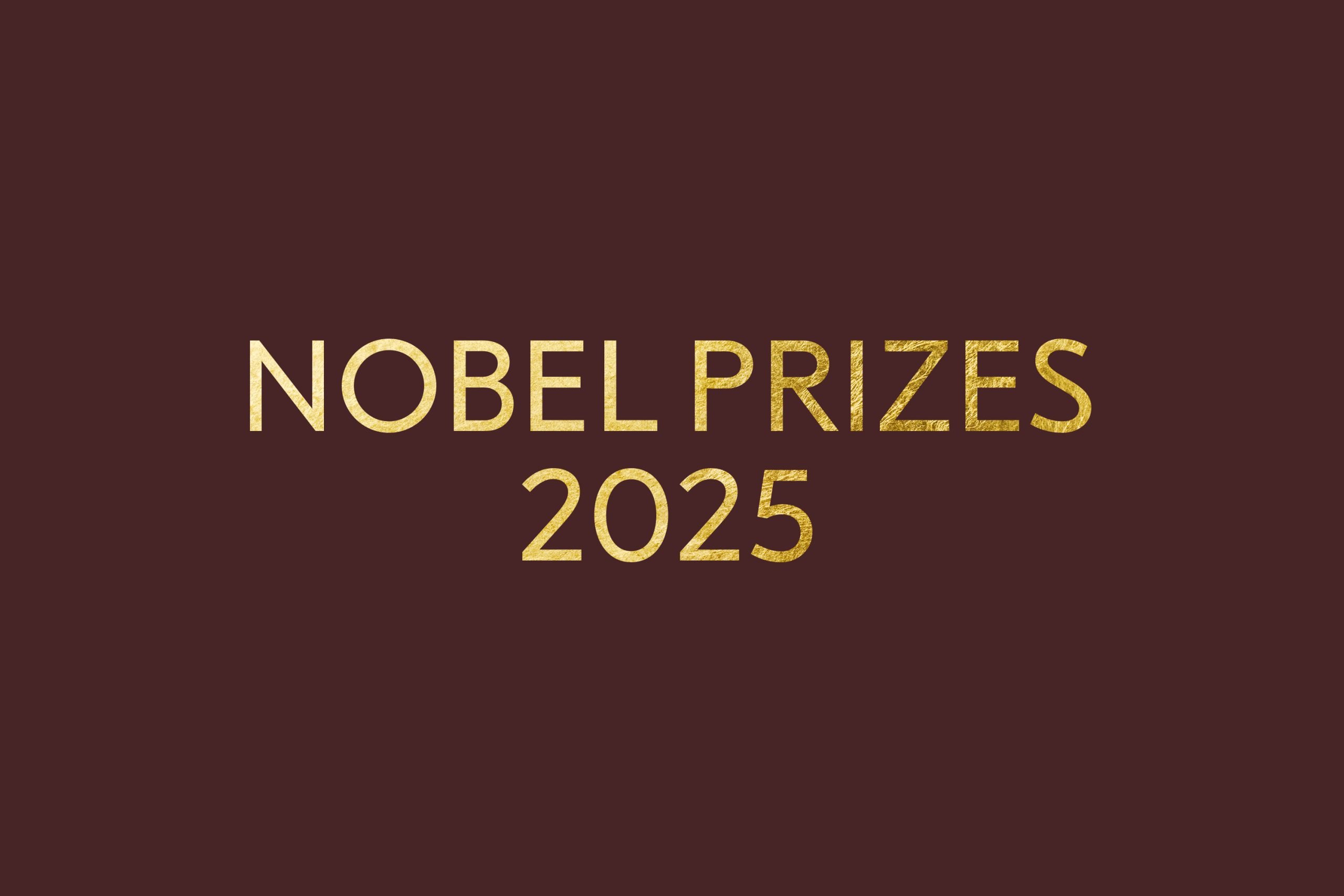
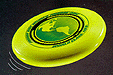
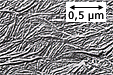
A Frisbee is a mixture of crystalline (ordered) and amorphous (disordered) polymer structures. |
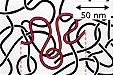
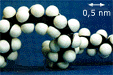
Each polymer molecule consists of linked basic units called monomers. The number of monomers in a chain can be very large, from thousands to several millions. The chains may be entangled like spaghetti (as above) or be ordered in crystalline formations.
|
The monomer is specific for every polymer and determines the name of the substance. A Frisbee is made of polyethylene which consists of linked ethylene (CH2CH2) monomers.
|
|||
|
|
||||||
|
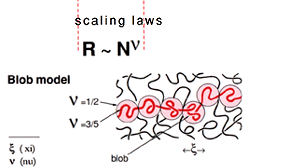
If the polymer chain is long, its size can be described by simple proportion ratios called scaling laws: When the number of monomers N is doubled, the size is increased by the scaling factor 2v. The exponent v is universal in the sense that it is the same for all polymer chains although it depends on the polymer concentration. |
||||||
|
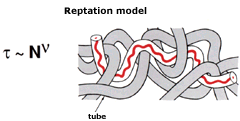
The snake-like (reptile-like) motion of an entangled polymer chain is explained by imaging that it is confined to a “tube” formed by adjacent chains. The reptation time t, the time needed for the chain to completely move out of the tube, can be obtained from simple scaling arguments. The reptation model leads to a smaller exponent (v= 3) than the measured one (v= 3.3) but it can nevertheless explain a number of phenomena and is very powerful in its simplicity. |
|
|||||
 |
 |
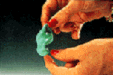
Are you familiar with “silly putty”, the strange substance which is both solid and liquid-like? If you pull it slowly in comparison with the reptation time, the material flows like a very viscous liquid. If you form it into a ball and strike it quickly, it bounces like rubber.
|
||||
|
Photo: L. Falk
|
Photo: L. Falk |
|||||
|
||||||
|
||||||
|
||||||
Nobel Prizes and laureates
Six prizes were awarded for achievements that have conferred the greatest benefit to humankind. The 14 laureates' work and discoveries range from quantum tunnelling to promoting democratic rights.
See them all presented here.