Nobel Prize in Physics 2020
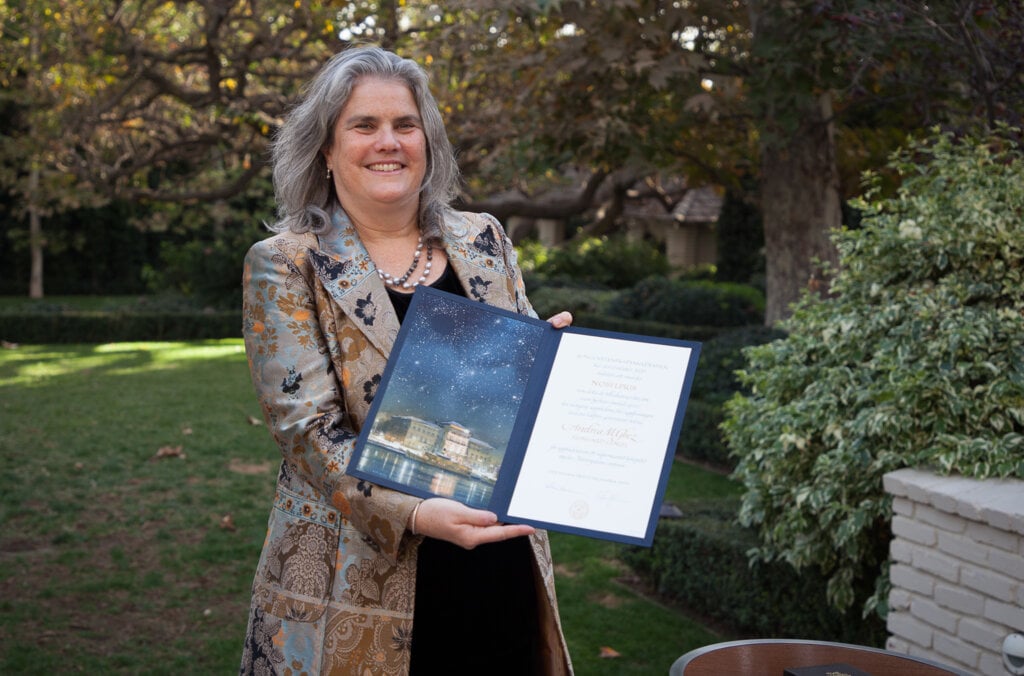
Watching the lunar landings as a child marked the first small step on Andrea Ghez’s journey to surveying stars at the centre of our galaxy. Ghez’s focus, patience and ability to ignore people blocking her path to success resulted in one giant leap for physics with her Nobel Prize-awarded discovery of a supermassive black hole at the heart of the Milky Way.


Four years after Andrea Ghez was born in 1965 in New York, Neil Armstrong took his historic first steps on the moon. Captivated by the historic achievement, Ghez’s enduring fascination with the universe began. She quickly announced her intention to become the first woman on the moon and her parents bought her a small telescope.
Ghez became intrigued by the enormity of the universe and its many mysteries. She lay awake at night thinking about the beginning of time and whether space has an edge.
At school, it became clear that Ghez had an aptitude for mathematics and science. Her parents encouraged her love of these subjects, which she thought about as puzzles with pieces that must be put together in a logical way. When a college counsellor tried to discourage her from applying to the Massachusetts Institute of Technology (MIT) because she was a girl, Ghez’s science teacher, Judy Keane, encouraged her to persevere, leading Ghez to develop a lifelong passion for proving people wrong.
“At every stage, someone has always said no, you can’t do this because you’re a girl. I got very used to ignoring when people said I couldn’t do something.”
Andrea Ghez
She began studying math at MIT, before changing to physics and graduating in 1987. Despite there being few women in her field, Ghez felt she had found her people. At Caltech, she studied young stars with Gerry Neugebauer – a pioneer of infrared astronomy – using an approach that would prove crucial to her later work. She later moved to the University of Arizona, and then the University of California Los Angeles (UCLA) which would became the centre of her own research universe.
At UCLA, Ghez set out to solve the mystery of what lies at centre of our galaxy, the Milky Way. She has been revealing its secrets for more than a quarter of a century.
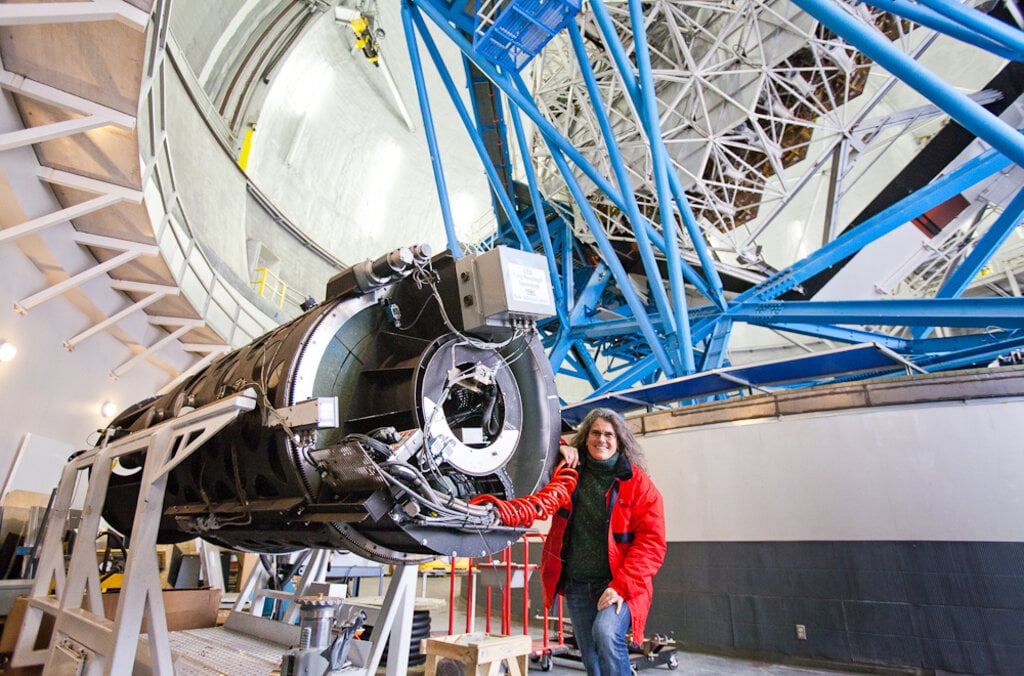
Researchers had long suspected a black hole could sit at its heart but were unable to find definitive proof. Ghez set out a plan to do so using the world’s largest telescope, found at the Keck Observatory, Hawaii.
Ghez was looking for something that cannot be seen. Born through the death of huge stars, black holes are infinitesimally small and infinitely dense with gravity so strong that not even light can escape. Ghez suggested studying the area around the suspected black hole – Sagittarius A* – and tracking the motions of stars at the centre of the galaxy to demonstrate its existence. If there was a black hole, the stars would start to stray from their paths and accelerate due to the gravitational pull of the black hole.
However, Ghez soon encountered challenges. Measurements of accelerations had never been made around supermassive black holes before, and her proposal to study the movement of stars orbiting Sagittarius A* and use it as a ‘natural lab’ was initially turned down. She persevered and secured ‘telescope time’, but more obstacles lay ahead. Despite being perched high on a remote Hawaiian volcano, there was too much distortion from the atmosphere to produce usable data, so Ghez refined a new technique to measure the distortion and then cancel it out. Adaptive optics enabled her to peer through the dust clouds to the heart of the Milky Way and make observations with exceptional clarity. “It was so exciting just to get to the telescope and see the first image that showed that this is really going to work,” she said.

“When things don’t make sense. When you get some new piece of information and it doesn’t conform to your previous ideas. It really forces you to rethink your model for describing how things work. For me, that is the most interesting moment.”
Andrea Ghez
At the turn of the new century, Ghez and her research team reported that for the first time, astronomers had seen stars accelerate around the supermassive black hole and within five years took the first clear picture of the centre of the Milky Way. She tracked the motions of around 30 stars close to the centre, which she likened to a crowded, dynamic city, to explore the gravitational effects of Sagittarius A*. They included S0-2, a star with an elliptical orbit that takes just 16 years to travel around the galaxy’s centre. Ghez observed that it was very active when it was closer to the source of the unusual emissions due to the effects of stronger gravity. By stitching together a quarter-century’s worth of data points, Ghez and her team revealed the star’s movement.

In July 2019, they published the strongest proof so far that there is an invisible supermassive object hiding at the centre of our galaxy. Using S0-2’s complete orbit to measure the supermassive black hole’s gravity, Ghez and her team also showed experimental proof for Albert Einstein’s theory of general relativity. It describes how everything in the universe is held in the grip of gravitation, shaping space itself, with heavy masses able to bend space and slow time to form black holes. “Einstein’s right, at least for now,” she said, noting that extremes of gravity mean the theory could break down.
Two years later, astronomers unveiled the first image of the supermassive black hole Ghez had described, providing further evidence of its existence, and clues about the workings of the mysterious destructive giants, which are thought to lurk at the centre of most galaxies.
Ghez’s work has unlocked new knowledge about our galaxy and created a test bed for our physical understanding of the universe, proving that enduring curiosity and persistence pays off. She didn’t intend to run a grand experiment lasting more than a quarter of a century. “At every stage, we’ve only thought about what’s possible to do next,” she said.
“Hard problems require patience. If it were easy, it would have already been done. Moving the frontier of knowledge forward is just hard work.”
Andrea Ghez
In 2020, Ghez was awarded the Nobel Prize in Physics together with Reinhard Genzel and Roger Penrose. From being inspired by Armstrong’s “one small step,” and overcoming several challenges, she continues to make strides with her own work. “The centre of the galaxy is such a rich and exciting place, and this is a project that just gets more and more interesting with time,” she said.