This is a page with key-subjects from the statutes. Either choose one of these, or scroll down to the beginning of the listing.
§
1.
The Nobel Foundation is established under the terms of the will
of the engineer Dr. Alfred Bernhard Nobel, drawn up on November
27, 1895, which in its relevant parts states:
"The whole of my remaining realizable estate shall be dealt with in the following way: the capital, invested in safe securities by my executors, shall constitute a fund, the interest on which shall be annually distributed in the form of prizes to those who, during the preceding year, shall have conferred the greatest benefit to mankind. The said interest shall be divided into five equal parts, which shall be apportioned as follows: one part to the person who shall have made the most important discovery or invention within the field of physics; one part to the person who shall have made the most important chemical discovery or improvement; one part to the person who shall have made the most important discovery within the domain of physiology or medicine; one part to the person who shall have produced in the field of literature the most outstanding work in an ideal direction; and one part to the person who shall have done the most or the best work for fraternity between nations, for the abolition or reduction of standing armies and for the holding and promotion of peace congresses. The prize for physics and chemistry shall be awarded by the Swedish Academy of Sciences; that for physiological or medical works by Karolinska Institutet in Stockholm; that for literature by the Academy in Stockholm; and that for champions of peace by a committee of five persons to be elected by the Norwegian Storting. It is my express wish that in awarding the prizes no consideration whatever shall be given to the nationality of the candidates, but that the most worthy shall receive the prize, whether he be a Scandinavian or not."
The provisions of the will as set forth
above shall be observed by the Foundation together with the
explanations and more detailed instructions embodied in these
Statutes and in a settlement arrived at with certain of Dr.
Nobel's heirs on June 5, 1898. In this settlement, after an
agreement had been reached concerning a minor part of Dr. Nobel's
estate, they declared that they "hereby acknowledge Dr. Nobel's
will and renounce unconditionally, for themselves and their
heirs, all further claims on Dr. Nobel's estate and all claims to
take part in its administration, and similarly every right to
protest against the elucidations of, or addition to, the will as
well as any other provisions as to its carrying into effect and
the uses to which the proceeds are put, which, now or in the
future, shall be enjoined by the Crown or whomsoever competent;
subject, however, to the following express reservations:
a) that the statutes, common to the prize-awarding institutions,
dealing with the manner of, and the conditions for, the award of
prizes as prescribed in the will, shall be drawn up in
consultation with a representative nominated by Robert Nobel's
family and submitted to the approval of the Crown; and
b) that there
shall be no departure from the following main principles, viz:
that each of the annual prizes established by the will shall be
awarded at least during each five-year period from, and
including, the year immediately following that in which the Nobel
Foundation commences its activities, and
that the amount of a prize thus awarded shall under no
circumstances be less than sixty percent of that portion of the
annual yield of the fund that shall be available for the prize
award, nor shall it be divided into more than three prizes at
most."
§ 2.
The "Academy in Stockholm," mentioned in the will, shall refer to
the Swedish Academy.
The term "literature" shall comprise not only belles-lettres but
also other writings which, by virtue of their form and style,
possess literary value.
The duties devolving upon Karolinska Institutet under the will
shall be performed by the Nobel Assembly of Karolinska
Institutet.
The provision in the will that the annual award of prizes shall
be intended for works "during the preceding year" should be
understood in the sense that the awards shall be made for the
most recent achievements in the fields of culture referred to in
the will and for older works only if their significance has not
become apparent until recently.
§ 3.
To be eligible to be considered for a prize, a written work shall
have been issued in print or have been published in another form,
to be decided on its own behalf by each prize-awarding
body.
§ 4.
A prize amount may be equally divided between two works, each of
which is considered to merit a prize. If a work that is being
rewarded has been produced by two or three persons, the prize
shall be awarded to them jointly. In no case may a prize amount
be divided between more than three persons.
Work produced by a person since deceased shall not be considered
for an award. If, however, a prizewinner dies before he has
received the prize, then the prize may be presented.
Each prize-awarding body shall be competent to decide whether the
prize it is entitled to award may be conferred upon an
institution or association.
§ 5.
A work may not be awarded a prize, unless it by experience or
expert scrutiny has been found to be of such outstanding
importance as is manifestly intended by the will.
If none of the works under consideration is found to be of the
importance indicated in the first paragraph, the prize money
shall be reserved until the following year. If, even then, the
prize cannot be awarded, the amount shall be added to the
Foundation's restricted funds.
§ 6.
For each prize awarded by a Swedish prize-awarding body, the
latter shall appoint a Nobel Committee consisting of three, four
or five persons, to give their opinion on the matter of the award
of the prize. The adjudication needed for the award of the Peace
Prize shall be carried out by the committee of the Norwegian
Storting referred to in the will, known as the Norwegian Nobel
Committee.
Swedish citizenship or membership of the prize-awarding
institution shall not be a necessary qualification for election
to membership of a Nobel Committee. Persons other than Norwegians
may be members of the Norwegian Nobel Committee.
A member of a Nobel Committee shall receive remuneration for his
work, in an amount to be determined by the prize-awarding
body.
If it is necessary for special reasons, the prize-awarding body
shall be entitled to appoint experts to take part as members in
the deliberations and decisions of the Nobel Committee.
§ 7.
To be considered eligible for an award, it is necessary to be
nominated in writing by a person competent to make such a
nomination. A personal application for an award shall not be
considered.
Competence to submit nominations shall be incumbent on
representatives, domestic as well as foreign, of the field of
culture in question, in conformity with detailed regulations
issued by the prize-awarding body.
Each year the prize adjudication shall embrace such nominations
as have been submitted during the preceding twelve months up to
February 1. If, in addition to the prize for the current year,
the prize-awarding body has at its disposal prize money reserved
under §5, the question of the award of the prize for the
current year shall be decided before a decision is made
concerning the amount reserved from the preceding year.
§ 8.
Nominations should be explained and accompanied by the
publications and other documents cited in support of them.
Each prize-awarding body shall decide on its own behalf how
documents shall be submitted.
Where a nomination is written in a language that cannot be
translated without particular trouble or considerable expense, or
where, to be able to appraise a proposed work, the prize-awarding
body must chiefly make itself acquainted with the contents of a
document written in such a language, the prize-awarding body
shall not be under obligation to take up the nomination for
further consideration.
§ 9.
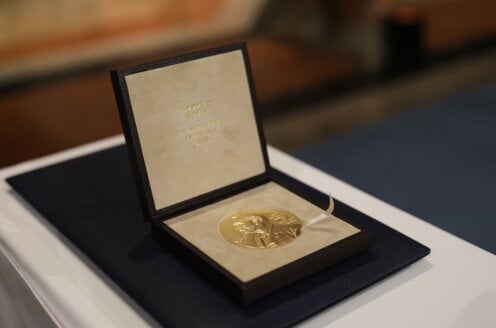
On the Festival Day of the Foundation, December 10, which is the
anniversary of the death of the testator, the prize-awarding
bodies shall present to each prizewinner a check for the amount
of the prize, a diploma and a gold medal bearing the image of the
testator and an appropriate inscription.
Should a prizewinner decline the prize, or before October 1 in
the calendar year immediately following fail to cash the
prize-awarding body's check in the manner stipulated by the
Board, the amount of the prize shall be added to the Foundation's
restricted funds.
It shall be incumbent on a prizewinner, whenever this is
possible, to give a lecture on a subject relevant to the work for
which the prize has been awarded. Such a lecture should be given
before, or no later than six months after, the Festival Day in
Stockholm or, in the case of the Peace Prize, in Oslo.
§ 10.
No appeals may be made against the decision of a prize-awarding
body with regard to the award of a prize.
Proposals received for the award of a prize, and investigations
and opinions concerning the award of a prize, may not be
divulged. Should divergent opinions have been expressed in
connection with the decision of a prize-awarding body concerning
the award of a prize, this may not be included in the record or
otherwise divulged.
A prize-awarding body may, however, after due consideration in
each individual case, permit access to material which formed the
basis for the evaluation and decision concerning a prize, for
purposes of research in intellectual history. Such permission may
not, however, be granted until at least 50 years have elapsed
after the date on which the decision in question was made.
§ 11.
The Board of the Foundation shall establish financial limits on
the work that the prize-awarding bodies perform in accordance
with these statutes. The framework grants that the Board annually
makes available to the prize-awarding bodies shall also include
funds for developing and maintaining such expertise as is needed
to perform the prize adjudication work.
§ 12.
For assistance with the scrutiny necessary for the prize
adjudication and for promoting the objects of the Foundation in
other ways, the prize-awarding bodies may establish Nobel
Institutes. Each Nobel Institute shall be under the leadership of
the prize-awarding body that established it.
§ 13.
The Foundation shall be represented by a Board of Directors,
which has its registered office in Stockholm and consists of
seven members and two deputies, Swedish or Norwegian citizens,
who shall be elected by the trustees of the prize-awarding
bodies. The Board shall choose from among its own members a
Chairman, a Vice-Chairman and an Executive Director. The members
of the Board and the deputies shall be appointed for a term of
two years, counting from May 1.
The trustees of the prize-awarding bodies shall determine a
reasonable remuneration to be paid in a manner decided by the
Board to each Board member, with the exception of the Executive
Director, who is not entitled to remuneration as a Board member.
The trustees shall also determine a reasonable remuneration for
the auditors. The Board shall determine the salary of the
Executive Director.
§ 14.
The Board shall administer the property of the Foundation for the
purpose of maintaining good long-term prize-awarding capacity and
safeguarding the value of the Foundation's assets in real
terms.
The Board shall ensure that the Foundation achieves a good return
and risk-spreading by means of appropriate asset structure and
turnover.
The Board may also use income resulting from the sale of
Foundation assets for prize-awarding and expenses, to the extent
this income is not needed to maintain good long-term
prize-awarding capacity and safeguard the value of Foundation
assets in real terms, or unless the fourth paragraph requires
another use.
Of total annual income, at least one tenth shall be allocated to
restricted funds.
§ 15.
The Board shall establish rules of procedure, including regulations for the
work of the Board, the Executive Director and the other employees of the
Foundation.
§ 16.
The Board may not make a decision on any matter unless at least
four members participate in the handling of the matter.
Voting shall occur openly. In the case of elections to positions
to which a member of the Board may be chosen, however, if one
member so requests, voting shall take place by secret ballot.
Should an equal number of votes be cast for different opinions
and only a simple majority is required, the opinion represented
by the chairman shall prevail. In electing the chairman, and in
other elections that occur with secret ballots, however, in case
of an equal number of votes, the matter shall instead be decided
by drawing lots.
§
17.
The prize-awarding bodies shall elect, for two calendar years at
a time, fifteen trustees, six of whom shall be chosen by the
Academy of Sciences and three by each of the other prize-awarding
bodies. The Academy of Sciences shall choose four deputies and
each of the other prize-awarding bodies two.
The trustees shall elect a chairman among their own number. They
shall be summoned to such an election by the oldest in years
among the trustees of the Academy of Sciences.
A quorum of at least nine trustees shall be necessary for a
decision to be made. If any prize-awarding body neglects to elect
trustees, this shall not constitute an obstacle to the other
trustees to make decisions.
§ 18.
The administration of the Board and the accounts of the
Foundation shall, for each calendar year, be examined by six
auditors. Of these auditors the Government shall, before the
beginning of the year, appoint one, who shall be the chairman of
the auditors, and the prize-awarding bodies shall elect one and
the trustees one. The auditor elected by the trustees shall be an
authorized public accountant.
§ 19.
Before the end of February, the Board shall submit an annual
report to the chairman of the auditors. Before April 1, the
auditors shall complete their examination and present their
report to the trustees of the prize-awarding bodies and to the
Board.
If a prize-awarding body neglects to elect an auditor, or an
auditor, after being summoned to a meeting, fails to attend, this
shall not constitute an obstacle to the other auditors to carry
out their examination.
§ 20.
An auditor shall at all times enjoy free access to all the books,
accounts and other documents of the Foundation. The Board shall
provide him with the information he requests concerning its
administration. At least once a year, the auditors shall examine
and scrutinize all the Foundation's securities.
§ 21.
On the basis of the auditors' report, the trustees of the
prize-awarding bodies are authorized to discharge the Board from
personal liability for its administration during the year
reported or to take such action against the Board or any member
thereof that may be occasioned by the auditors' report.
§ 22.
Questions regarding amendment of these Statutes may be raised by
any prize-awarding body, by their trustees or by the Board. In
respect of proposals advanced by a prize-awarding body or by the
Board, the trustees shall give their opinion.
Before the Board, in compliance with the Swedish Foundations Act,
votes on a proposal to amend the Statutes that has been raised in
accordance with the first paragraph, the prize-awarding bodies
shall examine the proposal. In deciding on such a proposal, the
Academy of Sciences shall exercise two votes and the other
prize-awarding bodies one vote each. If the proposal fails to
secure at least three votes, or if the proposal affects the
interests of only one prize-awarding body and that body has not
approved the proposal, the Board may not adopt it. If any party,
within four months of receiving notice thereof, fails to express
its opinion concerning a proposal which has been made, this shall
not constitute an obstacle to a decision on the matter.
Copyright © The Nobel Foundation 2006