Svante Arrhenius
Biographical
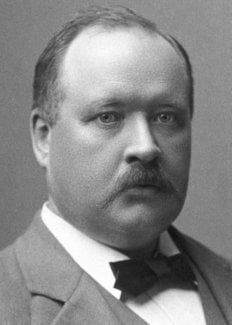
Svante August Arrhenius was born on February 19, 1859, the son of Svante Gustaf Arrhenius and Carolina Christina Thunberg. His ancestors were farmers; his uncle became Professor of Botany and Rector of the Agricultural High School at Ultuna near Uppsala and later Secretary of The Swedish Academy of Agriculture. His father was a land surveyor employed by the University of Uppsala and in charge of its estates at Vik, where Svante was born. The family moved to Uppsala in 1860. The boy was educated at the Cathedral school where the rector was a good physics teacher. From an early age Svante had shown an aptitude for arithmetical calculations, and at school he was greatly interested in mathematics and physics. In 1876 he entered the University of Uppsala, studying mathematics, chemistry and physics. The practical instruction in physics was not of the best, and in 1881 he went to Stockholm to work under Professor E. Edlund at the Academy of Sciences.
Here, Arrhenius began by assisting Edlund in his work on electromotive force measurements in spark discharges but soon moved to an interest of his own. This resulted in his thesis (1884) Recherches sur la conductibilité galvanique des électrolytes (Investigations on the galvanic conductivity of electrolytes). From his results the author concluded that electrolytes, when dissolved in water, become to varying degrees split or dissociated into electrically opposite positive and negative ions. The degree to which this dissociation occurred depended above all on the nature of the substance and its concentration in the solution – being more developed the greater the dilution. The ions were supposed to be the carriers of the electric current, e.g. in electrolysis, but also of the chemical activity. The relation between the actual number of ions and their number at great dilution (when all the molecules were dissociated) gave a quantity of special interest (“activity constant”).
The idea of a connection between electricity and chemical affinity, once advocated by Berzelius, had, however, so completely vanished from the general consciousness of scientists that the value of Arrhenius’ publication was not well understood by the science faculty at Uppsala, where the dissertation took place. On the other hand, Otto Pettersson, Professor of Chemistry at Stockholms Högskola, emphasized the originality of the dissertation*, and Wi. Ostwald travelled to Uppsala to make the acquaintance of the young author. The fundamental importance of Arrhenius’ work was thus made clear, and at the end of 1884 he got a docentship at Uppsala in physical chemistry – the first in Sweden in this new branch of science. Through Edlund’s influence he was awarded a travelling fellowship from the Academy of Sciences which enabled him to work in 1886 with Ostwald in Riga and with Kohlrausch in Würzburg. In 1887 he was with Boltzmann in Graz and in 1888 he worked with van ‘t Hoff in Amsterdam. During these years Arrhenius was able to prove the influence of the electrolytic dissociation on the osmotic pressure, the lowering of the freezing point and increase of the boiling point of solutions containing electrolytes. Later on he studied its importance in connection with biological problems such as the relationship between toxins and antitoxins, serum therapy, its role for digestion and absorption as well as for the gastric and pancreatic juices. The paramount importance of the electrolytic dissociation theory is today universally acknowledged, even if certain modifications have been found necessary.
In 1891, Arrhenius declined a professorship offered to him from Giessen, Germany, and soon afterwards he obtained a lectureship in physics at Stockholms Högskola. In 1895 he became Professor of Physics there. He was in addition Rector from 1897 to 1905, when he retired from the professorship. He had got an invitation to a professorship in Berlin, and the Academy of Sciences then decided (1905) to start a Nobel Institute for Physical Chemistry with Arrhenius as its chief. Initially he had to work in a rented flat, but a new building was inaugurated in 1909. A large number of collaborators came to him from Sweden and from other countries, and helped to give his ideas wider currency.
In 1900 Arrhenius published his Lärobok i teoretisk elektrokemi (Textbook of theoretical electrochemistry), in 1906 followed Theorien der Chemie (Theories of Chemistry) and Immunochemistry and in 1918 the Silliman lectures Theories of solutions. He took a lively interest in various branches of physics, as illustrated by his theory of the importance of the CO2-content of the atmosphere for the climate, his discussion of the possibility that radiation pressure might enable the spreading of living spores through the universe (panspermy) and by his various contributions to our knowledge of the northern lights. In 1903 appeared his Lehrbuch der kosmischen Physik (Textbook of cosmic physics).
Many lectures and short publications gave witness of his interest and capacity for writing for the general public. Especially during the last decades of his life he published a number of popular books, which were usually translated into several languages and appeared in numerous editions. To these belong Världarnas utveckling (1906, Worlds in the Making), Stjärnornas Öden (1915, Destiny of the Stars) and others. In 1913 appeared Smittkopporna och deras bekämpande (Smallpox and its combating) and in 1919 Kemien och det moderna livet (Chemistry and modern Life).
Arrhenius was elected a Foreign member of the Royal Society in 1911, and was awarded the Society’s Davy medal and also the Faraday Medal of the Chemical Society (1914). Among the many tokens of distinction that he received were honorary degrees from the Universities of Birmingham, Cambridge, Edinburgh, Greifswald, Groningen, Heidelberg, Leipzig and Oxford.
Arrhenius was a contented man, happy in his work and in his family life. During the First World War, he made successful efforts to release and repatriate German and Austrian scientists who had been made prisoners of war.
He was twice married – in 1894 to Sofia Rudbeck, by whom he had one son, and in 1905 to Maria Johansson by whom he had one son and two daughters.
He died at Stockholm on October 2, 1927, and is buried at Uppsala.
* The Stockholms Högskola (High School of Stockholm) corresponded in those days to a science faculty of the universities, but it was a private foundation and did not have the right to hold examinations for degrees or to judge the value of theses. It was not until 1960 that the University of Stockholm, with its many faculties, was established by the State.
This autobiography/biography was written at the time of the award and first published in the book series Les Prix Nobel. It was later edited and republished in Nobel Lectures. To cite this document, always state the source as shown above.
The Nobel Foundation's copyright has expired.Nobel Prizes and laureates
Six prizes were awarded for achievements that have conferred the greatest benefit to humankind. The 14 laureates' work and discoveries range from quantum tunnelling to promoting democratic rights.
See them all presented here.