Alfred Werner
Biographical
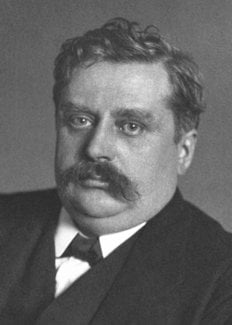
Alfred Werner, son of factory foreman J.A. Werner and his wife Jeanne, née Tesche, was born on December 12, 1866, at Mülhausen in Alsace, where he went to school. While he was at school he showed an interest in chemistry and did, when he was only 18, his first independent chemical research.
From 1885 until 1886 he did his military service in Karlsruhe and, during this, attended the lectures of Engler at the Technical High School in that city. In 1886 he attended lectures at the Federal Technical High School at Zurich and in 1889 obtained there the Diploma in Technical Chemistry. During his studies there he was much influenced by Professor A. Hantzsch.
In 1889 he was appointed Assistant in Professor Lunge’s laboratory at the Zurich Technical High School and he then began to cooperate with Professor Hantzsch in research. In 1890 he took his degree in the University of Zurich with a thesis on the spatial arrangements of the atoms in molecules containing nitrogen.
From 1890 until 1891 he did further work on this subject and visited Paris, where he worked under Professor Berthelot at the Collège de France. In 1892 he returned to Zurich as a lecturer in the Technical High School, and in 1893 he was appointed Associate Professor in the University of Zurich, to succeed Victor Merz and then gave the University lectures on organic chemistry.
In 1895 he became, when he was only 29 years old, Professor of Chemistry in the University, giving the lectures on organic chemistry until, in 1902, he took over the lectures on inorganic chemistry as well. In 1895 he was acquired Swiss nationality and though he was offered posts at Vienna, Basle and Wurzburg, he declined these, preferring to remain in Zurich.
Werner’s name will always be associated with the theory of coordination which he established and with his work on the spatial relationships of atoms in the molecule, the foundations of which were laid in the work he did, when he was only 24, for his doctorate thesis in 1892. In this work he formulated the idea that, in the numerous compounds of tervalent nitrogen, the three valence bonds of the nitrogen atom are directed towards the three corners of a tetrahedron, the fourth corner of this being occupied by the nitrogen atom. In 1891 he had published a paper on the theory of affinity and valence, in which he substituted for Kekulé’s conception of constant valence, the idea that affnity is an attractive force exerted from the centre of the atom which acts uniformly towards all parts of the surface of the atom.
In 1893 he stated, in a paper on mineral compounds, his theory of variable valence, according to which inorganic molecular compounds contain single atoms which act as central nuclei around which are arranged a definite number of other atoms, radicals or other molecules in a simple, spatial, geometric pattern. The figure which expresses the number of atoms thus grouped round a central nucleus was called by Werner the coordination number, the most important of these coordination numbers being 3, 4, 6 and 8, the number 6 occurring especially often. Thousands of molecular compounds correspond to the number 6 type, and in the majority of these there is a central atom with coordinated atoms at the corners of an octahedron.
For the next 20 years Werner and his collaborators studied and prepared new series of molecular compounds and studied their configurations, publishing many papers on them, 150 of which were by himself. Finally, his work culminated in the discovery of optically-active isomers of the complexes studied, the existence of which had been forecast by his hypothesis. More than 40 series of optically-active complexes with octahedral symmetry were separated in optically-active forms, with the result that the spatial configuration of the complexes to the coordination number 6 was established as firmly as that of the tetrahedral carbon atom of van ‘t Hoff and Le Bel.
Werner also worked on complexes with other coordination numbers, especially 4, for which the form can be tetrahedral or a plane square. As Paul Pfeiffer, in his account of Werner’s work published in Great Chemists (1961, Edited by Eduard Farber, Interscience, New York) remarks the coordination theory of Werner extended throughout the whole range of systematic inorganic chemistry and into organic chemistry as well. For his work on it Werner was awarded the Nobel Prize for Chemistry for 1913.
Werner was corresponding member of the Royal Society of Sciences (Königliche Gesellschaft der Wissenschaften) at Göttingen and of the Physico-Medical Society (Physikalisch-medizinische Sozietät) of Erlangen. He held an honorary doctorate of the University of Geneva, and was an Honorary Member of the Society of Physics and Natural History in the same town, of the Physical Association (Physikalischer Verein) of Frankfurt/Main, of the German Bunsengesellschaft, of the Société Vaudoise des Sciences Naturelles at Lausanne, and of the Chemical Society of London. He was also a permanent member of the Imperial Society of Friends of Natural History, Anthropology and Ethnography of Moscow. France conferred upon him the Leblanc Medal of its Societe Chimique and the distinction of Officier de l’Instruction Publique.
Werner was a very sociable man, whose recreations were billiards, chess and the Swiss card game, Jass. He spent his holidays among the mountains and travelled much to attend scientific meetings outside Switzerland. As a lecturer he was a convincing and enthusiastic speaker with a gift for clear explanations of difficult problems. Among his pupils were such distinguished men as Jantsch, Karrer and Pfeiffer. Valuable for others were his books Neuere Anschauungen auf dem Gebiete der anorganischen Chemie (New ideas in inorganic chemistry) and Lehrbuch der Stereochemie (Textbook of stereochemistry), both published in 1904.
In 1894, Werner married Emma Giesker of Zurich, a member of a German family. They had one son, Alfred, and one daughter, Charlotte.
In 1913, the year in which he received the Nobel Prize for Chemistry, he was already suffering from arteriosclerosis and by 1915 this had compelled him to give up his general lectures on chemistry and in 1919 he had to give up his Professorship. On November 15, 1919, he died at the early age of 53.
This autobiography/biography was written at the time of the award and first published in the book series Les Prix Nobel. It was later edited and republished in Nobel Lectures. To cite this document, always state the source as shown above.
The Nobel Foundation's copyright has expired.Nobel Prizes and laureates
Six prizes were awarded for achievements that have conferred the greatest benefit to humankind. The 14 laureates' work and discoveries range from quantum tunnelling to promoting democratic rights.
See them all presented here.