Theodore W. Richards
Biographical
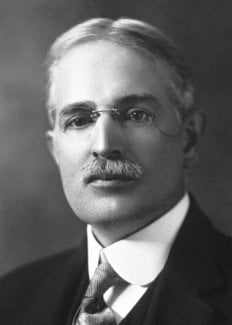
Theodore William Richards was born in Germantown, Pennsylvania, USA on January 31, 1868. His father, William T. Richards was a well-known painter of landscapes and seascapes: his mother, Anna, née Matlack, won fame for her poetical works.
During his childhood, Richards travelled to England and France and, up to the age of fourteen, he was educated by his mother. In 1883 he entered Haverford College, Pennsylvania, to graduate in science in 1885 and enter Harvard University. He received the degrees, B.A. in 1886; M.A. and Ph.D. in 1888. The following twelve months were spent in Germany where he studied under Victor Meyer, P. Jannasch, G. Kruss and W. Hempel; on his return to Harvard he was appointed Assistant in Chemistry. He successively became Instructor (1891), Assistant Professor (1894) and Professor (1901); in 1901 he also declined an offer of a full professorship in the University of Göttingen. In 1903 he became Chairman of the Department of Chemistry at Harvard and in 1912 he was appointed Erving Professor of Chemistry and Director of the Wolcott Gibbs Memorial Laboratory.
About half of Richards’ original work has concerned atomic weights, starting in 1886 with work on oxygen and copper. He quickly developed a new technique for the determination of halide ratios and did much towards improving methods of weighing. He invented the nephelometer and demonstrated the insidious effect of occluded moisture in gases and solids. By 1912 he had redetermined, with the highest accuracy, the atomic weights of over thirty important elements and in later years he was to play his part, by his work on the determination of the atomic weight of isotopes, in the modern concept of the atom. During his initial work he was guided by J.P. Cooke.
Richards also studied atomic and molecular volume and he formulated a hypothesis of compressible atoms. He carried out a series of measurements of compressibilities of many elements and compounds in support of his theory, developing, applying and testing new methods and techniques. He introduced the use of transition temperatures of pure hydrated salts as fixed points in the standardization of thermometers, and the fundamentals of adiabatic calorimetry were developed under his guidance. His researches are recorded in some three hundred technical papers published mainly in the Proceedings of the American Academy of Arts and Sciences, the Journal of the American Chemical Society and the publications of the Carnegie Institution of Washington.
Professor Richards received honorary doctorate degrees in science from Yale (1905), Harvard (1910), Cambridge, Oxford and Manchester (1911) and Princeton (1923); in philosophy from Prague (1909) and Christiania (1911); in law from Haverton (1908), Pittsburgh (1915) and Pennsylvania (1920); in chemistry from Clark (1909); and in medicine from Berlin (1910). He was President of the American Chemical Society (1914), the American Association for the Advancement of Science (1917) and the American Academy of Arts and Sciences (1919-21). He received the Davy Medal (Royal Society), 1910; the Faraday Medal, 1911, and Willard Gibbs Medal (American Chemical Society), 1912; the Franklin Medal (Franklin Institute), 1916; and the Le Blanc and Lavoisier Medal in 1922. He was appointed Officier de la Lègion d’Honneur in 1925 and he held fellowships or memberships of academies and learned societies in the United States, the British Isles, France, Germany and Scandinavia.
Richards married Miriam Stuart Thayer, daughter of Professor Joseph H. Thayer, in 1896; they had one daughter and two sons. His favourite recreations were sketching, golf and sailing.
He died at Cambridge, Massachusetts, on April 2, 1928.
This autobiography/biography was written at the time of the award and first published in the book series Les Prix Nobel. It was later edited and republished in Nobel Lectures. To cite this document, always state the source as shown above.
The Nobel Foundation's copyright has expired.Nobel Prizes and laureates
Six prizes were awarded for achievements that have conferred the greatest benefit to humankind. The 14 laureates' work and discoveries range from quantum tunnelling to promoting democratic rights.
See them all presented here.