Adolf Windaus
Biographical
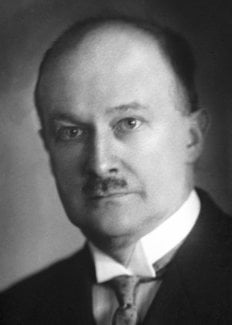 Adolf Windaus was born in Berlin on December 25, 1876, the son of Adolf Windaus and Margarete Elster. His ancestors had for generations mostly been artisans (from his father’s side, drapery manufacturers).
After attending the renowned “Französisches Gymnasium” (French grammar school) in Berlin, where his interests were mainly focussed on literature, he took up medicine in 1895 (in Freiburg i.Br. and in Berlin), passing his preliminary medical examinations (“Physikum”) in 1897.
He had been particularly fascinated by Emil Fischer‘s lectures during his stay in Berlin and in consequence he began studying chemistry at Freiburg i.Br. under Kiliani, at the same time continuing his medical studies. In the winter of 1899-1900 he obtained his Dr. phil. degree, the subject of his thesis dealing with the cardiac poisons of the Digitalis plant.
Windaus chose zoology as his subsidiary subject on account of the deep impression which Weismann’s lectures had made on him in Freiburg. After graduating Windaus moved to Berlin to work with Emil Fischer. It was there that he met Otto Diels, with whom he formed a life-long friendship. He returned to Freiburg i.Br. in 1901 and on Kiliani’s suggestion began his work on cholesterol and related sterols. Windaus’s decision to study these substances was based on the fact that nothing was known about the structure of cholesterol at the time and he expected that investigations in this field would yield new and unexpected results. From the very start he correctly believed that sterols, which occur in every cell, must be considered as the parent substance of other groups of natural substances. Based on this work, briefly entitled On Cholesterol, Windaus “habilitated” as lecturer in 1903. In 1919 he succeeded in transforming cholesterol into cholanic acid, which had previously been isolated from the bile acids by Wieland – another close friend of his who received the Nobel Prize for 1927 for his studies of the constitution of the bile acids and related substances – Windaus thus demonstrated that the bile acids are closely related to the sterols.
Another rich field of investigation from biological viewpoint was that of imidazole derivatives. This work, carried out in collaboration with Knoop, resulted from his attempt to prepare natural amino acids through the action of ammonia on sugar, and thus to establish conversion of sugar into proteins. The production of imidazole derivatives as a result of this reaction induced him to demonstrate the presence of a prototype of the imidazole ring in proteins. This in turn led to his demonstration that histidine, a building-stone of proteins, is an imidazole alanine, and to his discovery of histamine (imidazole-ethylalanine), a hormone of great importance in physiology and pharmacology, which was the reason for the interest shown by German chemical industry in his work.
As the foremost expert on sterols he was in 1925 invited by the American physiologist Alfred Hess to come to New York to cooperate in the study of the antirachitic vitamin.
It was also his interest in the imidazole derivatives that prompted him to examine the structure of the antineuritic vitamin. Cooperating with the I.G. Farbenindustry, which supplied the precious raw material for the work, he was able to prove that not an imidazole-ring (as suggested by Jansen and Donath), but a thiazole- and a pyrimidine-ring are present in vitamin B1.
Other research taken up by Windaus was into the stereochemical problems of the cis- and trans-linking of hydrogenated ring systems. In all these investigations his starting-point was always that of experimental observation, and not of theoretical deduction; the inductive method was the most suitable for his talents. During the last years of his life he also investigated the possibility of chemotherapy in cancer research.
Windaus was appointed Assistant Professor (1906), and Professor of Applied Medical Chemistry at Innsbruck University (1913), where he remained for two years. He moved to Göttingen in 1915 as Professor of Chemistry, succeeding Otto Wallach, where he stayed until his retirement in 1944 as Director of the Laboratory for General Chemistry, formerly the Wöhler Institute. Among his pupils may be mentioned Adolf Butenandt, Nobel Prize winner 1939 for his work on sex hormones – which are closely related to the sterols – and Hans Brockmann.
Windaus received the Nobel Prize in Chemistry in 1928, on account of his work on the constitution of sterols and their connection with vitamins. Among the many honours he was awarded were the Pasteur Medal (1938), the Goethe Medal (1941), also the “Groszes Verdienstireuz” (Grand Order of Merit) in 1951, and the “Groszes Verdienstkreuz mit Stern” (Grand Order of Merit with Star) in 1956. In addition he was recipient of the Order pour le Merite, Peace Class, in 1952. He was also honorary doctor of the Universities of Göttingen, Munich, Freiburg, and Hanover.
Professor Windaus married Elisabeth Resau in 1915. There were three children by his marriage: Günter (b. 1916), Gustav (b. 1918), and Margarete (b. 1921)
He died on June 9, 1959.
This autobiography/biography was written at the time of the award and first published in the book series Les Prix Nobel. It was later edited and republished in Nobel Lectures. To cite this document, always state the source as shown above.
Nobel Prizes and laureates
Six prizes were awarded for achievements that have conferred the greatest benefit to humankind. The 14 laureates' work and discoveries range from quantum tunnelling to promoting democratic rights.
See them all presented here.