Carl Bosch
Biographical
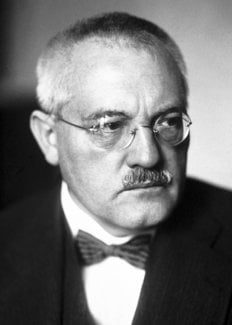
Carl Bosch was born at Cologne on August 27, 1874, and grew up there. From 1894 to 1896 he studied metallurgy and mechanical engineering at the Technische Hochschule in Charlottenburg, but started reading chemistry at Leipzig University in 1896. He graduated under Professor Wislicenus with a paper on organic chemistry in 1898. He entered the employ of the Badische Anilin- und Sodafabrik, Ludwigshafen, Rhine as a chemist in April 1899 and participated actively in the development of the then new industry of synthetic indigo under the guidance of Dr. Rudolf Knietsch.
At the turn of the century Bosch became interested in the problem of the fixing of nitrogen and his first experiments in this field were done with metal cyanides and nitrides; in 1907 he started a pilot plant for the production of barium cyanide.
Bosch’s opportunity for really large-scale work came when in 1908 the Badische Anilin- und Sodafabrik acquired the process of high-pressure synthesis of ammonia, which had been developed by Fritz Haber at the Technische Hochschule in Karlsruhe. Bosch was given the task of developing this process on a large industrial scale. This task involved the construction of plant and apparatus which would stand up to working at high gas pressure and high reaction temperatures. Haber’s catalysts, osmium and uranium had to be replaced by a contact substance which would be both cheaper and more easily available. Bosch and his collaborators found the solution by using pure iron with certain additives. Further problems which had to be solved were the construction of safe high-pressurized blast furnaces, a cheap way of producing and cleaning the gases necessary for the synthesis of ammonia. Step by step Bosch went on to using increasingly larger manufacturing units and thus created the industry which deals with the production of synthetic ammonia according to the high-pressure process.
From this work resulted the second task of making the thus won ammonia available for use in industry and agriculture. Bosch succeeded in working out methods for the industrial production of nitrogen fertilizers, thus providing practically every country in the world with sufficient fertilizers for agricultural purposes. The Stickstoffwerke (Nitrogen works) in Oppau were opened in 1913, followed by the even larger Leunawerke near Merseburg in 1917, where the synthesis of methanol and the hydrogenation of oil were added to the production programme. Bosch was appointed Managing Director of the Badische Anilin- und Sodafabrik in 1919 and in 1925 was made Principal of the I.G. Farbenindustrie Aktiengesellschaft, which was created by the merger of the German coal-tar dye works. In 1935 Bosch was appointed Chairman of the Board of Directors of the I.G. Farbenindustrie A.G.
Bosch was honoured in many ways and not only for his achievements and inventions in the field of industry, but also for his research in pure science, which he considered to be his duty. He received the honorary doctorate of the Technische Hochschule in Karlsruhe (1918), of the Landwirtschaftliche Hochschule (Agriculture College), Berlin (1921), the Technische Hochschule in Munich (1922), of Halle University (1927), the Technische Hochschule in Darmstadt (1928). The distinctions of Honorary Senator of the Universities of Heidelberg (1922) and Leipzig (1939), and of Honorary Citizen of Frankfurt (1939) were conferred upon him.
He received the Liebig Memorial Medal of the Association of German Chemists, the Bunsen Medal of the German Bunsen Society, the Siemens Ring, the Golden Grashof Memorial Medal of the VDI (Association of German Engineers), the Exner Medal from the Austrian Trade Association, and the Carl Lueg Memorial Medal from the Association of German Metallurgists. In 1931 he was awarded the highest international honour, the Nobel Prize for Chemistry, jointly with Friedrich Bergius, for their contributions to the invention and development of chemical high pressure methods.
Bosch particularly enjoyed his membership of various German and foreign scientific academies, and his chairmanship of the Kaiser Wilhelm Society of which he became its President in 1937.
He died after a prolonged illness on April 26, 1940.
This autobiography/biography was written at the time of the award and first published in the book series Les Prix Nobel. It was later edited and republished in Nobel Lectures. To cite this document, always state the source as shown above.
The Nobel Foundation's copyright has expired.Nobel Prizes and laureates
Six prizes were awarded for achievements that have conferred the greatest benefit to humankind. The 14 laureates' work and discoveries range from quantum tunnelling to promoting democratic rights.
See them all presented here.