Irving Langmuir
Biographical
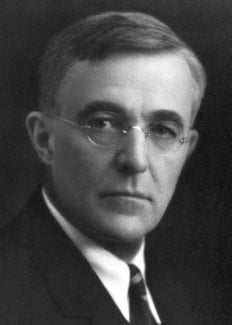
Irving Langmuir was born in Brooklyn, New York, on January 31, 1881, as the third of four sons of Charles Langmuir and Sadie, neé Comings. His early education was obtained in various schools and institutes in the USA, and in Paris (1892-1895). He graduated as a metallurgical engineer from the School of Mines at Columbia University in 1903. Postgraduate work in Physical Chemistry under Nernst in Göttingen earned him the degrees of M.A. and Ph.D. in 1906.
Returning to America, Dr. Langmuir became Instructor in Chemistry at Stevens Institute of Technology, Hoboken, New Jersey, where he taught until July 1909. He then entered the Research Laboratory of the General Electric Company at Schenectady where he eventually became Associate Director.
Langmuir’s studies embraced chemistry, physics, and engineering and were largely the outgrowth of studies of vacuum phenomena. In seeking the atomic and molecular mechanisms of these he investigated the properties of adsorbed films and the nature of electric discharges in high vacuum and in certain gases at low pressures.
His work on filaments in gases led directly to the invention of the gasfilled incandescent lamp and to the discovery of atomic hydrogen. He later used the latter in the development of the atomic hydrogen welding process.
He was the first to observe the very stable adsorbed monatomic films on tungsten and platinum filaments, and was able, after experiments with oil films on water, to formulate a general theory of adsorbed films. He also studied the catalytic properties of such films.
Langmuir’s work on space charge effects and related phenomena led to many important technical developments which have had a profound effect on later technology.
In chemistry, his interest in reaction mechanism caused him to study structure and valence, and he contributed to the development of the Lewis theory of shared electrons.
Among the awards made to him were: Nichols Medal, (1915 and 1920); Hughes Medal (1918); Rumford Medal (1921); Cannizzaro Prize (1925); Perkin Medal (1928); School of Mines Medal (Columbia University, 1929); Chardler Medal (1929); Willard Gibbs Medal (1930); Popular Science Monthly Award (1932); Nobel Prize in Chemistry (1932); Franklin Medal and Holly Medal (1934); John Scott Award (I937); “Modern Pioneer of Industry” (1940); Faraday Medal (1944); Mascart Medal (1950). In addition, he was a Foreign Member of the Royal Society of London, Fellow of the American Physical Society, Honorary Member of the British Institute of Metals, and of the Chemical Society (London). He had served as President of the American Chemical Society and as President of the American Association for the Advancement of Science.
Honorary degrees were bestowed upon Langmuir by the following colleges and universities: Northwestern, Union, Edinburgh (Scotland), Columbia, Kenyon, Princeton, Lehigh, Harvard, Oxford, Johns Hopkins, Rutgers, Queens (Canada), and Stevens Institute of Technology.
Dr. Langmuir’s hobbies were mountaineering, skiing, flying, and, most of all, to understand the mechanism of simple and familiar natural phenomena. He married Marion Mersereau in 1912. They had a son, Kenneth, and a daughter, Barbara. After a short illness, he died on August 16, 1957.
This autobiography/biography was written at the time of the award and first published in the book series Les Prix Nobel. It was later edited and republished in Nobel Lectures. To cite this document, always state the source as shown above.
Nobel Prizes and laureates
Six prizes were awarded for achievements that have conferred the greatest benefit to humankind. The 14 laureates' work and discoveries range from quantum tunnelling to promoting democratic rights.
See them all presented here.