Otto Diels
Biographical
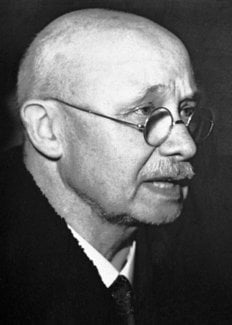
Otto Paul Hermann Diels was born in Hamburg, Germany, on January 23, 1876. When he was two years of age the family moved to Berlin, where his father was appointed to a professorship. His early education, from 1882 to 1895, was at the Joachimsthalsches Gymnasium, Berlin. In 1895 he went to Berlin University where he studied chemistry, together with other science subjects, under Emil Fischer, graduating in 1899. He was at once appointed assistant at the Institute of Chemistry at Berlin University, becoming a lecturer in 1904. Promotion to Professor followed in 1906, and he was appointed Head of Department in 1913. He became Professor at the University of Berlin in 1915 but, the following year, moved to the University of Kiel as Professor and Director of the Institute of Chemistry. There he remained until his retirement in 1945.
His earliest research was in the field of inorganic chemistry, where he was the discoverer of an oxide of carbon having some unusual properties – carbon suboxide. His subsequent work was in the domain of organic chemistry. He was responsible for introducing the use of selenium as a specific reagent for the dehydrogenation of hydroaromatic compounds (1927). This proved to be a very useful tool in elucidating chemical structures in the complicated steroid series, where his name is associated with the hydrocarbon 3′-methyl-1,2-cyclopentenophenanthrene. Diels obtained this skeletal steroid structure by dehydrogenating cholesterol, and other members of the series, with selenium.
His best known work was done in collaboration with Kurt Alder on the chemical reaction which bears their joint names (1928). This, sometimes known also as the diene synthesis, consists in the reaction of a diene with a second component which has carbonyl or carboxyl groups adjoining an ethylenic bond, to give unsaturated cyclic compounds. As the two reactants can be varied widely within the scope of this definition, a very large range of new compounds can be prepared. The reaction takes place without the need for forcing conditions and, by its use, many complicated natural products, and modifications thereof, may be synthesized.
Diels was the author of the Einführung in die organische Chemie (1907), which went through fifteen editions. He had many papers published, mostly in German scientific periodicals such as Liebigs Annalen der Chemie.
One of his earliest awards was in 1904, when he was awarded a Gold Medal at the St. Louis (USA) International Exhibition. He won the Adolf v. Baeyer Medallion in 1930 and the Grosskreuz des Verdienstordens der Bundesrepublik Deutschland in 1952. He held the honorary degree of Doctor of Medicine from the University of Kiel and was a member of the Academies of Halle, Munich, and Göttingen.
Diels married, in 1909, Paula Geyer. They had three sons and two daughters; two of their sons were killed in action during World War II. He was interested in reading, music, and travel for his recreation, and, in his younger days, he had been fond of mountaineering. He died on March 7, 1954.
This autobiography/biography was written at the time of the award and first published in the book series Les Prix Nobel. It was later edited and republished in Nobel Lectures. To cite this document, always state the source as shown above.
Nobel Prizes and laureates
Six prizes were awarded for achievements that have conferred the greatest benefit to humankind. The 14 laureates' work and discoveries range from quantum tunnelling to promoting democratic rights.
See them all presented here.