Giulio Natta
Biographical
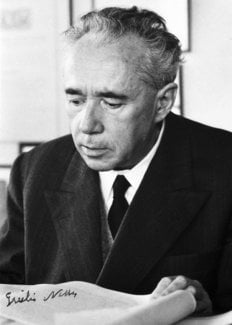
Giulio Natta was born at Imperia on February 26, 1903. He graduated in Chemical Engineering at the Polytechnic of Milan in 1924 and passed the examinations entitling him to teach there in 1927. In 1933 he was established on the staff of Pavia University as a full professor and at the same time was appointed director of the Institute of General Chemistry at that University, where he stayed till 1935, that is until he was appointed full professor in physical chemistry at the University of Rome. From 1936 to 1938 he was full professor and director of the Institute of Industrial Chemistry at the Polytechnic of Turin. He has been full professor and director of the Department of Industrial Chemistry at the Milan Polytechnic since 1938.
Now a world famous scientist, Prof. Natta began his career with a study of solids by means of X-rays and electron diffraction. He then used the same methods for studying catalysts and the structure of some high organic polymers (the latter from 1934). His kinetic research on methanol synthesis, on selective hydrogenation of unsaturated organic compounds and on oxosynthesis led to an understanding of the mechanism of these reactions and to an improvement in the selectivity of catalysts.
In 1938 Prof. Natta began to study the production of synthetic rubber in Italy; he took part in research work on butadiene and was the first to accomplish physical separation of butadiene from 1-butadiene by a new method of extractive distillation.
In 1938 he began to investigate the polymerisation of olefins and the kinetics of subsequent concurrent reactions. In 1953, with financial aid from a large Italian chemical company, Montecatini, Prof. Natta extended the research conducted by Ziegler on organometallic catalysts to the stereospecific polymerization, thus discovering new classes of polymers with a sterically ordered structure, viz. isotactic, syndiotactic and di-isotactic polymers and linear non branched olefinic polymers and copolymers with an atactic (or sterically nonordered) structure. These studies, which were developed for industrial application in Montecatini’s laboratories, led to the realisation of a thermoplastic material, isotactic polypropylene, which Montecatini were the first to produce on an industrial scale, in 1957, in their Ferrara plant. This product has been marketed successfully as a plastic material, by the name of Moplen, as a synthetic fibre, by the name of Meraklon, as a monofilament by the name of Merakrin and as packing film, by the name of Moplefan.
By X-ray investigations, Prof. Natta has also succeeded in determining the exact arrangement of chains in the lattice of the new crystalline polymers he has discovered.
No less important is his later research which led to the synthesis of completely new elastomers, in two different ways: by polymerization of butadiene into cis-1,4 polymers with a very high degree of steric purity and by copolymerization of ethylene with other a-olefins (propylene), originating extremely interesting materials such as saturated synthetic rubbers. The vulcanisation of these rubbers was made possible by the usual methods used for natural rubber, with the introduction of unsaturated monomeric units (terpolymers containing ethylene and propylene). The processes for the asymmetric synthesis, which allow the production of optically active macromolecules from optically inactive monomers, are of great scientific importance, due to their similarity to the natural biological processes. Other interesting results obtained by Natta in the field of macromolecular chemistry concern the synthesis of crystalline alternating copolymers of different couples of monomers and the synthesis of various sterically ordered polymers of non-hydrocarbon monomers.
Prof. Natta’s scientific and technical activity is documented in over 700 published papers, of which about 500 concern stereoregular polymers, and by a large number of patents in many different countries. In 1961 he was made an honorary life member of the New York Academy of Sciences of which he had been a fellow since 1958. In 1955 he became a “national member” of the Accademia dei Lincei; he is also a member of the Istituto Lombardo di Scienze e Lettere and of the Accademia delle Scienze of Turin. He was made honorary member of the Austrian (1960), Belgian (that awarded him the STAS medal) (1962), and Swiss (1963) Chemical Societies. Professor Natta received a gold medal from the town of Milan (1960), from the President of the Italian Republic (1961, reserved to those who gained merits in the field of school, culture and art), the first international gold medal of the synthetic rubber industry (1961); a gold medal from the Milan district (1962) and from the Society of Plastic Engineers (New York, 1963), the Perrin medal from the French Chemical Physical Society, and the Lavoisier medal from the Chemical Society of France (both in 1963), the Perkin gold medal of the English Society of Dyers and Colourists (1963), the John Scott award from the Board of Directors of the City Trust of Philadelphia, and the Medal “Leonardus Vincius Florentinus Doctor Ingenieurs” of FIDIIS, Paris (1971). The Turin University gave him an honorary degree in pure chemistry, and in 1963 Prof. Natta received an honorary degree from Mainz University.
Prof. Natta is a honorary member of the Industrial Chemical Society of Paris (1966) and of the Chemical Society of London (1970); an honorary member of the Rotary Club; associated foreign member of the Académie des Sciences de l’Institut de France (1964); member of the National Academy of XL, Rome (1964); joined member of the International Academy of Astronautics, Paris (1965); foreign member of the Academy of Sciences of Moscow, U.S.S.R. (1966); honorary president of the Italian Section of the Society of Plastics Engineers (SPE). He holds the following awards and honorary degrees: gold medal of the Union of Italian Chemists (1964); gold medal “Lomonosov” of the Moscow Academy of Sciences (1969); the “Carl-Dietrich-Harries-Plakette, of the Deutsche Kautschuk Gesellschaft, Frankfurt/Main (1971); honorary degrees from the University of Genoa (1964), the Polytechnic Institute of Brooklyn, New York (1964), the Catholic University of Louvain, Belgium (1965), and in 1971 from ESPCI, University of Paris.
This autobiography/biography was written at the time of the award and first published in the book series Les Prix Nobel. It was later edited and republished in Nobel Lectures. To cite this document, always state the source as shown above.
Giulio Natta died on 2 May 1979.
Nobel Prizes and laureates
Six prizes were awarded for achievements that have conferred the greatest benefit to humankind. The 14 laureates' work and discoveries range from quantum tunnelling to promoting democratic rights.
See them all presented here.