Robert B. Woodward
Biographical
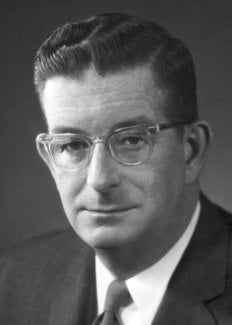
Robert Burns Woodward was born in Boston on April 10th, 1917, the only child of Margaret Burns, a native of Glasgow, and Arthur Woodward, of English antecedents, who died in October, 1918, at the age of thirty-three.
Woodward was attracted to chemistry at a very early age, and indulged his taste for the science in private activities throughout the period of his primary and secondary education in the public schools of Quincy, a suburb of Boston. In 1933, he entered the Massachusetts Institute of Technology, from which he was excluded for inattention to formal studies at the end of the Fall term, 1934. The Institute authorities generously allowed him to re-enroll in the Fall term of 1935, and he took the degrees of Bachelor of Science in 1936 and Doctor of Philosophy in 1937. Since that time he has been associated with Harvard University, as Postdoctoral Fellow (1937-1938), Member of the Society of Fellows (1938-1940), Instructor in Chemistry (1941-1944), Assistant Professor (1944-1946), Associate Professor (1946-1950), Professor (1950-1953), Morris Loeb Professor of Chemistry (1953-1960), and Donner Professor of Science since 1960. In 1963 he assumed direction of the Woodward Research Institute at Basel. He was a member of the Corporation of the Massachusetts Institute of Technology (1966-1971), and he is a Member of the Board of Governors of the Weizmann Institute of Science.
Woodward has been unusually fortunate in the outstanding personal qualities and scientific capabilities of a large proportion of his more than two hundred and fifty collaborators in Cambridge, and latterly in Basel, of whom more than half have assumed academic positions. He has also on numerous occasions enjoyed exceptionally stimulating and fruitful collaboration with fellow-scientists in laboratories other than his own. His interests in chemistry are wide, but the main arena of his first-hand engagement has been the investigation of natural products – a domain he regards as endlessly fascinating in itself, and one which presents unlimited and unparalleled opportunities for the discovery, testing, development and refinement of general principles.
Prof. Woodward holds more than twenty honorary degrees of which only a few are listed here: D.Sc. Wesleyan University, 1945; D. Sc. Harvard University, 1957; D. Sc. University of Cambridge (England), 1964; D. Sc. Brandeis University, 1965; D. Sc. Israel Institute of Technology (Haifa), 1966; D.Sc. University of Western Ontario (Canada), 1968;D.Sc. Universite de Louvain (Belgium), 1970.
Among the awards presented to him are the following: John Scott Medal (Franklin Institute and City of Philadelphia), 1945; Backeland Medal (North Jersey Section of the American Chemical Society), 1955; Davy Medal (Royal Society), 1959; Roger Adams Medal (American Chemical Society), 1961; Pius XI Gold Medal (Pontifical Academy of Sciences), 1969; National Medal of Science (United States of America), 1964; Willard Gibbs Medal (Chicago Section of the American Chemical Society), 1967; Lavoisier Medal (Societe Chimique de France), 1968; The Order of the Rising Sun, Second Class (His Majesty the Emperor of Japan), 1970; Hanbury Memorial Medal (The Pharmaccutical Society of Great Britain), 1970; Pierre Brnylants Medal (Université de Louvain), 1970.
Woodward is a member of the National Academy of Sciences; Fellow of the American Academy of Arts and Sciences; Honorary Member of the German Chemical Society; Honorary Fellow of The Chemical Society; Foreign Member of the Royal Society; Honorary Member of the Royal Irish Academy; Corresponding Member of the Austrian Academy of Sciences; Member of the American Philosophical Society; Honorary Member of the Belgian Chemical Society; Honorary Fellow of the Indian Academy of Sciences; Honorary Member of the Swiss Chemical Society; Member of the Deutsche Akademie der Naturforscher (Leopoldina); Foreign Member of the Accademia Nazionale dei Lincei; Honorary Fellow of the Weizmann Institute of Science; Honorary Member of the Pharmaceutical Society of Japan.
Woodward married Irja Pullman in 1938, and Eudoxia Muller in 1946. He has three daughters: Siiri Anne (b. 1939), Jean Kirsten (b. 1944), and Crystal Elisabeth (b. 1947), and a son, Eric Richard Arthur (b. 1953).
This autobiography/biography was written at the time of the award and first published in the book series Les Prix Nobel. It was later edited and republished in Nobel Lectures. To cite this document, always state the source as shown above.
Robert B. Woodward died on July 8, 1979.
Nobel Prizes and laureates
Six prizes were awarded for achievements that have conferred the greatest benefit to humankind. The 14 laureates' work and discoveries range from quantum tunnelling to promoting democratic rights.
See them all presented here.