Press release

12 October 1989
The Royal Swedish Academy of Sciences has decided to award the 1989 Nobel Prize in chemistry jointly to
Professor Sidney Altman, Yale University, New Haven, Connecticut, USA
Professor Thomas Cech, University of Colorado, Boulder, USA
for their discovery of catalytic properties of RNA.
Ribonucleic acid (RNA) – a biomolecule of many functions
Summary
This year’s Nobel Prize in chemistry has been awarded to Sidney Altman, USA and Thomas Cech, USA for their discovery that RNA (ribonucleic acid) in living cells is not only a molecule of heredity but also can function as a biocatalyst. This discovery, which came as a complete surprise to scientists, concerns fundamental aspects of the molecular basis of life. Many chapters in our textbooks have to be revised.
Many chemical reactions cannot occur without a catalyst. A catalyst is a molecule which can facilitate a chemical reaction without being consumed or changed. Virtually all chemical reactions taking place in a living cell require catalysts. Such biocatalysts are called enzymes. For example in saliva there is an enzyme which converts starch to glucose, in the liver there is another enzyme which breaks down alcohol. There are also enzymes that enable plants to convert the carbon dioxide in the air to sugar and starch. Until the results of Altman and Cech became known, all enzymes were considered to be proteins.
The specific properties and functions of a protein are determined by hereditary characters, or genes. Genes are composed of deoxyribonucleic acid, better known as DNA. The genetic information in DNA is arranged as a string of codes which determine the design of the proteins. However, before this information can be used for protein synthesis, the code must be transcribed into another type of nucleic acid, RNA (ribonucleic acid). Altman and Cech have now independently discovered that RNA is not only a molecule of heredity but can also serve as a biocatalyst. In addition to this conceptual influence on basic natural sciences, the discovery of catalytic RNA will probably provide a new tool for gene technology, with potential to create a new defence against viral infections.
Background
The discovery of Altman and Cech that RNA in living cells can play a role as a biocatalyst or enzyme came very surprisingly. So far, the central dogma of the biosciences has been that nucleic acids are the molecules of heredity, while proteins are the molecules of function and biocatalysis.
Enzymes are biocatalysts which are crucial for nearly all chemical reactions taking place in living organisms. Their role is to increase reaction rates by some million-fold. Indeed, chemical reactions within a living cell would hardly take place at all in the absence of enzymes. Without enzymes there would simply be no life. So far all enzymes have been considered to be proteins. Proteins are large molecules which are built from a repertoire of twenty amino acids. Normally a protein is composed as a string of several hundreds of amino acids. The remarkable range of functions mediated by proteins results from different amounts and combinations of these twenty, which in turn are determined by the genetic message in the DNA molecules.
The DNA molecules are located in the chromosomes. Each DNA molecule consists of two very long strands arranged as a double helix. Each strand is composed of the molecular letters of heredity. Surprisingly, there are only four such letters, which are designated A, T, C and G. The genetic information in the DNA strand is arranged as a long sentence of three-letter words (e.g. CAG ACT GCC), each corresponding to one of the twenty amino acids which build the proteins. This means that there is a flow of genetic information from the DNA to the proteins, which in turn provide the structural framework of living cells and give them their different functions in the organism. However, this flow of genetic information cannot occur unless the DNA code is transcribed to another code in another type of nucleic acid – RNA (ribonucleic acid). This connection between the nucleic acids (the molecules of heredity) and the proteins (the molecules of structure and function) is what has been called the central dogma of the biosciences.
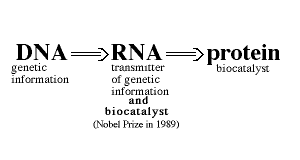
During the 1970s both Altman and Cech independently studied how the genetic code of the DNA was transcribed into RNA. This process requires, apart from the actual transcription, a shearing and splicing of the RNA molecules. The reason is that the DNA strands contain regions (introns) which are not essential for making proteins, and the excess codes are also transcribed into the RNA molecules. Before the RNA can be further used by the cell, these extra pieces of nucleic acid have to be removed and the useful pieces rejoined. As all chemical reactions in a cell, this RNA shearing and splicing requires enzymes. It was during the search for the enzymatic proteins of these reactions that Altman and Cech made their surprising discovery – the enzymes were not proteins but nucleic acids!
In 1978 Altman was studying an RNA-cutting enzyme from the bacterium Escherichia coli. This enzyme, named RNAs P by biochemists, is composed of a complex between one protein and one RNA molecule. When Altman and his co-workers chemically split RNAs P and separated the protein from the nucleic acid, the enzyme was no longer functional. However, he could restore the enzymatic activity by remixing the two different components. This was the first time that an RNA molecule had been shown to be necessary for a catalytic reaction. However, it was not until five years later that it was possible for Altman to show that the RNA molecule itself could carry out the RNA-shearing activity.
Cech was studying the splicing of RNA in a unicellular organism called Tetrahymena thermophila. He discovered, much to his surprise, that when he put an unprocessed RNA molecule into a test tube in the absence of protein, it started to splice itself. In other words, the RNA molecule could cut itself into pieces and Join the genetically important RNA fragments together again. Through the discovery of this chemically very complicated self-splicing reaction, Cech in 1982 became the first to show that RNA molecules can have a catalytic function. Subsequent development has been rapid and today close to a hundred RNA enzymes (also called ribozymes) are known.
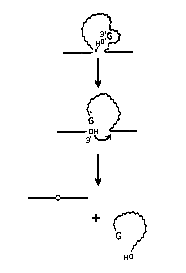 |
| A schematic picture of the self-splitting of RNA-molecules. Previously it was thought that this process, which is crucial for the transcription of the genetic message, required the catalytic activity of proteins (from Ann. Rev. Biochem. 1986 55:606). |
As already mentioned, the discovery of catalytic RNA has altered the central dogma of the biosciences. Moreover, it has already had a profound influence on our understanding of how life on earth began and developed. We know that the flow of genetic information from DNA to protein requires enzymes and other proteins. So which was the first biomolecule – DNA or protein? The discovery of catalytic RNA may solve this “chicken and egg” problem. It is very likely that the RNA molecules were the first biomolecules to contain both the genetic information and play a role as biocatalysts.
Catalytic RNA will probably provide gene technology with a new tool. Specially engineered ribozymes will probably be used as gene shears to destroy such RNA molecules as produce harmful or undesirable properties in certain organisms. In particular, it is hoped that gene shears, by cutting and destroying virus RNA, will protect organisms against viral infections. This approach could help to create virusresistant plants and to cure viral infections such as colds, in humans. A more futurist possibility is to correct certain genetic disorders. These applications will probably require the tailoring of new RNA enzymes by chemists in laboratories. However, such a future use of gene shears will require that we learn more about the molecular mechanisms behind the catalytic properties of RNA – in other words continue the exciting research started by Altman and Cech.
Nobel Prizes and laureates
Six prizes were awarded for achievements that have conferred the greatest benefit to humankind. The 14 laureates' work and discoveries range from quantum tunnelling to promoting democratic rights.
See them all presented here.