Bjørnstjerne Bjørnson
Biographical
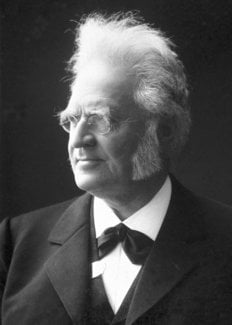
Bjørnstjerne Bjørnson (1832-1910) was the son of a Norwegian pastor. At school in Christiania (Oslo) Ibsen was one of his fellow students. Bjørnson participated early in the movement for a national Norwegian theatre and wrote some poetic plays which he did not publish. While a student, he became a literary critic for the Morgenbladet in 1854 and contributed criticism as well as stories to various other newspapers. In 1857 he succeeded in starting a literary career when he wrote the historical play Mellem slagene (Between the Battles) and became stage director at the Norwegian Theatre in Bergen. During the following years he took part in national politics (as he did all his life) and divided his creative activities between historical tragedies and country tales such as Arne (1858) and En glad gut (1860) “A Happy Boy”, both of which were meant to show a kinship between the contemporary peasant and the saga heroes of old in their taciturnity and love of adventure. The years 1860-1863 he spent abroad, mostly in Italy, where he was deeply affected by Michelangelo and Greek sculpture.
The seventies were marked by a second visit to Italy (1873-1875) and a turn toward realism and social problems which produced the plays En fallit (The Bankrupt) and Redaktøren (The Editor), both in 1875. In Kongen (1877) “The King”, he dealt with the loss of Christian ideals in today’s secular society, a concern which led him into a religious crisis and to a rejection of the church dogma. In 1882 he left Norway and spent five years abroad where En hanske (1883) “A Gauntlet” was written, a play in which he attacked hypocrisy concerning sexual matters as well as the liberal attitude of the Bohemians. During the following years he wrote educational novels such as Det flager i byen og på havnen(1884) “The Heritage of the Kurts” and På Guds veie (1889) “In God’s Way”, with its main theme of religious tolerance, as well as the educational play Over oevne, annet stykke (1895) “Beyond Human Power”.
His last important plays were Paul Lange og Tora Parsberg (1899), which treats the theme of political tolerance, and finally Nar den ny vin blomstrer (1909) “When the New Wine Blooms”. Bjørnson’s collected works were published in nine volumes in 1919.
This autobiography/biography was written at the time of the award and first published in the book series Les Prix Nobel. It was later edited and republished in Nobel Lectures. To cite this document, always state the source as shown above.
Bjørnstjerne Bjørnson died on April 26, 1910.
The Nobel Foundation's copyright has expired.Nobel Prizes and laureates
Six prizes were awarded for achievements that have conferred the greatest benefit to humankind. The 14 laureates' work and discoveries range from quantum tunnelling to promoting democratic rights.
See them all presented here.