Presentation
The following account of the work of Verner von Heidenstam is by Sven Söderman, Swedish Critic
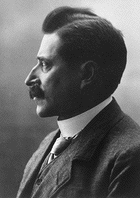
In the constellation of original artists who regenerated Swedish poetry at the end of the last century, Verner von Heidenstam was the most brilliant star. He was the leader of the generation of poets of 1890; he was the first to set forth in theory and also to realize in his works the ideal of new Swedish generations. Even in his first poems he opened new paths for imagination and form; and his later collections are in large part pure masterpieces of the lyric art. Not less significant – but more impressive because of its great dimensions – is his work in prose. Inspired by national subjects from the very beginning, it succeeds in capturing the most genuine characteristics of national life; it depicts the destinies of the Swedish people in epic poems, which by the richness of their imagination, the sharpness of their contours, and their composition, are works of the highest order in Scandinavian literature. No competent and impartial judge has ever questioned the rare originality of his genius, and Heidenstam has long been ranked among the masters of Swedish national literature.
Born in 1859 into an old family of the Swedish nobility, he first wanted to be a painter, but he abandoned the study of painting to devote himself to his vocation as a poet. His first collection of poems, Vallfart och vandringsår (1888) [Pilgrimage: The Wander Years], which contains predominantly Oriental themes, marked an epoch in the modern literature of Sweden. In truth it gave the final blow to the realistic school, enemy of all imagination, which was then dominant in Sweden and which since 1880 had darkened literature with its sadness and its gloom. This was the first manifestation of a new poetry in which free individuals, led only by the logic of their imagination, worshipped beauty for its own sake. This «renaissance», which a small polemical work (Renässans, 1889) announced a little later, was already completely realized in these poems, rich in colours and bold in form. They reaffirmed the right of man to the naive pleasure of living and surprised with their new rhythms and their poetic accents.
The Oriental poems which played so charmingly with colours and forms had inaugurated a new era and had made the renewal of Swedish poetry apparent to the eyes and to the imagination. In the great prose-poem intermixed with verse, Hans Alienus (1892), the tragic Odyssey of an uprooted worshipper of beauty, and especially in his Dikter (1895) [Poems] Heidenstam opens perspectives to an inner life. The time of hymns to voluptuousness is past; gravity and sadness are now persistent moods. Sentiment and duty are appreciated at their just value and what is firmly rooted in the depths of the human personality finds itself intuitively explained. What is characteristic in this conception of life, born of noble and unhappy experiences, is a proud and tolerant virility which constitutes the very essence of the suffering, the hope, and the intoxication of the poet, and a newly acquired capacity to reach the spiritual world by renunciation. An ample and profound imagination, genial sentiment, and pure humanity fill these poems – which are also admirable in the sense of form – and make Heidenstam a manly poet and a master of the lyric genre.
A new aspect of Heidenstam’s development appeared in his patriotic poetry. He had discovered early that love for the ancestral hearth and for the home of one’s birth is what most strongly links man to life. To this love he gave an intense expression even in the poems of his youth; this love henceforth linked him more closely to his country and to his people and oriented his poetic genius toward the historic tales and memories of Sweden. Compelled by such love, he summarized, in a cycle of poems, Ett folk (1902) [One People], all that is Swedish into a unity with the same rights and obligations for those who enter therein; and his love finally suggested a patriotic dream of grandeur and called forth this passionate demand: «No people may be greater than you; that is the goal, no matter what the cost.» A whole series of great prose-poems bears witness to his patriotism. In Karolinerna (1897-98) [The Charles Men] he describes, in the form of separate narratives, the inevitable ruin of Swedish greatness through the act of Charles XII; with a few quick strokes he sketches the tragic character of this national hero and shows that in the end he was only the echo of an ancient saga. In Heliga Birgittas pilgrimsfärd (1901) [Saint Bridget’s Pilgrimage] he gives a penetrating explanation of this remarkable woman, suggesting that she quite conscously sought sainthood but that she attained it unconsciously when of her on will she divested herself of her pride. Truly monumental are the two volumes of Folkunga Trädet (1905-07) [The Tree of the Folkungs], Folke Filbyter and Bjälboarvet [The BjäIbo Inheritance], which constitute the trunk and lower branches of «the genealogical tree of the Folkungs», a great historical prose epic in which he retraces the character of a clan of chieftains and the destinies of the Swedes during a period of the Middle Ages. Here the historical imagination of the author, sustained by an inspiration forever fresh, follows all threads in weaving the fates of his characters. His imagination, with its symbolic visions, glistens before the eye.
While Heidenstam was working on this epic about the life and character of the Swedes, his cult for man was taking shape, and one finds traces of it in the work. This cult often includes the necessity to renew life through sacrifice and to aspire to a more elevated earthly existence, an idea which is opposed to love and the cult of woman and results logically in the exaltations of stories Sankt Göran och draken (1900) [St. George and the Dragon] and Skogen susar (1904) [The Forest Whispers]. This collection contains, in particular, the great prose-poem «Herakles».
Beside these works, Heidenstam has published, among other things, stories and memories of a trip, Från Col di Tenda till Blocksberg (1888) [From Col di Tenda to Blocksberg]; the novel Endymion (1889), Oriental to the core; the book of historical lectures Svenskarna och deras hövdingar (1908-10) [The Swedes and Their Chieftains]; and the collections Tankar och teckningar (1899) [Thoughts and Notes] and Dagar och händelser (1909) [Days and Occurrences]. In this last book he has notably treated subjects of aesthetics and general culture.
The final aspect of Heidenstam’s concept of life is offered us through his Nya dikter (1915) [New Poems], a collection mainly of philosophical poems of an elevated humanity, of a mellow wisdom, of a beauty of images strangely serene. In loneliness men come to understand themselves; love is the bond which should unite them, and creative humility is the great force which builds the world and which raises statues of the gods.
«O Man, you will become wise only when you reach the summit of the evening-cool heights where all the earth is beheld.»
Biographical note on Verner von Heidenstam
The literary career of Verner von Heidenstam (1859-1940) practically came to an end with the publication of his Nya dikter. His only work of importance after this date was his idealized autobiography När kastanjerna blommade [When the Chestnuts Bloomed], which was published posthumously in 1941. His collected works in 23 volumes were published between 1943 and 1945.
Verner von Heidenstam died on May 20, 1940.
Nobel Prizes and laureates
Six prizes were awarded for achievements that have conferred the greatest benefit to humankind. The 14 laureates' work and discoveries range from quantum tunnelling to promoting democratic rights.
See them all presented here.