Seamus Heaney
Biographical
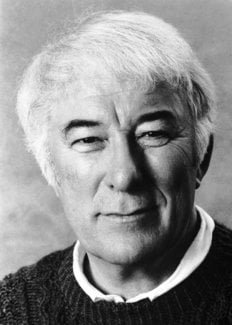
Seamus Heaney was born in April 1939, the eldest member of a family which would eventually contain nine children. His father owned and worked a small farm of some fifty acres in County Derry in Northern Ireland, but the father’s real commitment was to cattle-dealing. There was something very congenial to Patrick Heaney about the cattle-dealer’s way of life to which he was introduced by the uncles who had cared for him after the early death of his own parents. The poet’s mother came from a family called McCann whose connections were more with the modern world than with the traditional rural economy; her uncles and relations were employed in the local linen mill and an aunt had worked “in service” to the mill owners’ family. The poet has commented on the fact that his parentage thus contains both the Ireland of the cattle-herding Gaelic past and the Ulster of the Industrial Revolution; indeed, he considers this to have been a significant tension in his background, something which corresponds to another inner tension also inherited from his parents, namely that between speech and silence. His father was notably sparing of talk and his mother notably ready to speak out, a circumstance which Seamus Heaney believes to have been fundamental to the “quarrel with himself” out of which his poetry arises.
Heaney grew up as a country boy and attended the local primary school. As a very young child, he watched American soldiers on manoeuvres in the local fields, in preparation for the Normandy invasion of 1944. They were stationed at an aerodrome which had been built a mile or so from his home and once again Heaney has taken this image of himself as a consciousness poised between “history and ignorance” as representative of the nature of his poetic life and development. Even though his family left the farm where he was reared (it was called Mossbawn) in 1953, and even though his life since then has been a series of moves farther and farther away from his birthplace, the departures have been more geographical than psychological: rural County Derry is the “country of the mind” where much of Heaney’s poetry is still grounded.
When he was twelve years of age, Seamus Heaney won a scholarship to St. Columb’s College, a Catholic boarding school situated in the city of Derry, forty miles away from the home farm, and this first departure from Mossbawn was the decisive one. It would be followed in years to come by a transfer to Belfast where he lived between 1957 and 1972, and by another move from Belfast to the Irish Republic where Heaney has made his home, and then, since 1982, by regular, annual periods of teaching in America. All of these subsequent shifts and developments were dependent, however, upon that original journey from Mossbawn which the poet has described as a removal from “the earth of farm labour to the heaven of education.” It is not surprising, then, that this move has turned out to be a recurrent theme in his work, from “Digging”, the first poem in his first book, through the much more orchestrated treatment of it in “Alphabets”(The Haw Lantern, 1987), to its most recent appearance in “A Sofa in the Forties” which was published this year in The Spirit Level.
At St. Columb’s College, Heaney was taught Latin and Irish, and these languages, together with the Anglo-Saxon which he would study while a student of Queen’s University, Belfast, were determining factors in many of the developments and retrenchments which have marked his progress as a poet. The first verses he wrote when he was a young teacher in Belfast in the early 1960s and many of the best known poems in North, his important volume published in 1975, are linguistically tuned to the Anglo-Saxon note in English. His poetic line was much more resolutely stressed and packed during this period than it would be in the eighties and nineties when the “Mediterranean” elements in the literary and linguistic heritage of English became more pronounced. Station Island (1984) reveals Dante, for example, as a crucial influence, and echoes of Virgil – as well as a translation from Book VI of The Aeneid – are to be found in Seeing Things (1991). Heaney’s early study of Irish bore fruit in the translation of the Middle Irish story of Suibhne Gealt in Sweeney Astray (1982) and in several other translations and echoes and allusions: the Gaelic heritage has always has been part of his larger keyboard of reference and remains culturally and politically central to the poet and his work.
Heaney’s poems first came to public attention in the mid-1960s when he was active as one of a group of poets who were subsequently recognized as constituting something of a “Northern School” within Irish writing. Although Heaney is stylistically and temperamentally different from such writers as Michael Longley and Derek Mahon (his contemporaries), and Paul Muldoon, Medbh McGuckian and Ciaran Carson (members of a younger Northern Irish generation), he does share with all of them the fate of having be en born into a society deeply divided along religious and political lines, one which was doomed moreover to suffer a quarter-century of violence, polarization and inner distrust. This had the effect not only of darkening the mood of Heaney’s work in the 1970s, but also of giving him a deep preoccupation with the question of poetry’s responsibilities and prerogatives in the world, since poetry is poised between a need for creative freedom within itself and a pressure to express the sense of social obligation felt by the poet as citizen. The essays in Heaney’s three main prose collections, but especially those in The Government of the Tongue (1988) and The Redress of Poetry (1995), bear witness to the seriousness which this question assumed for him as he was coming into his own as a writer.
These concerns also lie behind Heaney’s involvement for a decade and a half with Field Day, a theatre company founded in 1980 by the playwright Brian Friel and the actor Stephen Real. Here, he was also associated with the poets Seamus Deane and Tom Paulin, and the singer David Hammond in a project which sought to bring the artistic and intellectual focus of its members into productive relation with the crisis that was ongoing in Irish political life. Through a series of plays and pamphlets (culminating in Heaney’s case in his version of Sophocles’ Philoctetes which the company produced and toured in 1990 under the title, The Cure at Troy), Field Day contributed greatly to the vigour of the cultural debate which flourished throughout the 1980s and 1990s in Ireland.
Heaney’s beginnings as a poet coincided with his meeting the woman whom he was to marry and who was to be the mother of his three children. Marie Devlin, like her husband, came from a large family, several of whom are themselves writers and artists, including the poet’s wife who has recently published an important collection of retellings of the classic Irish myths and legends (Over Nine Waves, 1994). Marie Heaney has been central to the poet’s life, both professionally and imaginatively, appearing directly and indirectly in individual poems from all periods of his oeuvre right down to the most recent, and making it possible for him to travel annually to Harvard by staying on in Dublin as custodian of the growing family and the family home.
The Heaneys had spent a very liberating year abroad in 1970/71 when Seamus was a visiting lecturer at the Berkeley campus of the University of California. It was the sense of self-challenge and new scope which he experienced in the American context that encouraged him to resign his lectureship at Queen’s University (1966-72) not long after he returned to Ireland, and to move to a cottage in County Wicklow in order to work full time as a poet and free-lance writer. A few years later, the family moved to Dublin and Seamus worked as a lecturer in Carysfort College, a teacher training college, where he functioned as Head of the English Department until 1982, when his present arrangement with Harvard University came into existence. This allows the poet to spend eight months at home without teaching in exchange for one semester’s work at Harvard. In 1984, Heaney was named Boylston Professor of Rhetoric and Oratory, one of the university’s most prestigious offices. In 1989, he was elected for a five-year period to be Professor of Poetry at Oxford University, a post which requires the incumbent to deliver three public lectures every year but which does not require him to reside in Oxford.
In the course of his career, Seamus Heaney has always contributed to the promotion of artistic and educational causes, both in Ireland and abroad. While a young lecturer at Queen’s University, he was active in the publication of pamphlets of poetry by the rising generation and took over the running of an influential poetry workshop which had been established there by the English poet, Philip Hobsbaum, when Hobsbaum left Belfast in 1966. He also served for five years on The Arts Council in the Republic of Ireland (1973-1978) and over the years has acted as judge and lecturer for countless poetry competitions and literary conferences, establishing a special relationship with the annual W.B. Yeats International Summer School in Sligo. In recent years, he has been the recipient of several honorary degrees; he is a member of Aosdana, the Irish academy of artists and writers, and a Foreign Member of The American Academy of Arts and Letters. In 1996, subsequent to his winning the Nobel Prize in Literature in 1995, he was made a Commandeur de L’Ordre des Arts et Lettres by the French Ministry of Culture.
This autobiography/biography was written at the time of the award and later published in the book series Les Prix Nobel/ Nobel Lectures/The Nobel Prizes. The information is sometimes updated with an addendum submitted by the Laureate.
Seamus Heaney died on 30 August 2013.
Nobel Prizes and laureates
Six prizes were awarded for achievements that have conferred the greatest benefit to humankind. The 14 laureates' work and discoveries range from quantum tunnelling to promoting democratic rights.
See them all presented here.