Ivan Pavlov
Biographical
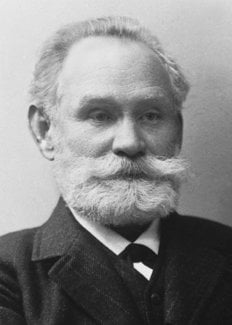
Ivan Petrovich Pavlov was born on September 14, 1849 at Ryazan, where his father, Peter Dmitrievich Pavlov, was a village priest. He was educated first at the church school in Ryazan and then at the theological seminary there.
Inspired by the progressive ideas which D. I. Pisarev, the most eminent of the Russian literary critics of the 1860’s and I. M. Sechenov, the father of Russian physiology, were spreading, Pavlov abandoned his religious career and decided to devote his life to science. In 1870 he enrolled in the physics and mathematics faculty to take the course in natural science.
Pavlov became passionately absorbed with physiology, which in fact was to remain of such fundamental importance to him throughout his life. It was during this first course that he produced, in collaboration with another student, Afanasyev, his first learned treatise, a work on the physiology of the pancreatic nerves. This work was widely acclaimed and he was awarded a gold medal for it.
In 1875 Pavlov completed his course with an outstanding record and received the degree of Candidate of Natural Sciences. However, impelled by his overwhelming interest in physiology, he decided to continue his studies and proceeded to the Academy of Medical Surgery to take the third course there. He completed this in 1879 and was again awarded a gold medal. After a competitive examination, Pavlov won a fellowship at the Academy, and this together with his position as Director of the Physiological Laboratory at the clinic of the famous Russian clinician, S. P. Botkin, enabled him to continue his research work. In 1883 he presented his doctor’s thesis on the subject of «The centrifugal nerves of the heart». In this work he developed his idea of nervism, using as example the intensifying nerve of the heart which he had discovered, and furthermore laid down the basic principles on the trophic function of the nervous system. In this as well as in other works, resulting mainly from his research in the laboratory at the Botkin clinic, Pavlov showed that there existed a basic pattern in the reflex regulation of the activity of the circulatory organs.
In 1890 Pavlov was invited to organize and direct the Department of Physiology at the Institute of Experimental Medicine. Under his direction, which continued over a period of 45 years to the end of his life, this Institute became one of the most important centres of physiological research.
In 1890 Pavlov was appointed Professor of Pharmacology at the Military Medical Academy and five years later he was appointed to the then vacant Chair of Physiology, which he held till 1925.
It was at the Institute of Experimental Medicine in the years 1891-1900 that Pavlov did the bulk of his research on the physiology of digestion. It was here that he developed the surgical method of the «chronic» experiment with extensive use of fistulas, which enabled the functions of various organs to be observed continuously under relatively normal conditions. This discovery opened a new era in the development of physiology, for until then the principal method used had been that of «acute» vivisection, and the function of an organism had only been arrived at by a process of analysis. This meant that research into the functioning of any organ necessitated disruption of the normal interrelation between the organ and its environment. Such a method was inadequate as a means of determining how the functions of an organ were regulated or of discovering the laws governing the organism as a whole under normal conditions – problems which had hampered the development of all medical science. With his method of research, Pavlov opened the way for new advances in theoretical and practical medicine. With extreme clarity he showed that the nervous system played the dominant part in regulating the digestive process, and this discovery is in fact the basis of modern physiology of digestion. Pavlov made known the results of his research in this field, which is of great importance in practical medicine, in lectures which he delivered in 1895 and published under the title Lektsii o rabote glavnykh pishchevaritelnyteh zhelez (Lectures on the function of the principal digestive glands) (1897).
Pavlov’s research into the physiology of digestion led him logically to create a science of conditioned reflexes. In his study of the reflex regulation of the activity of the digestive glands, Pavlov paid special attention to the phenomenon of «psychic secretion», which is caused by food stimuli at a distance from the animal. By employing the method – developed by his colleague D. D. Glinskii in 1895 – of establishing fistulas in the ducts of the salivary glands, Pavlov was able to carry out experiments on the nature of these glands. A series of these experiments caused Pavlov to reject the subjective interpretation of «psychic» salivary secretion and, on the basis of Sechenov’s hypothesis that psychic activity was of a reflex nature, to conclude that even here a reflex – though not a permanent but a temporary or conditioned one – was involved.
This discovery of the function of conditioned reflexes made it possible to study all psychic activity objectively, instead of resorting to subjective methods as had hitherto been necessary; it was now possible to investigate by experimental means the most complex interrelations between an organism and its external environment.
In 1903, at the 14th International Medical Congress in Madrid, Pavlov read a paper on «The Experimental Psychology and Psychopathology of Animals». In this paper the definition of conditioned and other reflexes was given and it was shown that a conditioned reflex should be regarded as an elementary psychological phenomenon, which at the same time is a physiological one. It followed from this that the conditioned reflex was a clue to the mechanism of the most highly developed forms of reaction in animals and humans to their environment and it made an objective study of their psychic activity possible.
Subsequently, in a systematic programme of research, Pavlov transformed Sechenov’s theoretical attempt to discover the reflex mechanisms of psychic activity into an experimentally proven theory of conditioned reflexes.
As guiding principles of materialistic teaching on the laws governing the activity of living organisms, Pavlov deduced three principles for the theory of reflexes: the principle of determinism, the principle of analysis and synthesis, and the principle of structure.
The development of these principles by Pavlov and his school helped greatly towards the building-up of a scientific theory of medicine and towards the discovery of laws governing the functioning of the organism as a whole.
Experiments carried out by Pavlov and his pupils showed that conditioned reflexes originate in the cerebral cortex, which acts as the «prime distributor and organizer of all activity of the organism» and which is responsible for the very delicate equilibrium of an animal with its environment. In 1905 it was established that any external agent could, by coinciding in time with an ordinary reflex, become the conditioned signal for the formation of a new conditioned reflex. In connection with the discovery of this general postulate Pavlov proceeded to investigate «artificial conditioned reflexes». Research in Pavlov’s laboratories over a number of years revealed for the first time the basic laws governing the functioning of the cortex of the great hemispheres. Many physiologists were drawn to the problem of developing Pavlov’s basic laws governing the activity of the cerebrum. As a result of all this research there emerged an integrated Pavlovian theory on higher nervous activity.
Even in the early stages of his research Pavlov received world acclaim and recognition. In 1901 he was elected a corresponding member of the Russian Academy of Sciences, in 1904 he was awarded a Nobel Prize, and in 1907 he was elected Academician of the Russian Academy of Sciences; in 1912 he was given an honorary doctorate at Cambridge University and in the following years honorary membership of various scientific societies abroad. Finally, upon the recommendation of the Medical Academy of Paris, he was awarded the Order of the Legion of Honour (1915).
After the October Revolution, a special government decree, signed by Lenin on January 24, 1921, noted «the outstanding scientific services of Academician I.P.Pavlov, which are of enormous significance to the working class of the whole world».
The Communist Party and the Soviet Government saw to it that Pavlov and his collaborators were given unlimited scope for scientific research. The Soviet Union became a prominent centre for the study of physiology, and the fact that the 15th International Physiological Congress of August 9-17, 1935, was held in Leningrad and Moscow clearly shows that it was acknowledged as such.
Pavlov directed all his indefatigable energy towards scientific reforms. He devoted much effort to transforming the physiological institutions headed by him into world centres of scientific knowledge, and it is generally acknowledged that he succeeded in this endeavour.
Pavlov nurtured a great school of physiologists, which produced many distinguished pupils. He left the richest scientific legacy – a brilliant group of pupils, who would continue developing the ideas of their master, and a host of followers all over the world.
In 1881, Pavlov married Seraphima (Sara) Vasilievna Karchevskaya, a teacher, the daughter of a doctor in the Black Sea fleet. She first had a miscarriage, said to be due to her having to run after her very fast-walking husband. Subsequently they had a son, Wirchik, who died very suddenly as a child; three sons, Vladimir, Victor and Vsevolod, one of whom was a well-known physicist and professor of physics at Leningrad in 1925, and a daughter, Vera.
Dr. Pavlov died in Leningrad on February 27, 1936.
This autobiography/biography was written at the time of the award and first published in the book series Les Prix Nobel. It was later edited and republished in Nobel Lectures. To cite this document, always state the source as shown above.
The Nobel Foundation's copyright has expired.Nobel Prizes and laureates
Six prizes were awarded for achievements that have conferred the greatest benefit to humankind. The 14 laureates' work and discoveries range from quantum tunnelling to promoting democratic rights.
See them all presented here.