Paul Müller
Biographical
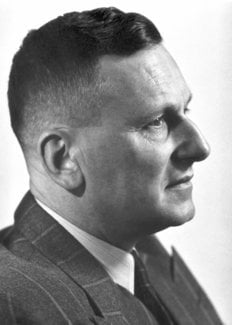
Paul Hermann Müller was born at Olten, Solothurn, Switzerland, on January 12th, 1899, and his early childhood was spent at Lenzburg, Aargau, the birthplace of his father who was an employee of the Swiss Federal Railway. The family moved to Basle where Paul attended primary school and, later, Free Evangelical elementary and secondary schools. He commenced work in 1916 as a laboratory assistant at Dreyfus and Company and the following year he joined Lonza A.G. as an assistant chemist in the Scientific-Industrial Laboratory of their electrical plant, gaining a wealth of practical knowledge which later stood him in good stead in his career as an industrial chemist. He matriculated in 1918 and returned to school to obtain his diploma (1919) which entitled him to attend Basle University: he studied there under Professors Fichter and Rupe for his Doctorate which he received in 1925. He began his career with J. R. Geigy A.G., Basle, in May, 1925, to become Deputy Director of Scientific Research on Substances for Plant Protection in 1946.
Müller’s first researches concerned the chemical and electrochemical oxidation of m-xylidine, and his early work at J. R. Geigy concerned vegetable dyes and natural tanning agents. He devoted some of his spare time to research on tanning agents and he invented synthetic agents which tanned hides pure white – they were, however, not fast to light. Later, in 1930, he developed the light-fast synthetic tanning agents Irgatan FL and Irgatan FLT. He worked on disinfectants for a short while, on moth-proofing agents for textiles, on pesticides in general, and he developed Graminone, a mercury-free seed disinfectant, before, in 1935, he started his researches on new synthetic contact insecticides.
Four years of intensive work led to the synthesis of dichlorodiphenyltrichloroethane (DDT) and the basic Swiss patent was granted in 1940. This compound was originally made in 1873 by an Austrian student, but had never received any particular attention. Field trials now showed it to be effective not only against the common housefly, but also against a wide variety of pests, including the louse, Colorado beetle, and mosquito; and two products based on DDT, Gesarol and Neocide, were marketed in 1942. These formulations were brought to the notice of British and American medical entomologists at a time, during World War II, when supplies of pyrethrum were rapidly falling short of demand. Production was soon established on both sides of the Atlantic and they proved to be of enormous value in combatting typhus and malaria – malaria was, in fact, completely eradicated from many island areas. These compounds have also had great value in agricultural entomology and they have provided a great stimulus in the search for other insecticides.
Müller has had several papers on his work published in Helvetica Chimica Acta. He married Friedel Rüegsegger in 1927. They have two sons, Heinrich (b. 1929) and Niklaus (b. 1933), and one daughter, Margaretha (b. 1934), all married.
This autobiography/biography was written at the time of the award and first published in the book series Les Prix Nobel. It was later edited and republished in Nobel Lectures. To cite this document, always state the source as shown above.
Paul Müller died on October 12, 1965.
Nobel Prizes and laureates
Six prizes were awarded for achievements that have conferred the greatest benefit to humankind. The 14 laureates' work and discoveries range from quantum tunnelling to promoting democratic rights.
See them all presented here.