Dickinson W. Richards
Biographical
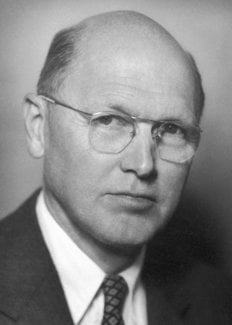
Dickinson Woodruff Richards Jr. was born on October 30, 1895, in Orange, New Jersey, U.S.A. He is the son of Dickinson W. Richards, a New York lawyer and Sally Lambert, whose father and three of her brothers practised medicine in New York. He was educated at the Hotchkiss School in Connecticut, and, in 1913, went to Yale University to study English and Greek. In June, 1917, he was given his A.B. degree, but had, three months earlier, joined the United States Army. After a period as instructor in artillery during 1917-1918, Richards served, during 1918-1919 as an artillery officer in France.
After the war, Richards entered Columbia University College of Physicians and Surgeons and received his M.A. degree in physiology in 1922, and his M.D. degree in 1923. He then spent the years 1923-1927 on the Staff of the Presbyterian Hospital, New York, and then went to work for a year at the National Institute for Medical Research, London, under Sir Henry Dale, on the control of the circulation in the liver.
Returning to the Presbyterian Hospital and the College of Physicians and Surgeons, Richards began his researches on pulmonary and circulatory physiology under the direction of Professor L. J. Henderson of Harvard.
In 1931 he began to collaborate with André Cournand at the Bellevue Hospital, New York, and this work resulted, in 1940, in the development of a technique for catheterization of the heart and in studies (carried out between 1941 and 1956) of traumatic shock, the diagnosis of congenital heart diseases, the physiology of heart failure, measurement of the actions of cardiac drugs, and various forms of dysfunction in chronic cardiac and pulmonary diseases and their treatment. For this work he was awarded, together with André Cournand and Werner Forssmann, the Nobel Prize for Physiology or Medicine for 1956.
From 1935 onwards he has been medical adviser to Merck & Co., Inc., New Jersey.
In 1945 Richards was appointed Professor of Medicine at Columbia University and Visiting Physician and Director of the First (Columbia) Division of the Bellevue Hospital, New York, and in 1947 he became Lambert Professor of Medicine.
In 1961 he retired from this Chair and became Emeritus Lambert Professor.
Professor Richards is a former Editor of The American Review of Tuberculosis, and was also on the Editorial Board of Medicine and of Circulation.
Richards married in 1931 Constance Burrell Riley, they have four daughters: Ida Elizabeth (Mrs. Robert W. Chamberlin, Jr.), Gertrude Woodruff (Mrs. Isaac Daw Russell), Ann Huntington Richards, and Constance Lord Richards.
This autobiography/biography was written at the time of the award and first published in the book series Les Prix Nobel. It was later edited and republished in Nobel Lectures. To cite this document, always state the source as shown above.
Dickinson W. Richards died on February 23, 1973.
Nobel Prizes and laureates
Six prizes were awarded for achievements that have conferred the greatest benefit to humankind. The 14 laureates' work and discoveries range from quantum tunnelling to promoting democratic rights.
See them all presented here.