Peter Medawar
Biographical
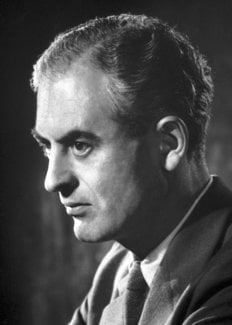
Peter Brian Medawar was born on February 28, 1915, in Rio de Janeiro. He is the son of a business man who is a naturalized British subject, born in the Lebanon.
Medawar was educated at Marlborough College, England, where he went in 1928. Leaving this College in 1932, he went to Magdalen College, Oxford, to study zoology under Professor J. Z. Young. After taking his bachelor’s degree at Oxford, Medawar worked for a time at Sir Howard Florey‘s School of Pathology at Oxford and there became interested in research in fields of biology that are related to medicine.
In 1935 he was appointed Christopher Welch Scholar and Senior Demonstrator at Magdalen College, Oxford, and in 1938 he became, by examination, a Fellow of Magdalen College. In 1942 he was Rolleston Prizeman and in 1944 he became Senior Research Fellow of St John’s College, Oxford, and University Demonstrator in zoology and comparative anatomy. In 1946 he was elected a Fellow of Magdalen College, Oxford, and in 1947 he was appointed Mason Professor of Zoology at the University of Birmingham. In 1951 he moved to London as Jodrell Professor of Zoology at University College, London. Here he remained until 1962, when he was appointed Director of the National Institute for Medical Research, London.
Medawar’s earlier research, done at Oxford, was on tissue culture, the regeneration of peripheral nerves and the mathematical analysis of the changes of shape of organisms that occur during this development. During the early stages of the Second World War he was asked by the Medical Research Council to investigate why it is that skin taken from one human being will not form a permanent graft on the skin of another person, and this work enabled him to establish theorems of transplantation immunity which formed the basis of his further work on this subject. When he moved to Birmingham in 1947 he continued to work on it, in collaboration with R. Billingham, and together they studied there problems of pigmentation and skin grafting in cattle, and the use of skin grafting to distinguish between monozygotic and dizygotic twins in cattle. In this work they took into consideration the work of R. D. Owen and concluded that the phenomenon that they called «actively acquired tolerance» of homografts could be artificially reproduced. For this earlier work on transplantation and growth, Medawar was elected a Fellow of the Royal Society, London. When he moved to London in 1951, Medawar continued to work with R. Billingham and L. Brent, on this phenomenon of tolerance, and his detailed analysis of it occupied him for several years. He also carried out other researches into transplantation immunity.
The Royal Society of London, where he was the Croonian Lecturer in 1958, awarded him the Royal Medal in 1959. In the same year, he was Reith Lecturer for the British Broadcasting Corporation. He has been elected a Foreign Member of the New York Academy of Sciences, the American Academy of Arts and Sciences, and the American Philosophical Society.
In 1937 Medawar married Jean Shinglewood Taylor, daughter of a Cambridge physician. They have two sons, Charles and Alexander, and two daughters, Caroline and Louise.
This autobiography/biography was written at the time of the award and first published in the book series Les Prix Nobel. It was later edited and republished in Nobel Lectures. To cite this document, always state the source as shown above.
For more updated biographical information, see:
Medawar, Peter Brian. Memoirs of a Thinking Radish: An Autobiography. Oxford University Press, Oxford, 1986.
Peter Medawar died on October 2, 1987.
Nobel Prizes and laureates
Six prizes were awarded for achievements that have conferred the greatest benefit to humankind. The 14 laureates' work and discoveries range from quantum tunnelling to promoting democratic rights.
See them all presented here.