Andrew Huxley
Biographical
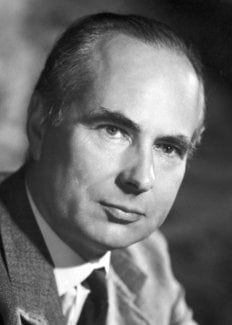
Andrew Fielding Huxley was born in Hampstead, London, on 22nd November 1917. His father, Leonard Huxley, who was a son of the nineteenth – century scientist and writer Thomas Huxley, was for a time a classics master at Charterhouse School and later took up a literary career, writing a number of biographies and being editor of the «Cornhill» magazine. The children of his first marriage included Sir Julian Huxley the biologist and Aldous Huxley the writer. After his first wife’s death, Andrew’s father married Rosalind Bruce, and Andrew is the youngest of the two sons of this marriage. His father died in 1933.
Andrew was educated at University College School (1925-1930) and Westminster School (1930-1935, King’s Scholar); and went up to Trinity College, Cambridge in 1935 with a major entrance scholarship. He had turned over to science from classics in 1932, and went to Cambridge expecting that his career would be in the physical sciences: he has always been mechanically minded, and he was inspired at Westminster by the physics teaching of the late J. F. Rudwick. He naturally took physics, chemistry and mathematics in his Part I at Cambridge, but the rules required him to take another science and he picked physiology, largely on the recommendation of an old friend, B. Delisle Burns, now of the Physiology Department, McGill University. Huxley found physiology interesting, partly for its subject matter and partly through contact with Adrian, Roughton, Rushton, Hodgkin and the late G. A. Millikan (all Fellows of Trinity) and others in the department, and he decided to specialise in it. He spent 1937-1938 doing anatomy with the intention of qualifying in medicine, and 1938-1939 doing the Part II course in physiology. In August 1939 Huxley joined Hodgkin at the Marine Biological Laboratory at Plymouth for his first introduction to research, and they succeeded in recording electrically from the inside of the squid giant axon.
For the first year of the war Huxley was a clinical student, but when medical teaching in London was stopped by air attacks, he changed to work of more immediate application, and spent the rest of the war on operational research in gunnery, first for Anti-Aircraft Command and later for the Admiralty.
In 1941 Huxley was elected to a research fellowship at Trinity College, Cambridge, and he took this up at the beginning of 1946 together with a teaching appointment in the Department of Physiology. He continued to hold college and university posts in Cambridge until 1960, when he became head of the Department of Physiology at University College London. In 1969 he was appointed to a Royal Society Research Professorship which he holds in the Department of Physiology at University College London.
From 1946 to 1951 Huxley worked mostly in collaboration with Hodgkin on nerve conduction, but also with R. Stämfli on myelinated nerve fibres. In 1952 he turned to muscle contraction, and developed an interference microscope for studying the striation pattern in isolated muscle fibres. This has continued to be his main line of work up to the present, though he has done some further computations on the generation of the action potential. Huxley has also developed a microtome for electron microscope sections, and a micromanipulator.
Huxley was an Editor of the Journal of Physiology from 1950-1957, he has also been an Editor of the Journal of Molecular Biology. He became a Fellow of the Royal Society in 1955, and served on its Council, 1960-1962. He worked at Woods Hole, Massachusetts, in 1953 as a Lalor Scholar; gave the Herter Lectures at Johns Hopkins Medical School in 1959; and the Jesup Lectures at Columbia University in 1964.
In 1947 Andrew Huxley married Jocelyn Richenda Gammell Pease, daughter of M. S. Pease, a geneticist, and the Hon. H. B. Pease (née Wedgwood). Mrs. Huxley is a Justice of the Peace, and is active in a variety of public work in Cambridgeshire. They have six children: Janet Rachel (born 20 April 1948), who read Biochemistry at Bristol University; Stewart Leonard (born 19 December 1949), who read engineering at Cambridge University; Camilla Rosalind (born 12 March 1952), who entered Cambridge University in 1971; Eleanor Bruce (born 21 February 1959); Henrietta Catherine (born 25 December 1960); and Clare Marjory Pease (born 4 November 1962).
This autobiography/biography was written at the time of the award and first published in the book series Les Prix Nobel. It was later edited and republished in Nobel Lectures. To cite this document, always state the source as shown above.
Sir Andrew Huxley died on 30 May 2012.
Nobel Prizes and laureates
Six prizes were awarded for achievements that have conferred the greatest benefit to humankind. The 14 laureates' work and discoveries range from quantum tunnelling to promoting democratic rights.
See them all presented here.