Roger W. Sperry
Article

Roger Wolcott Sperry
by Norman H. Horowitz
This article was published on 23 July 1997.
Roger Wolcott Sperry (1913-1994) was born in Hartford, Connecticut and grew up on a farm outside Hartford. He attended Hartford public schools. At West Hartford High School he was a star athlete in several sports, but he also did well enough academically to win a scholarship to Oberlin College, in Ohio. He graduated from Oberlin in 1935 with a degree in English. At college, Sperry’s main passion, aside from 17th century English poetry, seems to have been athletics, as in high school. He was captain of the basketball team, and he also took part in varsity baseball, football, and track.
Sperry stayed at Oberlin after graduating and took a Master’s degree in psychology. He then went to the University of Chicago, where he worked for his Ph.D. in zoology under Paul Weiss, one of the most influential biologists of the time. Following his Ph.D., he spent some years at Harvard and the Yerkes Laboratory for Primate Biology in Florida before returning to Chicago as a faculty member.
In 1951, Sperry was invited to present his work at the California Institute of Technology (Caltech), which was seeking to fill the newly endowed Hixon Professorship of Psychobiology. His lectures on neurospecificity (summarized below) were brilliant, and he was offered the position. He joined the Caltech faculty in 1954 and remained there for the rest of his life.
Sperry’s first major scientific work – one which occupied him for over a decade – was to disprove a widely accepted theory that had been advanced by his professor at the University of Chicago, Paul Weiss. According to this theory, the vast neural network that connects the sense organs and muscles to the brain originates as an undifferentiated and unspecified mesh of randomly connected nerve fibers which is later transformed, under the influence of experience and learning, into the highly coordinated, purposeful system that is actually seen in animals. Plasticity and interchangeability of function were the key ideas. This theory did not come out of the blue, of course, but was based on careful experimental work that Weiss had performed, but misinterpreted.
In a series of experiments that have become famous, Sperry showed that the actual state of affairs is precisely the opposite of that imagined in Weiss’ theory. Instead of being composed of interchangeable parts, the circuits of the brain are largely hardwired, in the sense that each nerve cell is tagged with its own chemical individuality early in embryonic development; once this happens, the function of the cell is fixed and is not modifiable thereafter.
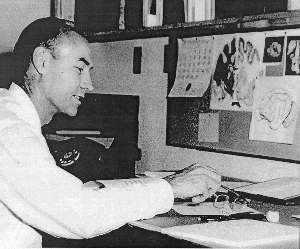
Roger Sperry at his desk.
Copyright © California Institute of Technology
Photo: W. W. Girdner
All rights reserved. Commercial use or modification of this material is prohibited.
The experiments that led to this radical conclusion involved surgical procedures on a variety of animals from fish and salamanders to monkeys. Sperry showed that if nerve connections were rearranged – for example, by redirecting to the other side of the animal the sensory nerves that innervate the left foot of a rat – inappropriate responses resulted that could not be unlearned. In this case, stimulation of the right foot caused the rat to move its left foot, and no amount of experience or retraining could change this response.
In experiments with fish, frogs, and salamanders (chosen because they have great powers of regeneration), Sperry demonstrated that individual nerve fibers (which are actually different cells) behave as if each is chemically different from every other, and these chemical differences are matched in the brain. The result is that in an animal whose optic nerves are severed and then allowed to regenerate, the thousands of individual fibers that make up each optic nerve grow back into the brain and there make the same connections they had before. The animal is then able to see as if the nerves had never been severed. Proof that no adaptive reorganization of the neural circuits is involved in regeneration consisted of showing that if an eye whose optic nerve is severed is also rotated in its socket, the world seen by the eye after regeneration is still upside down and backwards. Furthermore, as in the case of the rat with the crossed nerves, no amount of retraining makes it see correctly: the animal invariably strikes to the left when it sees a worm on its right.
The conclusion that the circuitry of the brain is fixed in early development is supported by much more evidence than I can summarize here. It has given rise to a field of research focused on “axonal guidance”. Sperry’s result concerning the chemical individuality of each nerve fiber has been confirmed by modern molecular methods. It is a result that is loaded with meanings at many levels – from immediate consequences for neurosurgery to large and still not fully explored implications for evolution and development, and even for social-political questions. It raises other fascinating and still unsolved questions. For example, the capacity to learn obviously implies some neural plasticity. But given the basic determinism of the brain that Sperry uncovered, what does learning actually consist of at the cellular and chemical level? These and other questions posed by his findings are now being studied, and no doubt they will continue to be worked on for a long time in the future.
Important as his work on neurospecificity was, it was not this for which he was awarded the Nobel Prize in 1981, but his discoveries on split brains. Essentially, Sperry and his students showed that if the two hemispheres of the brain are separated by severing the corpus callosum (the large band of fibers that connects them), the transfer of information between the hemispheres ceases, and the coexistence in the same individual of two functionally different brains can be demonstrated. The findings contradicted the generally held view – again based on misinterpretation of evidence – that sectioning of the corpus callosum produced no definite behavioral effects. The probable explanation is that the two hemispheres, although separated from one another, are usually in agreement, so that no obvious conflict results. By means of ingenious tests, however, Sperry and his group showed that definite behavioral phenomena can be demonstrated following the brain-splitting operation.
Sperry started this investigation with cats and monkeys, but later extended it to human beings when patients became available whose hemispheres had been surgically separated in order to control intractable epilepsy. It was with these patients that he was able to show that a conscious mind exists in each hemisphere. The left hemisphere is the one with speech, as had been known, and it is dominant in all activities involving language, arithmetic, and analysis. The right hemisphere, although mute and capable only of simple addition (up to about 20) is superior to the left hemisphere in, among other things, spatial comprehension – in understanding maps, for example, or recognizing faces. Until these patients were studied, it had been doubted whether the right hemisphere was even conscious. By devising ways of communicating with the right hemisphere, Sperry could show that this hemisphere is, to quote him: “indeed a conscious system in its own right, perceiving, thinking, remembering, reasoning, willing, and emoting, all at a characteristically human level, and … both the left and the right hemisphere may be conscious simultaneously in different, even in mutually conflicting, mental experiences that run along in parallel.”
As with his earlier work, the discovery of the duality of consciousness revealed in the split-brain experiments opened whole new fields of brain research, and these are now being worked by a new generation of biologists, and, of course, philosophers.
First published 23 July 1997
Nobel Prizes and laureates
Six prizes were awarded for achievements that have conferred the greatest benefit to humankind. The 14 laureates' work and discoveries range from quantum tunnelling to promoting democratic rights.
See them all presented here.