Gertrude B. Elion
Biographical
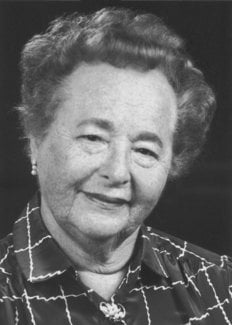
I was born in New York City on a cold January night when the water pipes in our apartment froze and burst. Fortunately, my mother was in the hospital rather than at home at the time. My father emigrated from Lithuania to the United States at the age of 12. He received his higher education in New York City and graduated in 1914 from the New York University School of Dentistry. My mother came at the age of 14 from a part of Russia which, after the war, became Poland; she was only 19 when she was married to my father. My first seven years were spent in a large apartment in Manhattan where my father had his dental office, with our living quarters adjoining it.
My brother was born about six years after I was, and shortly thereafter we moved to the Bronx, which was then considered a suburb of New York City. There were still many open lots where children could play and large parks, including the Bronx Zoo, to which I was very much devoted. My brother and I had a happy childhood. We went to a public school within walking distance of our house. Our classrooms were generally quite crowded, but we received a good basic education.
I was a child with an insatiable thirst for knowledge and remember enjoying all of my courses almost equally. When it came time at the end of my high school career to choose a major in which to specialize I was in a quandary. One of the deciding factors may have been that my grandfather, whom I loved dearly, died of cancer when I was 15. I was highly motivated to do something that might eventually lead to a cure for this terrible disease. When I entered Hunter College in 1933, I decided to major in science and, in particular, chemistry.
By this time my father was not financially well-off since he, like many others, had invested heavily in the stock market, and in the crash of 1929 had gone into bankruptcy. Fortunately, he still had his profession and his loyal patients. Had it not been that Hunter College was a free college, and that my grades were good enough for me to enter it, I suspect I might never have received a higher education. My brother also was able to take advantage of a free higher education, going to the College of the City of New York where he studied physics and engineering.
I remember my school days as being very challenging and full of good comradery among the students. It was an all-girls school and I think many of our teachers were uncertain whether most of us would really go on with our careers. As a matter of fact, many of the girls went on to become teachers and some went into scientific research. Because of the depression, it was not possible for me to go on to graduate school, although I did apply to a number of universities with the hope of getting an assistantship or fellowship.
Jobs were scarce and the few positions that existed in laboratories were not available to women. I did get a three-month job teaching biochemistry to nurses in the New York Hospital School of Nursing. Unfortunately, because of the trimester system, the same job would not have been available again for nine months. By chance, I met a chemist who was looking for a laboratory assistant. Although he was unable to pay me any salary at that time, I decided that the experience would be worthwhile. I stayed there for a year and a half and was finally making the magnificent sum of $20 a week. By then I had saved some money and, with help from my parents, entered graduate school at New York University in the fall of 1939. I was the only female in my graduate chemistry class but no one seemed to mind, and I did not consider it at all strange.
After a year of graduate studies I had finished all the required courses but now needed to do the research work for my Master’s degree. During this period, I took a job as a teacher-in-training and then as a substitute teacher in the New York City secondary schools, teaching chemistry, physics and general science for two years. In the meantime, I did my research work at night and on week-ends at New York University, and obtained my Master of Science degree in chemistry in 1941.
By this time, World War II had begun and there was a shortage of chemists in industrial laboratories. Although I was finally able to get a job in a laboratory, it was not in research. I did analytical quality control work for a major food company. After a year and a half, during which I learned a good deal about instrumentation, I became restless because the work was so repetitive and I was no longer learning anything. I applied to employment agencies for a research job, and was chosen to go to a laboratory at Johnson and Johnson in New Jersey. Unfortunately, that laboratory was disbanded after about six months. At that time I was offered a number of positions in research laboratories but the one which intrigued me most was a position as assistant to George Hitchings. My thirst for knowledge stood me in good stead in that laboratory, because Dr. Hitchings permitted me to learn as rapidly as I could and to take on more and more responsibility when I was ready for it. From being solely an organic chemist, I soon became very much involved in microbiology and in the biological activities of the compounds I was synthesizing. I never felt constrained to remain strictly in chemistry, but was able to broaden my horizons into biochemistry, pharmacology, immunology, and eventually virology.
At the same time, I was eager to get my doctorate degree and began to go to school at night at Brooklyn Polytechnic Institute. After several years of long range commuting, I was informed that I would no longer be able to continue my doctorate on a part-time basis, but would need to give up my job and go to school full-time. I made what was then a critical decision in my life, to stay with my job and give up the pursuit of a doctorate. Years later, when I received three honorary doctorate degrees from George Washington University, Brown University and the University of Michigan, I decided that perhaps that decision had been the right one after all. Unfortunately, neither of my parents lived to see this recognition.
The work became fascinating almost from the very beginning. We were exploring new frontiers, since very little was known about nucleic acid biosynthesis or the enzymes involved with it. I had been assigned quite early to work on the purines and, with the exception of a few deviations into the pteridines and into some other condensed pyrimidine systems, the remainder of my work concentrated almost completely on the purines. Each series of studies was like a mystery story in that we were constantly trying to deduce what the microbiological results meant, with little biochemical information to help us. Then, in the mid-1950’s came the work of Greenberg, Buchanan, Kornberg and others which elucidated the pathways for the biosynthesis and utilization of purines, and many of our findings began to fall into place. When we began to see the results of our efforts in the form of new drugs which filled real medical needs and benefited patients in very visible ways, our feeling of reward was immeasurable.
Over the years, my work became both my vocation and avocation. Since I enjoyed it so much, I never felt a great need to go outside for relaxation. Nevertheless, I became an avid photographer and traveler. Possibly my love for travel stems from the early years when my family seldom went away on vacation. Thus, my curiosity about the rest of the world did not begin to be satisfied until I began to travel. I have traveled fairly widely over the world, but there still remain many places for me to explore. Another major interest is music, not because I am musically talented, but because I love to listen to it. I am an opera lover and have been a subscriber to the Metropolitan Opera for over 40 years. I also enjoy concerts, ballet and theater.
Although I never married, my brother fortunately did, and I have had the pleasure of watching his three sons and daughter grow up. Several of them now have children of their own. We have been a close-knit family, although often separated by distance, and have shared each other’s happiness, sorrows, and aspirations.
In my professional career I was promoted frequently, and in 1967 I was appointed Head of the Department of Experimental Therapy, a position which I held until I retired in 1983. This department was sometimes termed by some of my colleagues a “mini-institute” since it contained sections of chemistry, enzymology, pharmacology, immunology and virology, as well as a tissue culture laboratory. This made it possible to coordinate our work and cooperate in a manner that was extremely useful for development of new drugs.
I have been associated with the National Cancer Institute in many capacities, from 1960 when I served on one of its study sections, to serving later on a number of its advisory committees and the Board of Scientific Counselors for the Division of Cancer Treatment, and most recently as a member of the National Cancer Advisory Board. I have taken an active part in the American Association for Cancer Research, serving on its Board of Directors, its program committees, and in 1983 – 84 as its President. In addition, I have served on Advisory Committees for the American Cancer Society, the Leukemia Society of America, and a number of committees for the Tropical Disease Research division of the World Health Organization, currently serving as Chairman of the Steering Committee on the Chemotherapy of Malaria. I am a member of the American Chemical Society, the Royal Society of Chemistry, the Transplantation Society, the American Society of Biological Chemists, the American Society of Pharmacology and Experimental Therapeutics, the American Association for Cancer Research, the American Society of Hematology, the American Association for the Advancement of Science, the American Association of Pharmaceutical Scientists, and am a Fellow of the New York Academy of Sciences.
After my official retirement as Department Head from Burroughs Wellcome, I have remained there as a Scientist Emeritus and Consultant, and have tried to take an active part in the discussions, seminars and staff meetings relating to research. In addition, I have become a Research Professor of Medicine and Pharmacology at Duke University and each year work with one third-year medical student who wishes to do research in the areas of tumor biochemistry and pharmacology. This has been a very stimulating experience and one that I hope to continue for some time to come. I serve on a number of editorial boards and continue to lecture and write. In a sense, my career appears to have come full circle from my early days of being a teacher to now sharing my experience in research with the new generations of scientists.
This autobiography/biography was written at the time of the award and later published in the book series Les Prix Nobel/ Nobel Lectures/The Nobel Prizes. The information is sometimes updated with an addendum submitted by the Laureate.
Gertrude B. Elion died on February 21, 1999.
Nobel Prizes and laureates
Six prizes were awarded for achievements that have conferred the greatest benefit to humankind. The 14 laureates' work and discoveries range from quantum tunnelling to promoting democratic rights.
See them all presented here.