Award ceremony speech
Presentation Speech by Professor Ralf Pettersson of the Nobel Committee at Karolinska Institutet, December 10, 1999.
Translation of the Swedish text.
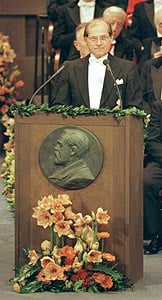
Copyright © Nobel Prize Outreach 1999 Photo: Hans Mehlin
Your Majesties, Your Royal Highness, Ladies and Gentlemen,
Imagine a large factory that manufactures thousands of different items in millions of copies every hour, that promptly packages and ships each of them to waiting customers. Naturally, to avoid chaos, each product requires a clearly labeled address tag. Günter Blobel is being awarded this year’s Nobel Prize in Physiology or Medicine for having shown that newly synthesized proteins, analogous to the products manufactured in the factory, contain built-in signals, or address tags, that direct them to their proper cellular destination.
An adult human is comprised of approximately 100,000 billion cells, all of which are structurally similar. A striking feature is that each cell contains small compartments or organelles. Organelles are bounded by impermeant, lipid-rich membranes that ensure the physical and functional separation of vital biochemical processes. This compartmentalization enables cells to be compared to a large city in which each public function is housed in a separate building. The blueprint for all cellular processes is maintained in the genome located in the cell nucleus, the City Hall of the cell. Energy production takes place within mitochondria, the power plant of the cell; the breakdown and recycling of waste takes place in the lysosome etc. The production of new products, proteins in the case of the cell, is carried out by ribosomes in a process resembling an assembly line. There is indeed a feverish amount of activity within cells. Every second, thousands of protein molecules are degraded and replaced by new ones. How does a newly made protein get to its correct intracellular location, and how do proteins enter into and move across the membranes surrounding individual organelles? These two central questions occupied the minds of scientists during the 1960s.
Günter Blobel has provided the answer to both these questions. In 1967 he joined the renowned cell biology laboratory headed by George Palade at the Rockefeller University in New York. Palade, who received the Nobel Prize in 1974, had defined and charted the route that secretory proteins take from their site of synthesis within the cell to the cell surface. Secreted proteins are made in the cell in association with a membrane system called the endoplasmic reticulum.
Blobel began by examining how a newly synthesized secretory protein is targeted to and then translocated across the endoplasmic reticulum membrane. Based on the results from a series of elegant experiments, Blobel put forth the so-called “signal hypothesis,” in a preliminary form in 1971 and a mature final form in 1975, to explain how this process takes place. The signal hypothesis postulated that newly made proteins contain built-in signals, address tags or zip codes, that target proteins to the endoplasmic reticulum and that subsequently lead them across the reticulum membrane through a specialized channel. Proteins that are translocated across to the other side are packaged for subsequent transport to the cell surface.
To test this hypothesis, Blobel developed an ingenious experimental test tube system, which enabled him to individually study each step of the process. The system which relied on components obtained from mouse, rabbit, and dog cells, laid the foundation for the development of the field of molecular cell biological research. In the following 20 years, Blobel and his co-workers characterized this complex process in great detail. The original signal hypothesis, in all its essential parts, has stood the test of time and proven to be correct.
Blobel extended his studies and was able to demonstrate that proteins destined to become transported to other organelles, or that become integrated into different cellular membranes, also contain specific address tags and so-called “topogenic” signals. The guiding principles that Blobel has helped to elucidate are universally applicable and highly conserved. They have remained almost unchanged during the course of evolution, functioning in yeast, plant, and animal cells.
Perhaps the most important consequences of Günter Blobel’s discoveries is that we now understand the fundamental principles guiding the formation and maintenance of cell and organelle structure. The signal hypothesis provides a framework to understand the mechanisms underlying many hereditary diseases and other disease processes in which specific proteins become mislocalized. In addition, these discoveries have enabled the pharmaceutical industry to turn cultured cells into efficient mini-factories for the production of protein-based drugs, such as insulin, growth hormone, coagulation factors, etc.
Günter Blobel, your discovery that proteins contain built-in signals that direct them to their correct destination within cells and across membranes has had a profound impact on our understanding of how a cell and its organelles are assembled and maintained. Your work has also laid the foundation for modern molecular cell biology. On behalf of the Nobel Assembly at Karolinska Institutet I wish to convey to you my warmest congratulations and I now ask you to step forward to receive your Nobel Prize from the hands of His Majesty the King.
Nobel Prizes and laureates
Six prizes were awarded for achievements that have conferred the greatest benefit to humankind. The 14 laureates' work and discoveries range from quantum tunnelling to promoting democratic rights.
See them all presented here.