Albert Gobat
Biographical
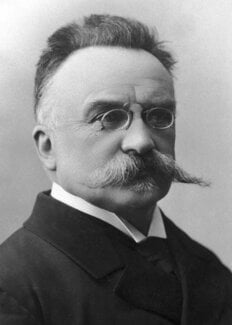
Charles Albert Gobat (May 21, 1843-March 16, 1914) was born at Tramelan, Switzerland, the son of a Protestant pastor and the nephew of Samuel Gobat, a missionary who became bishop of Jerusalem. A brilliant student, he studied at the Universities of Basel, Heidelberg, Bern, and Paris, taking his doctorate in law, summa cum laude, from Heidelberg in 1867.
For the next fifteen years, Gobat devoted his time and energy to the law. He began his practice in Bern and, at the same time, lectured on French civil law at Bern University. He then opened an office in Delémont in the canton of Bern, which soon became the leading legal firm of the district.
After 1882, however, he became increasingly absorbed in politics and education. In that year he was appointed superintendent of public instruction for the canton of Bern, a position he held for thirty years. A progressive in educational philosophy, he reformed the system of primary training, obtained increased budgetary support to improve the teacher-pupil ratio, supported the study of living languages, provided pupils with an alternative to the traditionally narrow classical education by establishing curricula in vocational and professional training.
His personal scholarship was concerned with history. He won acclaim for his erudite République de Berne et la France pendant les guerres de religion (1891) and widespread recognition (as well as large sales) for his more popularly conceived Histoire de la Suisse racontée au peuple [A People’s History of Switzerland] (1900).
Meanwhile, he was pursuing a career in politics. In 1882 he was elected to the Grand Council of Bern, becoming president of the cantonal government for the 1886-1887 term. From 1884 to 1890 he was a member of the Council of States of Switzerland and from 1890 until his death a member of the National Council, the other chamber of the central Swiss legislative body. In politics as in education, Gobat was a liberal, a moderate reformer. A major piece of legislation he sponsored in 1902 applied the principle of arbitration to commercial treaties. By its terms, Switzerland agreed to insert in all commercial treaties such as customs agreements, a clause requiring the parties to submit to the Permanent Court of Arbitration at The Hague any dispute that might arise from the day-to-day operation of the treaty.
The Interparliamentary Union, which held its first major international conference in 1889, provided Gobat with an appealing outlet for his advocacy of arbitration and peace. Founded largely through the efforts of the English parliamentarian Cremer, a Nobel Peace Prizewinner in 1903, and the French Deputy Passy, a co-recipient of the Nobel Peace Prize for 1901, the Interparliamentary Union, then as now, brought together interested members of the parliaments of all countries to discuss international issues and to explore ways to improve collaboration among nations via parliamentary and democratic institutions; at this time, however, its primary objective was to promote international arbitration.
Gobat presided over the fourth conference of the Union convened in 1892 at Bern. This conference officially established a central headquarters at Bern to be called the Interparliamentary Bureau and entrusted its direction to Albert Gobat. As director of the Bureau, a position he filled without remuneration for the next seventeen years, Gobat supervised the details of setting up the annual conferences, prepared the agenda, arranged for the publication of the proceedings (beginning in 1896), edited a monthly publication to which he frequently made personal contributions, encouraged members to sponsor within their own legislatures proposals to improve relations among nations. After the twelfth Interparliamentary Conference of 1904 in St. Louis passed a resolution calling for a second Hague Peace Conference, it was Gobat who acted as the Union’s spokesman in asking U. S. President Theodore Roosevelt to appeal to all nations to participate in such conference.1
When Élie Ducommun, co-laureate for 1902, died in 1906, Gobat took over the direction of the International Peace Bureau, performing duties for that office during the next eight years analogous to those he had discharged for the Interparliamentary Bureau.
Gobat died with his boots on. On March 16, 1914, while attending meeting of the peace conference at Bern, he arose as if to speak but collapsed, dying about an hour later.
| Selected Bibliography |
| Dictionnaire historique et biographique de la Suisse. Neuchâtel, 1924-. |
| Gobat, Albert, Le Cauchemar de l’Europe. Strasbourg, 1911. |
| Gobat, Albert, Croquis et impressions d’Amérique. Bern, Grunau, 1904. |
| Gobat, Albert, Développement du Bureau international permanent de la paix. Bern, 1910. |
| Gobat, Albert, L’Histoire de la Suisse racontée au peuple. Neuchâtel, Zahn, 1900. |
| Gobat, Albert, «The International Parliament», The Independent, 55 (May 14, 1903) 1148-1150. |
| Gobat, Albert, La République de Berne et la France pendant les guerres de religion. Paris, Gedalge, 1891. |
| Obituary, Journal de Genève (17 mars 1914). |
| Passy, Frédéric, «The Recipients of the Nobel Prize of Peace», The Independent, 55 (March 5, 1903) 554-557. |
1. Roosevelt responded affirmatively to this request and shortly thereafter had Secretary of State Hay issue a circular to the other nations. For various reasons, however, the credit for convening the Conference of 1907 is legitimately ascribed to Czar Nicholas II of Russia.
This autobiography/biography was written at the time of the award and first published in the book series Les Prix Nobel. It was later edited and republished in Nobel Lectures. To cite this document, always state the source as shown above.
The Nobel Foundation's copyright has expired.Nobel Prizes and laureates
Six prizes were awarded for achievements that have conferred the greatest benefit to humankind. The 14 laureates' work and discoveries range from quantum tunnelling to promoting democratic rights.
See them all presented here.