Ernesto Teodoro Moneta
Biographical
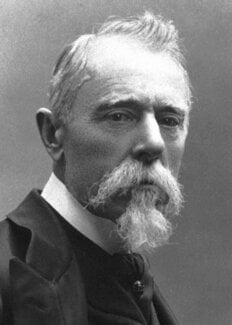
Ernesto Teodoro Moneta (September 20, 1833-February 10, 1918) had a personality as paradoxical as the term «militant pacifist» which was so often applied to him. He was a nationalistic internationalist, a deeply religious anticlerical propagandist, a crusader for physical fitness who daily took a tram to avoid walking across a square to lunch in a restaurant opposite his office.
Born of aristocratic Milanese parents, he spent his childhood in two country houses where his impoverished family could still live on a patriarchal scale, although without luxury. He was profoundly affected by his experiences in the uprising against Austria when, at the age of fifteen, he fought next to his father to defend his family home and saw three Austrian soldiers die nearby. It was probably then that Moneta’s dual advocacy of peace and yet of fighting for his own kind of nationalism was born. From 1848 to 1866 he spent a great deal of his time in efforts for Italian independence and unification, fighting with Garibaldi in 1859 and 1860 and later under General Sirtori whose aide-de-camp he became. Disillusioned by the campaign of 1866, however, he cut short what seemed to be a promising army career and returned to civilian life, although he remained personally loyal to General Sirtori all his life.
Moneta was a handsome, warm, cheerful man who enjoyed riding horses, acting in amateur theatricals, and contributing play reviews to Il Secolo, daily newspaper founded in 1866 by Edoardo Sonzogno. When two of his friends took over Il Secolo in 1867, he accepted the position of editor, which he held from 1867 until 1895. Journalism proved to be the ideal outlet for Moneta’s dynamism and idealism, his career as a pacifist being an organic outgrowth of his daily intellectual stimulation and passionate commitment as editor of Il Secolo.
A man of strong personal convictions, Moneta was respected for his integrity as much as for his courage and willingness to accept innovations. He forged Il Secolo into a powerful instrument for shaping public opinion without compromising its editorial balance. Although he respected religion and was a practicing Catholic, he permitted Il Secolo to adopt an anticlerical stance because he believed for many years that specific abuses among the clergy were impeding Italian unification and social progress. He became virtually estranged from his wife – and from his two sons during her lifetime – largely because she was unable to accept this apparent inconsistency in her husband’s attitude toward the religion which meant so much to her.
Since Moneta understood and sympathized with the problems of the Italian army, he campaigned vigorously in the columns of Il Secolo for reforms which public opinion could bring about. He contended that the lengthy basic training of recruits and conscripts was wasteful and inefficient, that organized athletics, target practice, and civilian drills in the villages could drastically cut down the time needed to train recruits, that militarism could be de-emphasized, yet the effective strength of the army actually increased.
During the last thirty years of the nineteenth century, Moneta gathered material and insights for his opus Le guerre, le insurrezioni e la pace nel secolo XIX [Wars, Insurrections and Peace in the Nineteenth Century], which he published in four volumes in 1903, 1904, 1906, and 1910. The part of this work which remains of greatest interest is the first volume, in which he describes the development of the international peace movement during the course of the century. Moneta concentrates his interest on military rather than on social or economic issues throughout the work and utilizes the point of view and approach of the journalist, narrating in a first-person, anecdotal style. His recurrent theme is the lack of substantive results achieved by wars and militarism. Yet, during his career as editor of Il Secolo, Moneta was one of the most vocal nationalists in Italy. He managed to make his intense patriotism and his devotion to the cause of national defense and of Italian unification consistent with his dedication to the fostering of international peace and arbitration, becoming a full-time pacifist immediately upon his retirement from Il Secolo. Although his highly personal brand of nationalism almost approached chauvinism, he fought for years against the contempt for Austria displayed by many Il Secolo readers and against the «Gallophobia» which swept Italy during the 1880’s.
The range of activities in which Moneta engaged for the propagation of world peace is impressive. In 1890 he began to issue an annual almanac called L’Amico della pace. After his retirement as editor of Il Secolo, he continued to contribute to its columns from time to time and to republish many of his articles in pamphlets and periodicals. Ever aware of the value of propaganda for peace, he even printed one-page tracts and distributed them to rural schoolmasters. In 1898 he founded a fortnightly review, La Vita internazionale, which gained sufficient prestige to ensure publication on a regular basis for many years during a period when most such periodicals languished in Italy for lack of interest and financial support.
His work for peace was not solely of a literary nature. He became the Italian representative on the Commission of the International Peace Bureau in 1895. He attended peace congresses for many years, and his courtly, deceptively diffident presence became increasingly familiar and respected. He had encouraged l’Unione lombarda per la pace e l’arbitrato internazionale [the Lombard Union for International Peace and Arbitration] since its foundation in 18871, and had himself founded, besides several organizations of an ephemeral nature, the Società per la pace e la giustizia internazionale [Society for International Peace and Justice]2, which lasted from 1887 until 19373, long after his death. He lectured at the newly founded Italian Popular University. In 1906 he planned and had constructed a Pavilion for Peace at the Milan International Exposition, during which he presided over the fifteenth annual International Peace Congress.
From 1900 until his death in 1918, Moneta suffered from glaucoma, and he spent long periods in the country recuperating from eye operations which barely prevented total blindness. Physical suffering refined Moneta’s high sense of purpose but did not diminish his essential exuberance, even in advanced age, or his ability to state vigorously his convictions. During World War I, for example, supporting Italy’s role in the war, he said4: «I, as an Italian, cannot put myself au dessus de la mêlée. I must participate in the life of my country, rejoice in her joys, and weep in her sorrows.»
Moneta succumbed to pneumonia in 1918 at the age of eighty-five. The monument which his friends erected to him in 1925 was carted off to a warehouse during the Fascist regime, thus escaping destruction when a bomb fell on the site during World War II. The inscription on its base preserves the essential paradox of his life, for it honors him both as a partisan of Garibaldi’s and as an apostle of peace.
| Selected Bibliography |
| Combi, Maria, Ernesto Teodoro Moneta: Premio Nobel per la pace 1907. Milano, Mursia, 1968. |
| Moneta, Ernesto Teodoro, Dal presente all’ avvenrie, Milano, 1913. |
| Moneta, Ernesto Teodoro, Le guerre, le insurrezioni e la pace nel secolo decimonono, Compedio storico. 4 vols. Milano, 1903-1910. |
| Moneta, Ernesto Teodoro, L’ideale della pace e la patria. Milano, 1913. |
| Moneta, Ernesto Teodoro, Irredentismo e gallophia. Milano, 1903. |
| Moneta, Ernesto Teodoro, La nostra pace. Milano, Bellini, 1909. |
| Moneta, Ernesto Teodoro, Patria e umanità. Milano, Sonzogno, 1899. |
| Pinardi, Giuseppe, La Carrière d’un pacifiste: E. T. Moneta. Le Havre, Publication de «L’Universel», 1904. |
| Schou, August, Histoire de l’internationalisme III: Du Congrès de Vienne jusqu’à la première guerre mondiale (1914), pp. 355-359. Publications de l’Institut Nobel Norvégien, Tome VIII. Oslo, Aschehoug, 1963. |
1. He contributed to it the financial bonus his publisher awarded him after 20 years with Il Secolo. As editor of a politically significant newspaper, he could not become a board member, but he met with the founding president Francesco Viganò and founding secretary Angelo Mazzoleni when Hodgson Pratt came to Milan to found an Italian branch of his International Arbitration and Peace Society, and after he left Il Secolo, he became active in the Union itself – often referred to as the Lombard Peace Union. For a discussion of Moneta’s complicated relationship to this organization and to the one he founded in 1887, see Maria Combi, Ernesto Teodoro Moneta (especially the Foreword, pp. 7-13, and Chapter V, pp. 77-107).
2. Whose functions were less politically sensitive, although those who met with Moneta in founding it were virtually the same as those founding the Lombard Union.
3. It was revived in 1945 by Doro Rosetti, nephew and collaborator of Moneta.
4. The (London) Times (February 11, 1918) 7.
This autobiography/biography was written at the time of the award and first published in the book series Les Prix Nobel. It was later edited and republished in Nobel Lectures. To cite this document, always state the source as shown above.
The Nobel Foundation's copyright has expired.Nobel Prizes and laureates
Six prizes were awarded for achievements that have conferred the greatest benefit to humankind. The 14 laureates' work and discoveries range from quantum tunnelling to promoting democratic rights.
See them all presented here.