Fredrik Bajer
Biographical
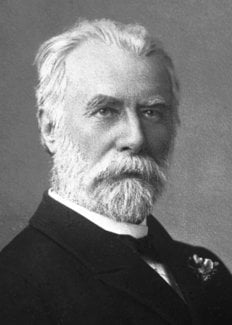
The Danish pacifist, Fredrik Bajer (April 21, 1837-January 22, 1922), was born in Vester Egede, near Naestved, Denmark. The son of a clergyman named Alfred Beyer, he adopted the altered spelling of his surname in 1865.
Bajer entered the Sorø Academy in 1848 and six years later a military school. In 1856 he joined the army as a lieutenant in the Dragoons, stationed first in Naestved and then in Holstein, interrupting his service for two years in 1860 to take advanced courses in another military school. During the 1864 war against Prussia and Austria, he commanded troops in northern Jutland, winning attention by his ability and conduct and earning promotion to the rank of first lieutenant. Despite his record, he was discharged from the army in June of 1865 during a general reduction of troops at the end of the war. Even before his dismissal, however, he had begun to think, as his autobiography shows, that he was more cut out for a philosophical than for a military way of life.
Between the ages of twenty-eight and thirty-five, Bajer laid the foundations of his later career. He studied languages, mastering French, Norwegian, and Swedish; established himself as a teacher and translator in Copenhagen; supplemented his income by free-lance writing; spoke and wrote on the subjects which were thereafter to claim the major share of his attention; and entered politics in 1872. In that year he was elected to the Folketing, the Danish House of Representatives, retaining his seat there for the next twenty-three years.
In politics Bajer displayed liberal tendencies, but, disliking party discipline, remained independent of political affiliation. The main causes he supported in his political life were those with which he had already become prominently identified: international peace and Danish neutrality, Scandinavian unity, women’s rights, and education.
In the field of education, Bajer was professionally interested in linguistics, particularly in orthography and phonation, but he was concerned with school organization as well; he was a member of the governing board of the Pedagogical Society and played an important role in the first Scandinavian conference of schoolmen held in Göteborg in 1870.
Bajer was one of Denmark’s leading spokesmen for women’s rights helping to found the Dansk Kvindesamfund [Danish Women’s Society] in 1871 and supporting legislation in the Folketing on behalf of equality for women, especially in economic matters.
In 1870 Bajer started the Nordisk Fristats Samfund [Society of Nordic Free States], dedicated to the promotion of Nordic unity and cooperation, and for two years edited its weekly journal Folkevennen [Friend of the People]. Eventually, his ideas on Scandinavian unity became inextricably associated with his evolving ideas on neutrality and peace.
Bajer was introduced to the organized peace movement of his day through his study of languages and became especially interested in the efforts of the French peace leader, Frédéric Passy, and the work of the Ligue intenationale et permanente de la paix founded in 1867, offering his help in distributing its literature. Perceiving one aspect of peace in terms of neutrality, he founded the first Danish peace society in 1882 under the name Foreningen til Danmarks Neutralisering [Society for Promotion of Danish Neutrality], serving as its president until 1892. (Later this association became the Danish Peace Society, and still later the Danish Peace and League of Nations Society.) Using his military training to advantage, he cited the danger the Nordic countries faced in the event of a European war because of the strategic importance of the water routes adjacent to their borders and proposed that Scandinavian neutrality, modeled on that of Switzerland and Belgium, be internationally recognized. Between 1883 and 1889 his proposal was adopted in principle by several international organizations, but later Bajer came to believe that neutrality should be a way of life for Denmark to pursue independently without relying on other states to guarantee it.
Bajer rapidly became a major figure in the flourishing international peace movement. He participated in the European Peace Congress at Bern in 1884, shared the initiative with those who called the first Scandinavian Peace Meeting in 1885, attended the first regular World Peace Congress at Paris in 1889 and regularly represented the Danish Peace Society at the congresses until 1914, and also in 1889 attended the first meeting of the Interparliamentary Union held in Paris. At the second World Peace Congress in London in 1890, Bajer proposed the creation of a permanent bureau, with headquarters in Bern, to act as a focus for the peace movement and a clearinghouse for pacifist information. The proposal was approved in 1891 at the congress in Rome, and Bajer was named the first president of its governing board. Bajer founded the Danish Interparliamentary Group in 1891, acting as its secretary for twenty-five years, and prepared the way for the creation of the Scandinavian Interparliamentary Union in 1908.
Believing that arbitration was a mechanism which could satisfactorily supplant that of war in settling differences among nations, Bajer guided through the Danish Parliament in 1888, a carefully, if somewhat cautiously, worded proposal to establish arbitration agreements with Sweden and Norway.
To his active participation in all these causes Bajer constantly added the support of his writing, publishing many articles, pamphlets, and books in the course of his activity.
After 1907, Bajer’s health deteriorated. In that year he resigned from active office on the board of the Peace Bureau to become its honorary president, and in 1916 from his various duties in connection with the Interparliamentary work. An invalid in his last years, he still kept informed on world events and, even while observing World War I, resolutely maintained his faith in the pacifist cause. He died in Copenhagen in 1922.
| Selected Bibliography |
| Bajer, Fredrik. Collections of Bajer’s papers are held by the Royal Library of Copenhagen and the Royal Library of Stockholm. |
| Bajer, Fredrik, Dansk Fredsforenings Historie. København, Gjellerup, 1894. |
| Bajer, Fredrik, Idéen til Nordens, saerlig Danmarks, vedvarende Neutralitet. København, 1900. |
| Bajer, Fredrik, Klara-Rafael Fejden. København, Topp, 1879. |
| Bajer, Fredrik, Livserindringer, udgivne af hans Søn. København, Gjellerup, 1909. |
| Bajer, Fredrik, Nordens politiske Digtning, 1789-1804. København, Topp, 1878. |
| Bajer, Fredrik, Nordens, saerlig Danmarks, Neutralitet under Krimkrigen. København, Schultz, 1914. |
| Bajer, Fredrik, Nordiske Neutralitetsforbund. København, Studentersamfund Forlag, 1885. |
| Bajer, Fredrik, Om Årsager til Krig og Voldgift i Europa siden År 1800. København, Gjellerup, 1897. |
| Bajer, Fredrik, Samlinger til jaevnførende nordisk Lyd-og Retskrivningslaere. København, Gad, 1871. |
| Bajer, Fredrik, A Serious Drama of Modern History: How Danish Slesvig Was Lost, trans. from the Danish by P.H. Peckover. London, Peace Society, 1897. (Da det danske Slesvig gik tabt. Under pseudonym Bjarke Frode. København, 1896.) |
| Bajer, Fredrik, Tactics for the Friends of Peace, trans. from the Danish by P.H. Peckover. Wisbech: Poyser, 1891. (Fredsvennernes Krigsplan. København: Möller, 1891.) |
| Dansk biografisk Leksikon. |
| Privatarkiver Politikeren Fredrik Bajer og Hustrus Arkiv. Foreløbige Arkivregistraturer Serie 8. København, 1963. Contains brief bibliography. |
| Schou, August, Histoire de l’internationalisme III: Du Congrès de Vienne jusq’à la première guerre mondiale (1914), pp. 510-515. Publications de l’Institut Nobel Norvégien, Tome VIII. Oslo, Aschehoug, 1963. |
This autobiography/biography was written at the time of the award and first published in the book series Les Prix Nobel. It was later edited and republished in Nobel Lectures. To cite this document, always state the source as shown above.
The Nobel Foundation's copyright has expired.Nobel Prizes and laureates
Six prizes were awarded for achievements that have conferred the greatest benefit to humankind. The 14 laureates' work and discoveries range from quantum tunnelling to promoting democratic rights.
See them all presented here.