Elihu Root
Biographical
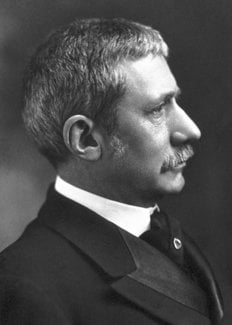
Elihu Root (February 15, 1845-February 7, 1937), who became one of the most brilliant administrators in American history, was born in Clinton, New York, son of a professor of mathematics at Hamilton College. Perhaps it was inevitable that the father and Elihu’s elder brother, who was also a mathematician, should be nicknamed «Cube» and «Square». At Hamilton College, Elihu was graduated first in his class in 1864 at the age of nineteen. He taught school for one year, was graduated from the Law School of New York University in 1867, founded a law firm after one year of practice, and by the age of thirty had established himself as a prominent lawyer specializing in corporate affairs. He became a wealthy man in the thirty or so years which he devoted to legal practice, acting as counsel to banks, railroads, and some of the great financiers of the day. His comprehensive grasp of legal principles, his formidable power of analysis, his creative genius in discovering solutions to problems, his disciplined attention to detail, and his skill in expression, whether written or oral, earned him recognition from his colleagues as the leader of the American bar.
Although he had participated in local Republican politics in New York, he was little known as a political figure when, in 1899, President McKinley invited him to become his secretary of war. Since the nation was just emerging from the Spanish-American War, it seemed an unlikely appointment. But President McKinley, with remarkable insight, said that he needed a lawyer in the post, not a military man, and Root accepted the call of what he called «the greatest of all our clients, the government of our country»1.
As secretary of war from 1899 to 1904, Root performed the services that moved Henry L. Stimson, himself a later secretary of war, to say that «no such intelligent, constructive, and vital force» had occupied that post in American history2. He reorganized the administrative system of the War Department, established new procedures for promotion, founded the War College, enlarged West Point, opened schools for special branches of the service, created a general staff, strengthened control over the National Guard, restored discipline within the department. He was most concerned, however, about the three dependencies acquired as a result of the war. He devised a plan for returning Cuba to the Cubans; wrote a democratic charter for the governance of the Philippines, designing it to insure free government, to protect local customs, and to bring eventual self-determination; and eliminated tariffs on Puerto Rican goods imported into the United States.
He returned to his private legal practice in 1904, but in 1905 at President Theodore Roosevelt‘s invitation, accepted the post of secretary of state. His record is impressive. He brought the consular service under Civil Service, thus removing it from the «spoils system»; maintained the «open door» policy in the Far East, a policy he had helped to formulate as secretary of war; negotiated the so-called «Gentlemen’s Agreement» with Japan which dealt with emigration of Japanese to America; strengthened amicable relations with South America in 1906 during an unprecedented diplomatic tour; sponsored the Central American Peace Conference held in Washington in 1907 which resulted in the creation of the Central American Court of Justice, an international tribunal for the judicial settlement of disputes; negotiated some forty reciprocal arbitration treaties; along with Lord Bryce, resolved current American-Canadian problems and instituted the Permanent American-Canadian Joint High Commission for the settlement of future problems.
A United States senator from 1909 to 1915, Elihu Root took an active role in settling the North Atlantic fisheries dispute, in opposing a bill which would have exempted U.S. shipping from paying tolls to use the Panama Canal while levying charges against other nations’ shipping, and in pressing for international arbitration.
In 1915 he declined candidacy for reelection to the Senate and even declined, at least publicly, nomination by the Republican Party for the presidency of the United States. Although seventy years of age, he continued to be active as an elder statesman. He opposed Woodrow Wilson‘s neutrality policy but supported him during the war; he accepted Wilson’s appointment as ambassador extraordinary to head a special diplomatic mission to Russia in 1917; on the 1919 Treaty of Versailles and the League of Nations he took a middle stance between Wilson on the one hand and the «irreconcilables» on the other; as a delegate to the Washington Naval Conference of 1921-1922, he took a leading role in drafting the Five-Power Treaty limiting naval armament.
Root dedicated a large portion of his life to the cause of international arbitration. He, more than any other, formulated the plan to create the Central American Court of Justice. In 1907 he instructed the American delegates to the Hague Conference to support the founding of a World Court; in 1920, at the request of the Council of the League of Nations, he served on a committee to devise plans for the Permanent Court of International Justice which was set up in 1921; in 1929 after intermittent discussion between the League and the United States concerning certain reservations the Senate had insisted upon in its 1926 ratification of the Protocol for U. S. participation in the court, Root, on his eighty-fourth birthday, left for Geneva where he convinced the delegates from fifty-five nations to accept a revised Protocol; he later appeared before the Senate Foreign Relations Committee to urge ratification, but the Senate failed to act at that time and eventually declined to ratify at all.
Root was the first president of the Carnegie Endowment for International Peace and helped to found its European counterpart. He believed that international law, along with its accompanying machinery, represented mankind’s best chance to achieve world peace, but like the hardheaded realist he was, he also believed that it would take much time, wisdom, patience, and toil to implement it effectively.
| Selected Bibliography |
| Addresses Made in Honor of Elihu Root. New York, The Century Association, 1937. The introductory address by Royal Cortissoz deals mainly with Root’s relations to the arts; that by Henry L. Stimson with an assessment of Root’s career as secretary of war and secretary of state; that by Nicholas Murray Butler with the story of the 1916 Republican convention in Chicago. |
| Jessup, Philip C., Elihu Root. Vol. I, 1845-1909; Vol. II, 1905-1937. New York, Dodd, Mead, 1938. |
| Leopold, Richard W., Elihu Root and the Conservative Tradition. Boston, Little, Brown, 1954. |
| Root, Elihu. The papers of Elihu Root are held by the Library of Congress, Washington, D.C. |
|
Root, Elihu. The eight volumes of Root’s addresses and writings collected and edited by Robert Bacon and James B. Scott and published by the Harvard University Press between 1916 and 1925 are titled as follows:
|
| Scott, James B., «Elihu Root», in American Secretaries of State and Their Diplomacy, ed. by S.F. Bemis. Vol. IX, pp. 193-282. New York, Knopf, 1929. |
1. Quoted by Henry L. Stimson in Addresses Made in Honor of Elihu Root, p. 25.
This autobiography/biography was written at the time of the award and first published in the book series Les Prix Nobel. It was later edited and republished in Nobel Lectures. To cite this document, always state the source as shown above.
The Nobel Foundation's copyright has expired.Nobel Prizes and laureates
Six prizes were awarded for achievements that have conferred the greatest benefit to humankind. The 14 laureates' work and discoveries range from quantum tunnelling to promoting democratic rights.
See them all presented here.