Hjalmar Branting
Biographical
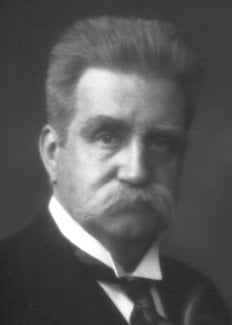
The «father» of socialism in Sweden, Karl Hjalmar Branting (November 23, 1860-February 24, 1925) was born in Stockholm, the only child of Professor Lars Branting, one of the principal developers of the Swedish school of gymnastics. He was educated at the exclusive Beskow School in Stockholm, passing his matriculation examination at the age of seventeen, with a distinguished record in mathematics and Latin. After studying at the University of Uppsala for the next five years, concentrating on mathematics and astronomy, he accepted a position in 1882 as an assistant to the director of the Stockholm Observatory.
But Branting was a social scientist as well as a natural scientist. By 1880 he had adopted liberal views, which had their origin in his studies and observations on social and cultural questions. In 1881 when he learned that the Stockholm Workers Institute, which provided lectures and courses of study for workingmen, had been denied financial support by the city, he contributed from his personal funds the amount necessary to keep the Institute open. For Branting the year of 1883 proved decisive. In Paris he heard the lectures of the French Socialist, Paul Lafargue; in Zurich he learned about German socialist doctrine from Eduard Bernstein, who was publishing Der Sozial-Demokrat while in self-imposed exile; wherever he went – including Russia – he tested his thinking in discussion with workingmen and social philosophers.
Giving up his scientific career in 1884, Branting joined the staff of the radical Stockholm paper Tiden [The Times] as foreign editor. He became editor-in-chief the next year but, like his predecessor in that office1, was unable to solve the financial crises which periodically afflicted the paper. Upon its demise in 1886, Branting became chief editor of another socialist newspaper, Socialdemokraten, making this journal, in the course of his thirty-one years’ association with it, a textbook for the education of the workers and a potent force in Swedish politics. Radical though Branting was, he taught evolution rather than revolution, believing that true democracy could not exist without the active involvement of the workingmen and that any socialist philosophy not based on the democratic concept was a mockery. Branting was not a utopian doctrinaire then or afterwards. Thirty years later, in 1918 for instance, he contended that socialism was an applied theory of democratic development and that communism, on the contrary, was an oligarchy, an enemy of democracy and an enticement to economic disaster in its demand for destruction of proprietary rights.
Branting was not only the schoolmaster of the movement, he was also its recruiter and field marshal. He formed workingmen’s clubs, helped to organize unions, supported strikes, directed strategy. In demand as a speaker at innumerable meetings, he became one of the most skillful speakers in the land, noted for his logical argument, precision of style, blunt honesty, warmth of personality.
He was the directing genius behind the formation of the Social Democratic Labor Party in 1889, serving as its president from 1907 until his death. To advance the aspirations of the workingman, political action should, he believed, be enmeshed with industrial action, not superimposed upon it.
Elected to the Lower Chamber of the Parliament in 1896 from a workingmen’s constituency in Stockholm, Branting was the sole Social Democrat to hold a seat until 1902. In Parliament he gave visibility to the rights of workers, decried legislation against unions, pled for universal suffrage, supported national defence, and advocated peaceful solution of the crisis between Sweden and Norway over the dissolution of the union in 1905. Meanwhile, the power of his party grew: in 1902 there were four Social Democrats out of a total membership of 230 in the Lower Chamber of the Parliament; in 1903, thirteen; in 1908, thirty-four; in 1911, sixty-four; in 1914, seventy-two; in 1921, a hundred and ten.
By 1917, the Social Democrats were a strong third party in what had traditionally been a two-party system. In that year the Social Democrats joined the Liberals in a coalition government, with Branting as minister of finance. The coalition sponsored the constitutional reform of 1919, extending the franchise to all males (women receiving the vote in 1921 under Branting’s government), but it was dissolved when the Liberals refused to support the Social Democrats’ demands for tax reform, unemployment insurance, and nationalization.
Branting then formed his first government, depending upon Liberal support since he did not command a majority in Parliament. When the power of the Liberal Party appeared to be diminishing, he dissolved the Parliament in October of 1920, but the ensuing elections went against him. He returned to the prime ministry in October, 1921, retaining the foreign affairs portfolio and departed in April, 1923, when faced by a combination of the Liberals and Conservatives. When the elections of 1924 gave the Social Democrats a majority over each of the other two parties, Branting, for the third time, became prime minister, resigning in January, 1925, when his health failed.
Branting’s lifelong interest in international affairs was intensified during and after World War I. He supported the Allied position but insisted upon Swedish neutrality, tried to preserve the international solidarity of the labor-union movement, served as Sweden’s representative to the Paris Peace Conference in 1919, advocated adoption of the Covenant of the League of Nations. He led the successful movement to bring Sweden into the League, served as the Swedish delegate to the League, and was named to the Council of the League in 1923. Branting was chairman of the Assembly’s Committee on Disarmament in 1920-1921 and a member of the Council’s Committee on Disarmament in 1924; he participated in the settlement of the Greek-Italian conflict of 1923 and served as «rapporteur» in the Mosul dispute between Britain and Turkey in 1924; he was involved in the drafting of the Geneva Protocol, a proposed international security system requiring arbitration between hostile nations.
Branting was a «constitutional pacifist». He believed that security should be based on functional principles of justice, that truth in dispute could best be found through arbitration by a judicial body, not through survival in trial by combat.
By the age of sixty-five, through his continuous and exacting labors, he had worn out a powerful physique bequeathed to him by heredity and strengthened by the discipline of gymnastics. He died in February, 1925, and was buried in Stockholm.
Selected Bibliography
Alsterdal, Alvar, och Ove Sandell, red., Hjalmar Branting: Socialism och demokrati. Stockholm, Prisma, 1970.
Branting, Anna (Jäderin), Min långa resa: Boken om Hjalmar och mig. Stockholm, Medén, 1945.
Branting, Hjalmar, Demokratins genombrott. Stockholm, Tidens Förlag, 1919.
Branting, Hjalmar, Den politiska krisen: Dess innebörd, uppkomst och första förlopp. Stockholm, Tidens Förlag, 1914.
Branting, Hjalmar, Socialdemokratins århundrade. Första bandet: Frankrike, England. Andra bandet: Tyskland, Sverige, Danmark, Norge. Stockholm, Aktiebolaget Ljus, 1904, 1906.
Branting, Hjalmar, Tal och skrifter i urval, utgåvas i 11 delar. Z. Höglund [o.fl.], red. Stockholm, Tidens Förlag, 1927-1930.
Branting, Hjalmar, Varför det var rätt att antaga pensionförsäkringslagen. Stockholm, Tidens Förlag, 1913.
Branting, Hjalmar, och Per A. Hansson, Demokratisk linje: Tal och artiklar. Stockholm, Tidens Förlag, 1948.
Hjalmar Branting: Statsmannen och människan. Stockholm, Morgon-Tidningen, 1950.
Höglund, Zeth, Hjalmar Branting. Stockholm, Folket i bilds Förlag, 1949. A condensation of the two-volume biography by the same author.
Höglund, Zeth, Hjalmar Branting och hans livsgärning. 2 band. Stockholm, Tidens Förlag, 1928-1929.
Lindgren, John, Från Per Götrek till Per Albin: Några drag ur den svenska socialdemokratins historia. Stockholm, Bonniers, 1946.
MacDonald, Ramsay, «Ebert and Branting: Helmsmen in Europe’s Storm and Stress Period», in Living Age, 325 (June 6, 1925) 487-495. Reprinted from Nineteenth Century and After, 97 (April, 1925) 465-475.
Magnusson, Gerhard, Socialdemokratin i Sverige. Första bandet: I brytningstider. Andra bandet: I kamptider. Tredje bandet: I ansvarstider. Stockholm, Norstedt, 1920-1924.
Nerman, Ture, Hjalmar Branting: Fritänkaren. Stockholm, Tidens Förlag, 1960.
Nerman, Ture, Hjalmar Branting: Kulturpublicisten. Stockholm, Tidens Förlag, 1958.
Vallentin, Hugo, «Hjalmar Branting: A Character Sketch of the Swedish Socialist Leader», in Fortnightly Review, 108 (July, 1917) 62-68.
1. K.P. Arnoldson, co-recipient of the Nobel Peace Prize for 1908.
This autobiography/biography was written at the time of the award and first published in the book series Les Prix Nobel. It was later edited and republished in Nobel Lectures. To cite this document, always state the source as shown above.
The Nobel Foundation's copyright has expired.Nobel Prizes and laureates
Six prizes were awarded for achievements that have conferred the greatest benefit to humankind. The 14 laureates' work and discoveries range from quantum tunnelling to promoting democratic rights.
See them all presented here.