Charles G. Dawes
Biographical
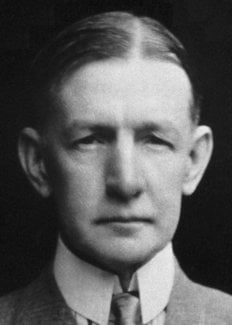
Charles Gates Dawes (August 27, 1865-April 23, 1951) pursued two careers during his lifetime, one in business and finance, the other in public service. He was at the height of his fame in both in 1926 when he was awarded the Nobel Peace Prize for 1925. He was the vice-president of the United States; he had achieved worldwide recognition for his report on German reparations in 1924; he had a secure reputation as a financier.
By ancestry he was destined for a life of such duality. His father had distinguished himself in the Civil War, achieving the rank of brevet brigadier general; an uncle had given his life. Four generations earlier, William Dawes had ridden with Paul Revere on April 18, 1775, to warn the Massachusetts colonists of the British advance which signalized the opening of the American Revolution; and seven generations earlier in 1628 the first William Dawes had been among the Puritans who came to America. Financial acumen was just as natural a heritage as active patriotism. Dawes’s father owned and managed a lumber company in Marietta, Ohio; an uncle was a prosperous banker.
Since Charles Dawes’s mother had graduated from Marietta College and his father was on its Board of Trustees, it was almost inevitable that he would enroll there. He received his bachelor’s degree in 1884 at the age of nineteen, studied for two years in the Law School of the University of Cincinnati, and returned to Marietta to earn a master’s degree.
In 1887 he moved to Lincoln, Nebraska, more to participate in the advantages of a fast-growing economy than to engage in the practice of law. In the seven years he lived there he earned a reputation as an intelligent, ingenious, persuasive, alert businessman. He controlled a city block of business offices, controlled a meat packing company, acted as director of a bank, and was an investor in land and in bank stocks. He laid the foundation for his large personal fortune in 1894, however, when he purchased control of a plant manufacturing artificial gas in La Crosse, Wisconsin, and of another plant immediately to the north of Chicago. Eventually, he and his brothers controlled twenty-eight gas and electric plants in ten states. To be near his main business office, he made his home in Evanston, a suburb to the north of Chicago, residing there until his death.
In 1902, turning over to his brothers the management of the utilities, he entered the third phase of his business career, that of banking. He founded and became president of the Central Trust Company of Illinois, often referred to as the «Dawes Bank», and spent virtually full time in its management until 1917.
The comptrollership of the currency was Dawes’s first official governmental position. President William McKinley, for whom he had acted as a fund raiser in the 1896 campaign, had appointed him in 1898, and in 1901 promised to support him as a candidate for the Senate from Illinois. When McKinley was assassinated, Dawes, shorn of presidential support, withdrew his candidacy.
In 1917 Dawes received his commission as a major in the army and twenty-six months later was discharged as a brigadier general. While on General Pershing’s staff he integrated the system of supply procurement and distribution for the entire American Expeditionary Force and later performed an analogous service for the Allies by devising an inter-Allied purchasing board, as well as a unified distribution authority. In 1919, despite the opposition raised by his own Republican Party, he strongly urged the Congress to accept the Treaty of Versailles and the League of Nations.
In 1920, appointed to the newly inaugurated position of Director of the Budget, Dawes applied his conceptions of efficiency and unity to the reform of budgetary procedures in the United States government. His most important reform resulted from his insistence that each department of the government prepare a true budget projecting future expenditures and stay within it. It is estimated that this reform and others, notably the unification of purchasing, saved the government about two billion dollars in the first year.
The League of Nations late in 1923 invited Dawes to chair a committee to deal with the question of German reparations. The «Dawes Report», submitted in April, 1924, provided facts on Germany’s budget and resources, outlined measures needed to stabilize the currency, and suggested a schedule of payments on a sliding scale. For his masterly handling of this crucial international problem, he was awarded the Nobel Peace Prize; he donated the money to the endowment of the newly established Walter Hines Page1 School of International Relations at Johns Hopkins University.
From 1924 to 1932, Dawes devoted his entire attention to public service. He was elected to the vice-presidency of the United States in 1924, serving in Office from 1925 to 1929. In 1929, when the Dominican Republic requested advice on improving the financial operation of its government, Dawes headed a commission whose extensive recommendations for reform were later adopted. From June of 1929 to January of 1932, Dawes was the U.S. ambassador to Great Britain. In 1930 he was a delegate to the London Naval Conference; in 1932 he accepted the chairmanship of the American delegation to the Disarmament Conference in Geneva but resigned to accept the chairmanship of the Reconstruction Finance Corporation, a governmental agency empowered to lend money to banks, railroads, and other businesses in effort to prevent total economic collapse during the depression.
Dawes was a disciplined and productive man. He led a full life in the commercial and political world until the age of sixty-seven; he wrote nine books; he discharged countless civic duties. Even in music he excelled. He performed on the flute and piano; composed a melody that Fritz Kreisler, the noted violinist, often played as an encore; combined his interest in music and his acumen in business to establish grand opera in Chicago. Withal he found time for family life. He admired his father and uncle; he brought his brothers into his business enterprises; and he was devoted to his wife and to his son and daughter, suffering intensely when his son was drowned in Lake Geneva, Wisconsin, while on summer vacation from Princeton University.
Dawes was a forthright man given to forthright talk. His nickname, «Hell and Maria» Dawes, came from some words uttered before a congressional committee investigating charges of waste and extravagance in the conduct of World War I. When a member of the committee asked Dawes if it was true that excessive prices were paid for mules in France, he shouted «Helen Maria, I’d have paid horse prices for sheep if the sheep could have pulled artillery to the front!»2
He died of a coronary thrombosis at his Evanston home on April 23, 1951.
| Selected Bibliography |
| Bliven, Bruce, «Dawes: Supersalesman», in The New Republic, 53 (1928) 263-267. A brief but excellent contemporaneous account of Dawes’s career. |
| Dawes, Charles Gates. The Dawes papers are deposited in the Library of Northwestern University, Evanston, Ill. His books are listed here chronologically by date of publication. |
| Dawes, Charles Gates, The Banking System of the United States and Its Relation to the Money and Business of the Country. Chicago, Rand McNally, 1894. |
| Dawes, Charles Gates, Essays and Speeches. New York, Houghton, 1915. |
| Dawes, Charles Gates, Journal of the Great War, 2 vols. New York, Houghton, 1921. |
| Dawes, Charles Gates, The First Year of the Budget of the United States. New York, Harper, 1923. |
| Dawes, Charles Gates, Notes as Vice President, 1928-1929. Boston, Little, Brown, 1935. |
| Dawes, Charles Gates, How Long Prosperity? New York, Marquis, 1937. |
| Dawes, Charles Gates, Journal as Ambassador to Great Britain. New York, Macmillan, 1939. |
| Dawes, Charles Gates, A Journal of Reparations. New York, Macmillan, 1939. |
| Dawes, Charles Gates, A Journal of the McKinley Years, ed. by Bascom N. Timmons. La Grange, Ill., Tower, 1950. |
| Leach, Paul Roscoe, That Man Dawes. Chicago, Reilly and Lee, 1930. |
| National Cyclopedia of American Biography. |
| Obituary, the New York Times (April 24, 1951). |
| Sherman, Richard Garrett, Charles G. Dawes: An Entrepreneurial Biography, 1865-1951. Unpublished Ph.D. dissertation. Iowa City, Iowa, University of Iowa, 1960. |
| Timmons, Bascom Nolly, Portrait of an American: Charles G. Dawes. New York, Holt, 1953. |
1. W.H. Page (1855-1918), American writer, editor, and diplomat; cofounder of Doubleday, Page & Co., a publishing firm; ambassador to Great Britain (1913-1918).
2. Apparently «Helen Maria» was an expletive in common usage in Nebraska. The newspapers printed it as «Hell and Maria», and that form stuck. Timmons tells the story in detail in Portrait of an American, pp. 193-198; Dawes also tells the story but leaves out the crucial phrase in Notes as Vice President, pp. 9-13.
This autobiography/biography was written at the time of the award and first published in the book series Les Prix Nobel. It was later edited and republished in Nobel Lectures. To cite this document, always state the source as shown above.
The Nobel Foundation's copyright has expired.Nobel Prizes and laureates
Six prizes were awarded for achievements that have conferred the greatest benefit to humankind. The 14 laureates' work and discoveries range from quantum tunnelling to promoting democratic rights.
See them all presented here.

