Arthur Henderson
Biographical
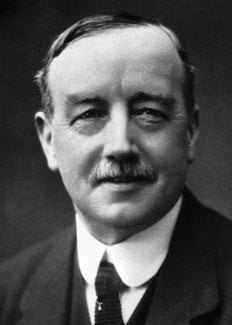
Arthur Henderson (September 13, 1863-October 20, 1935) was born in Glasgow, the son of David Henderson, a manual worker. When his father died in 1872, leaving the family in poverty, Arthur left school to work in a photographer’s shop. Upon his mother’s remarriage the family moved to Newcastle-upon-Tyne, where Arthur returned to school for three years. Aged twelve, he became an apprentice at the Robert Stephenson and Sons’ General Foundry Works. The dinner hour in the foundry, with its lively discussions, became his classroom and the newspapers his textbooks. Having joined the Ironfounders’ Union at the age of eighteen when he achieved journeyman status, he was elected within a short time secretary of the Newcastle lodge and for the remainder of his life held office continuously in his union at the local, district, or national level.
In the course of his work in the Methodist church, which he had joined as a young man, Henderson met Eleanor Watson and married her in 1888. They had a daughter and three sons. The eldest of the three sons, all of whom served in the armed forces in World War I, was killed in action; the other two became the father’s colleagues in the House of Commons in the last decade or so of his life.
The skill in speaking that he developed at the meetings of the Tyneside Debating Society and in his work as a lay preacher, helped to launch him on a political career begun with his election to the post of town councillor in 1892. In the same year he was chosen by his union to be their district delegate, a full-time salaried position. In 1896 he moved his family to Darlington; there, he was elected to the Durham County Council and in 1903 became the first Labor mayor of Darlington.
From 1900 to the close of his life Henderson put his talent for organizing at the disposal of Labor. He attended the London conference which set up the Labor Representation Committee in 1900, won election to Parliament in 1903 under the sponsorship of that committee, chaired the conference in 1906 which formed the Labor Party, acted as its secretary from 1911 to 1934, served several times as the chairman of the party’s executive committee, in 1918 took the lead in revising the party’s constitution so as to open its membership to those who by conviction, not necessarily vocation, wanted to join the party, and created a political machinery which made the party a power in the political life of the nation.
Henderson himself was almost continuously in Parliament after 1903, yet his electoral career was scarcely a smooth one, for in ten tries at the polls in general elections he lost five and won five but regained a seat after each of the losses by winning by-elections. Henderson was chairman of the parliamentary Labor Party, chief whip three times, president of the Board of Education (1915-1916) and paymaster-general (1916) in Asquith’s government, and in Lloyd George’s government a minister without portfolio, acting primarily as an adviser on labor questions.
As World War I drew to a close, Henderson’s thinking took on an international dimension. In 1917 he went to Russia as an official observer for the British government; in 1918 he broke with Lloyd George over his refusal to send delegates to a proposed international conference of socialists, a conference which, as it turned out, was never convened. In the same year he initiated the call for a conference at Bern, with delegates from the defeated and neutral nations joining those of the victorious, to formulate recommendations to send to Versailles where the representatives of the Allies were assembling to draw up the terms of the peace. In 1923 he was chairman of the Labor and Socialist International at Hamburg. In 1924 he was home secretary in MacDonald’s cabinet, but spent most of his energy on two international problems: the implementation of the Dawes Plan for German reparations and the drafting of the Geneva Protocol on the ultimate settlement of international disputes by arbitration.
With this background, he was, therefore, quite prepared to accept the office of foreign secretary when MacDonald offered it to him in 1929 upon forming his second government. In his two years in office he brought about Britain’s resumption of diplomatic relations with Russia, severed since 1917, maneuvered acceptance of the Young Plan for German reparations by the creditor nations and Germany, arranged with Briand for the evacuation of French troops from the Rhineland prior to the date stipulated in the Versailles Treaty, furthered the cause of Egyptian independence, actually achieved in 1936, and attended the entire sessions of the Tenth and Eleventh Assemblies of the League of Nations.
Henderson became the embodiment of the League’s disarmament effort. In January, 1931, he prodded the Council into completing preparations for the calling of a Disarmament Conference; in May of that year, he was unanimously approved as president of the conference; on February 2, 1932, he presided over the opening session. Despite his determined and persistent work, the conference failed. The world was stricken with an economic depression; Germany, under Hitler, withdrew from the conference in October, 1933; Henderson was barely able to hold the conference together in 1934, but even as late as December of that year at the Nobel ceremonies in Oslo, he optimistically insisted that the conference was still very much alive. The failure of the conference foreshadowed World War II, but his biographer, Mary A. Hamilton, states1, «If any man is clear of responsibility, it is Arthur Henderson.»
Henderson was a strong man. His powerful physical presence was the outer counterpart of his inner moral integrity. He had the qualities, Clement Attlee remarked in his eulogy on Henderson in the House of Commons2, needed «in a working ironworker to rise to preside over the Assembly of the nations».
| Selected Bibliography |
| Carlton, David, MacDonald versus Henderson: The Foreign Policy of the Second Labour Government. London, Macmillan, 1970. |
| Hamilton, Mary Agnes, Arthur Henderson: A Biography. London, Heineman, 1938. |
| Hamilton, Mary Agnes, «Arthur Henderson», in Dictionary of National Biography, 1937-1940. |
| Henderson, Arthur, The Aims of Labour. London, Headley, 1917. |
| Henderson, Arthur, Conference for the Reduction and Limitation of Armaments: Preliminary Report on the Work of the Conference. Geneva, 1936. |
| Henderson, Arthur, Consolidating World Peace: The Burge Memorial Lecture for the Year 1931. Oxford, Clarendon Press, 1931. |
| Henderson, Arthur, Labour’s Foreign Policy. London, Labour Party, 1933. |
| Henderson, Arthur, Labour’s Way to Peace. London, Methuen, 1935. |
| Jenkins, Edwin A., From Foundry to Foreign Office: The Romantic Life-Story of the Rt Hon. Arthur Henderson, M.P. London, Grayson & Grayson, 1933. |
| Obituary, The (London) Times (October 21, 1935). |
1. Arthur Henderson: A Biography, p. 444.
2. The (London) Times, (October 23, 1935) 9.
This autobiography/biography was written at the time of the award and first published in the book series Les Prix Nobel. It was later edited and republished in Nobel Lectures. To cite this document, always state the source as shown above.
The Nobel Foundation's copyright has expired.Nobel Prizes and laureates
Six prizes were awarded for achievements that have conferred the greatest benefit to humankind. The 14 laureates' work and discoveries range from quantum tunnelling to promoting democratic rights.
See them all presented here.