George C. Marshall
Biographical
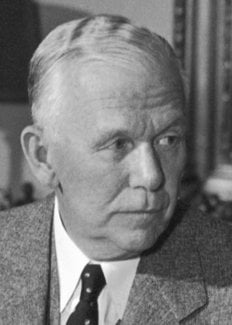
George Catlett Marshall (December 31, 1880-October 16, 1959), America’s foremost soldier during World War II, served as chief of staff from 1939 to 1945, building and directing the largest army in history. A diplomat, he acted as secretary of state from 1947 to 1949, formulating the «Marshall Plan», an unprecedented program of economic and military aid to foreign nations.
Marshall’s father owned a prosperous coal business in Pennsylvania, but the boy, deciding to become a soldier, enrolled at the Virginia Military Institute from which he was graduated in 1901 as senior first captain of the Corps of Cadets. After serving in posts in the Philippines and the United States, Marshall was graduated with honors from the Infantry-Cavalry School at Fort Leavenworth in 1907 and from the Army Staff College in 1908. The young officer distinguished himself in a variety of posts in the next nine years, earning an appointment to the General Staff in World War I and sailing to France with the First Division. He achieved fame and promotion for his staff work in the battles of Cantigny, Aisne-Marne, St. Mihiel, and Meuse-Argonne. After acting as aide-de-camp to General Pershing from 1919 to 1924, Marshall served in China from 1924 to 1927, and then successively as instructor in the Army War College in 1927, as assistant commandant of the Infantry School from 1927 to 1932, as commander of the Eighth Infantry in 1933, as senior instructor to the Illinois National Guard from 1933 to 1936, and as commander, with the rank of brigadier general, of the Fifth Infantry Brigade from 1936 to 1938. In July, 1938, Marshall accepted a post with the General Staff in Washington, D. C., and in September, 1939, was named chief of staff, with the rank of general, by President Roosevelt. He became general of the army in 1944, the year in which Congress created that five-star rank.
In his position as chief of staff, Marshall urged military readiness prior to the attack on Pearl Harbor in 1941, later became responsible for the building, supplying, and, in part, the deploying of over eight million soldiers. From 1941 he was a member of the policy committee that supervised the atomic studies engaged in by American and British scientists. The war over, Marshall resigned in November, 1945.
But Marshall could not resign from public service; his military career ended, he took up a diplomatic career. He had been associated with diplomatic events while chief of staff, for he participated in the conference on the Atlantic Charter (1941-1942), and in those at Casablanca (1943), Quebec (1943), Cairo-Teheran (1943), Yalta (1945), Potsdam (1945), and in many others of lesser import. In late 1945 and in 1946, he represented President Truman on a special mission to China, then torn by civil war; in January, 1947, he accepted the Cabinet position of secretary of state, holding it for two years. In the spring of 1947 he outlined in a speech at Harvard University the plan of economic aid which history has named the «Marshall Plan».
For one year during the Korean War General Marshall was secretary of defence, a civilian post in the U. S. Cabinet. Having resigned from this post in September, 1951, three months before his seventy-first birthday, he retired from public service, thereafter performing those ceremonial duties the public comes to expect of its famous men.
Selected Bibliography
Acheson, Dean, «General of the Army George Catlett Marshall», in Sketches from Life of Men I Have Known, pp. 147-166. New York, Harper, 1961.
Frye, William, Marshall: Citizen Soldier. Indianapolis, Bobbs-Merrill, 1947.
Jouvenel, B., L’Amérique en Europe: Le Plan Marshall et la coopération intercontinentale. Paris, 1948.
Marshall, George C., Report on the Army, July 1, 1939, to June 30, 1941: Biennial Report of General George C. Marshall. Washington, The Infantry Journal, 1941.
Marshall, George C., Selected Speeches and Statements of General of the Army George C. Marshall, ed. by H.A. De Weerd. Washington, The Infantry Journal, 1945.
Marshall, George C., The Winning of the War in Europe and the Pacific: Biennial Report of the Chief of Staff of the United States Army, July 1, 1943, to June 30, 1945, to the Secretary of War. New York, Simon & Schuster, 1945.
Marshall, Katherine Tupper, Together: Annals of an Army Wife. New York, Tupper & Love, 1946.
Payne, Robert, The Marshall Story. New York, Prentice-Hall, 1951. Contains a select bibliography.
Pogue, Forrest C., George C. Marshall: Education of a General. New York, Viking Press, 1963. Contains an excellent bibliography.
Pogue, Forrest C., George C. Marshall: Ordeal and Hope. New York, Viking Press, 1968.
Sherwood, Robert E., Roosevelt and Hopkins: An Intimate History. New York, Harper, 1950.
United States Army in the World War 1917-1919: Military Operations of the American Expeditionary Forces. Washington, Historical Division, Department of the Army, 1948. Volumes 8 and 9 describe the battles of St. Mihiel and Meuse-Argonne.
This autobiography/biography was written at the time of the award and first published in the book series Les Prix Nobel. It was later edited and republished in Nobel Lectures. To cite this document, always state the source as shown above.
Nobel Prizes and laureates
Six prizes were awarded for achievements that have conferred the greatest benefit to humankind. The 14 laureates' work and discoveries range from quantum tunnelling to promoting democratic rights.
See them all presented here.