Elie Wiesel
Biographical
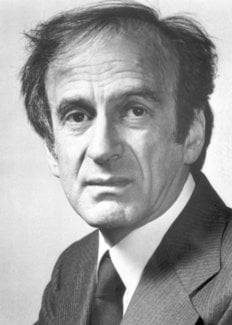
Elie Wiesel was born in 1928 in the town of Sighet, now part of Romania. During World War II, he, with his family and other Jews from the area, were deported to the German concentration and extermination camps, where his parents and little sister perished. Wiesel and his two older sisters survived. Liberated from Buchenwald in 1945 by advancing Allied troops, he was taken to Paris where he studied at the Sorbonne and worked as a journalist.
In 1958, he published his first book, La Nuit, a memoir of his experiences in the concentration camps. He has since authored nearly thirty1 books some of which use these events as their basic material. In his many lectures, Wiesel has concerned himself with the situation of the Jews and other groups who have suffered persecution and death because of their religion, race or national origin. He has been outspoken on the plight of Soviet Jewry, on Ethiopian Jewry and on behalf of the State of Israel today2.
Wiesel has made his home in New York City, and is now a United States citizen. He has been a visiting scholar at Yale University, a Distinguished Professor of Judaic Studies at the City College of New York, and since 1976 has been Andrew W. Mellon Professor in the Humanities at Boston University where he teaches “Literature of Memory.” Chairman of the United States Holocaust Memorial Council from 1980 – 1986, Wiesel serves on numerous boards of trustees and advisors.
1. forty (updated by Laureate – August 99)
2. and of the victims in Bosnia and Kosovo (updated by Laureate – August 99)
This autobiography/biography was written at the time of the award and later published in the book series Les Prix Nobel/ Nobel Lectures/The Nobel Prizes. The information is sometimes updated with an addendum submitted by the Laureate.
| Selected Bibliography |
| By Elie Wiesel |
| Against Silence: The Voice and Vision of Elie Wiesel. Ed., Irving Abrahamson. 3 vols. New York: Schocken, 1984. |
| All Rivers Run to the Sea: Memoirs. New York: Knopf, 1995. |
| From the Kingdom of Silence. New York: Summit, 1984. (Reminiscences, including text of Nobel speeches.) |
| The Night Trilogy: Night, Dawn, The Accident. New York: Hill & Wang, 1987. (Autobiographical novels.) |
| Other Sources |
| Brown, Robert McAfee, Elie Wiesel: Messenger to all Humanity. South Bend, Ind.: University of Notre Dame Press, 1984. |
| Fine, Ellen S., Legacy of Night: The Literary University of Elie Wiesel. Albany, NY State University of New York Press, 1982. |
This autobiography/biography was written at the time of the award and first published in the book series Les Prix Nobel. It was later edited and republished in Nobel Lectures. To cite this document, always state the source as shown above.
Elie Wiesel died on 2 July 2016.
Nobel Prizes and laureates
Six prizes were awarded for achievements that have conferred the greatest benefit to humankind. The 14 laureates' work and discoveries range from quantum tunnelling to promoting democratic rights.
See them all presented here.