The 14th Dalai Lama
Biographical
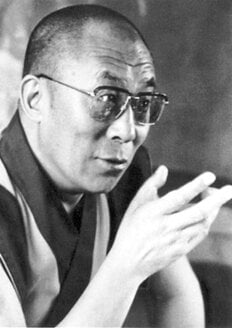
His Holiness the XIVth Dalai Lama, Tenzin Gyatso, is the spiritual and temporal leader of the Tibetan people. He was born in a small village called Taktser in northeastern Tibet. Born to a peasant family, His Holiness was recognized at the age of two, in accordance with Tibetan tradition, as the reincarnation of his predecessor the 13th Dalai Lama. The Dalai Lamas are the manifestations of the Bodhisattva of Compassion, who chose to reincarnate to serve the people. Dalai Lama means Ocean of Wisdom. Tibetans normally refer to His Holiness as Yeshin Norbu, the Wish-fulfilling Gem, or simply, Kundun, meaning The Presence.
Education in Tibet
He began his education at the age of six and completed the Geshe Lharampa Degree (Doctorate of Buddhist Philosophy) when he was 25. At 24, he took the preliminary examination at each of the three monastic universities: Drepung, Sera and Ganden. The final examination was held in the Jokhang, Lhasa, during the annual Monlam Festival of Prayer, held in the first month of every year. In the morning he was examined by 30 scholars on logic. In the afternoon, he debated with 15 scholars on the subject of the Middle Path, and in the evening, 35 scholars tested his knowledge of the canon of monastic discipline and the study of metaphysics. His Holiness passed the examinations with honours, conducted before a vast audience of monk scholars.
Leadership Responsibilities
In 1950, at 16, His Holiness was called upon to assume full political power as Head of State and Government when Tibet was threatened by the might of China. In 1954 he went to Peking to talk with Mao Tse-Tung and other Chinese leaders, including Chou En-Lai and Deng Xiaoping. In 1956, while visiting India to attend the 2500th Buddha Jayanti, he had a series of meetings with Prime Minister Nehru and Premier Chou about deteriorating conditions in Tibet. In 1959 he was forced into exile in India after the Chinese military occupation of Tibet. Since 1960 he has resided in Dharamsala, aptly known as “Little Lhasa”, the seat of the Tibetan Government-in-Exile.
In the early years of exile, His Holiness appealed to the United Nations on the question of Tibet, resulting in three resolutions adopted by the General Assembly in 1959, 1961 and 1965. In 1963, His Holiness promulgated a draft constitution for Tibet which assures a democratic form of government. In the last two decades, His Holiness has set up educational, cultural and religious institutions which have made major contributions towards the preservation of the Tibetan identity and its rich heritage. He has given many teachings and initiations, including the rare Kalachakra Initiation, which he has conducted more than any of his predecessors.
His Holiness continues to present new initiatives to resolve the Tibetan issues. At the Congressional Human Rights Caucus in 1987 he proposed a Five-Point Peace Plan as a first step towards resolving the future status of Tibet. This plan calls for the designation of Tibet as a zone of peace, an end to the massive transfer of ethnic Chinese into Tibet, restoration of fundamental human rights and democratic freedoms and the abandonment of China’s use of Tibet for nuclear weapons production and the dumping of nuclear waste, as well as urging “earnest negotiations” on the future of Tibet and relations between the Tibetan and Chinese people. In Strasbourg, France, on June 15, 1988, he elaborated on this Five-Point Peace Plan and proposed the creation of a self-governing democratic Tibet, “in association with the People’s Republic of China.” In his address, the Dalai Lama said that this represented “the most realistic means by which to re-establish Tibet’s separate identity and restore the fundamental rights of the Tibetan people while accommodating China’s own interests.” His Holiness emphasized that “whatever the outcome of the negotiations with the Chinese may be, the Tibetan people themselves must be the ultimate deciding authority.”
Contact with the West
Unlike his predecessors, His Holiness has met and talked with many Westerners and has visited the United States, Canada, Western Europe, the United Kingdom, the Soviet Union, Mongolia, Greece, Japan, Thailand, Malaysia, Singapore, Indonesia, Nepal, Costa Rica, Mexico, the Vatican, China and Australia. He has met with religious leaders from all these countries.
His Holiness met with the late Pope Paul VI at the Vatican in 1973, and with His Holiness Pope John Paul II in 1980, 1982, 1986 and 1988. At a press conference in Rome, His Holiness the Dalai Lama outlined his hopes for the meeting with John Paul II: “We live in a period of great crisis, a period of troubling world developments. It is not possible to find peace in the soul without security and harmony between the people. For this reason, I look forward with faith and hope to my meeting with the Holy Father; to an exchange of ideas and feelings, and to his suggestions, so as to open the door to a progressive pacification between people.”.
In 1981, His Holiness talked with the Archbishop of Canterbury, Dr Robert Runcie, and with other leaders of the Anglican Church in London. He also met with leaders of the Roman Catholic and Jewish communities and spoke at an interfaith service in his honour by the World Congress of Faiths. His talk focused on the commonality of faiths and the need for unity among different religions: “I always believe that it is much better to have a variety of religions, a variety of philosophies, rather than one single religion or philosophy. This is necessary because of the different mental dispositions of each human being. Each religion has certain unique ideas or techniques, and learning about them can only enrich one’s own faith.”
Recognition by the West
Since his first visit to the west in the early 1970s, His Holiness’ reputation as a scholar and man of peace has grown steadily. In recent years, a number of western universities and institutions have conferred Peace Awards and honorary Doctorate Degrees upon His Holiness in recognition of his distinguished writings in Buddhist philosophy and of his distinguished leadership in the service of freedom and peace.
Universal Responsibility
During his travels abroad, His Holiness has spoken strongly for better understanding and respect among the different faiths of the world. Towards this end, His Holiness has made numerous appearances in interfaith services, imparting the message of universal responsibility, love, compassion and kindness. “The need for simple human-to-human relationships is becoming increasingly urgent . . . Today the world is smaller and more interdependent. One nation’s problems can no longer be solved by itself completely. Thus, without a sense of universal responsibility, our very survival becomes threatened. Basically, universal responsibility is feeling for other people’s suffering just as we feel our own. It is the realization that even our enemy is entirely motivated by the quest for happiness. We must recognize that all beings want the same thing that we want. This is the way to achieve a true understanding, unfettered by artificial consideration.”
| Selected Bibliography |
| By the Dalai Lama |
| Freedom in Exile. The Autobiography of the Dalai Lama. New York: Harper Collins, 1990. (The fullest account, written in English.) |
| My Land and My People. Memoirs of the Dalai Lama of Tibet. New York: McGraw-Hill, 1962, Reprinted, New York: Potala Corp., 1983, 1985. (His first account, translated from Tibetan, written with David Howarth, English writer, after escaping to India.) |
| Ocean of Wisdom. Guidelines for Living. Santa Fe, N.M.: Clear Light Publ., 1989. Reprinted, San Francisco: Harper & Row, 1990. (Includes Nobel acceptance speech.) |
| A Policy of Kindness. An Anthology of Writings by and about the Dalai Lama. Sidney Piburn, ed., Ithaca, NY Snow Lion Press, 1990. (Includes the official Nobel lecture and the informal lecture.) |
| Other Sources |
| Avedon, John F. In Exile from the Land of Snows. New York: Knopf, 1984. (Tibet, before and after the invasion, focusing on lives of individuals, based largely on interviews, including many with the Dalai Lama.) |
| Piburn, Sidney, ed., The Nobel Peace Prize and the Dalai Lama. Ithaca, NY Snow Lion Publ., 1990. (The Nobel speeches and statements.) |
This autobiography/biography was written at the time of the award and first published in the book series Les Prix Nobel. It was later edited and republished in Nobel Lectures. To cite this document, always state the source as shown above.
Nobel Prizes and laureates
Six prizes were awarded for achievements that have conferred the greatest benefit to humankind. The 14 laureates' work and discoveries range from quantum tunnelling to promoting democratic rights.
See them all presented here.