James Franck
Biographical
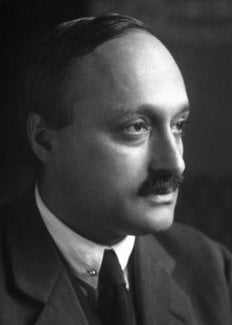
James Franck was born on August 26, 1882, in Hamburg, Germany. After attending the Wilhelm Gymnasium there, he studied mainly chemistry for a year at the University of Heidelberg, and then studied physics at the University of Berlin, where his principal tutors were Emil Warburg and Paul Drude. He received his Ph.D. at Berlin in 1906 under Warburg, and after a short period as an assistant in Frankfurt-am-Main, he returned to Berlin to become assistant to Heinrich Rubens. In 1911, he obtained the “venia legendi” for physics to lecture at the University of Berlin, and remained there until 1918 (with time out for the war in which he was awarded the Iron Cross, first class) as a member of the physics faculty having achieved the rank of associate professor.
After World War I, he was appointed member and Head of the Physics Division in the Kaiser Wilhelm Institute for Physical Chemistry at Berlin-Dahlem, which was at that time under the chairmanship of Fritz Haber. In 1920, Franck became Professor of Experimental Physics and Director of the Second Institute for Experimental Physics at the University of Göttingen. During the period 1920-1933, when Göttingen became an important center for quantum physics, Franck was closely cooperating with Max Born, who then headed the Institute for Theoretical Physics. It was in Göttingen that Franck revealed himself as a highly gifted tutor, gathering around him and inspiring a circle of students and collaborators (among them: Blackett, Condon, Kopfermann, Kroebel, Maier-Leibnitz, Oppenheimer, and Rabinovich, to mention some of them), who in later years were to be renowned in their own fields.
After the Nazi regime assumed power in Germany, Franck and his family moved to Baltimore, U.S.A., where he had been invited to lecture as Speyer Professor at Johns Hopkins University. He then went to Copenhagen, Denmark, as a guest professor for a year. In 1935, he returned to the United States as Professor of Physics at Johns Hopkins University, leaving there in 1938 to accept a professorship in physical chemistry at the University of Chicago. During World War II Franck served as Director of the Chemistry Division of The Metallurgical Laboratory at the University of Chicago, which was the center of the Manhattan District’s Project.
In 1947, at the age of 65, Franck was named professor emeritus at the University of Chicago, but he continued to work at the University as Head of the Photosynthesis Research Group until 1956.
While in Berlin Professor Franck’s main field of investigation was the kinetics of electrons, atoms, and molecules. His initial researches dealt with the conduction of electricity through gases (the mobility of ions in gases). Later, together with Hertz, he investigated the behaviour of free electrons in various gases – in particular the inelastic impacts of electrons upon atomswork which ultimately led to the experimental proof of some of the basic concepts of Bohr’s atomic theory, and for which they were awarded the Nobel Prize, for 1925. Franck’s other investigations, many of which were carried out with collaborators and students, were also dedicated to problems of atomic physics – those on the exchange of energy of excited atoms (impacts of the second type, photochemical researches), and optical problems connected with elementary processes during chemical reactions.
During his period at Göttingen most of his studies were dedicated to the fluorescence of gases and vapours. In 1925, he proposed a mechanism to explain his observations of the photochemical dissociation of iodine molecules. Electronic transitions from a normal to a higher vibrational state occur so rapidly, he suggested, that the position and momenta of the nuclei undergo no appreciable change in the process. This proposed mechanism was later expanded by E. U. Condon to a theory permitting the prediction of mostfavoured vibrational transitions in a band system, and the concept has since been known as the Franck-Condon principle.
Mention should be made of Professor Franck’s courage in following what was morally right. He was one of the first who openly demonstrated against the issue of racial laws in Germany, and he resigned from the University of Göttingen in 1933 as a personal protest against the Nazi regime under Adolf Hitler. Later, in his second homeland, his moral courage was again evident when in 1945 (two months before Hiroshima) he joined with a group of atomic scientists in preparing the so-called “Franck Report” to the War Department, urging an open demonstration of the atomic bomb in some uninhabited locality as an alternative to the military decision to use the weapon without warning in the war against Japan. This report, although failing to attain its main objective, still stands as a monument to the rejection by scientists of the use of science in works of destruction.
In addition to the Nobel Prize, Professor Franck received the 1951 Max Planck Medal of the German Physical Society, and he was honoured, in 1953, by the university town of Göttingen, which named him an honorary citizen. In 1955, he received the Rumford Medal of the American Academy of Arts and Sciences for his work on photosynthesis, a subject with which he had become increasingly preoccupied during his years in the United States. In 1964, Professor Franck was elected as a Foreign Member of the Royal Society, London, for his contribution to the understanding of exchanges of energy in electron collisions, to the interpretation of molecular spectra, and to problems of photosynthesis.
Franck was first married (1911) to Ingrid Josefson, of Göteborg, Sweden, and had two daughters, Dagmar and Lisa. Some years after the death of his first wife, he was married (1946) to Hertha Sponer, Professor of Physics at Duke University in Durham, North Carolina (U.S.A.).
Professor Franck died in Germany on May 21, 1964, while visiting in Göttingen.
This autobiography/biography was written at the time of the award and first published in the book series Les Prix Nobel. It was later edited and republished in Nobel Lectures. To cite this document, always state the source as shown above.
Nobel Prizes and laureates
Six prizes were awarded for achievements that have conferred the greatest benefit to humankind. The 14 laureates' work and discoveries range from quantum tunnelling to promoting democratic rights.
See them all presented here.