James Chadwick
Biographical
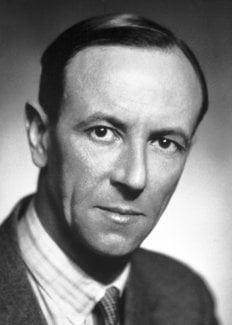
James Chadwick was born in Cheshire, England, on 20th October, 1891, the son of John Joseph Chadwick and Anne Mary Knowles. He attended Manchester High School prior to entering Manchester University in 1908; he graduated from the Honours School of Physics in 1911 and spent the next two years under Professor (later Lord) Rutherford in the Physical Laboratory in Manchester, where he worked on various radioactivity problems, gaining his M.Sc. degree in 1913. That same year he was awarded the 1851 Exhibition Scholarship and proceeded to Berlin to work in the Physikalisch Technische Reichsanstalt at Charlottenburg under Professor H. Geiger.
During World War I, he was interned in the Zivilgefangenenlager, Ruhleben. After the war, in 1919, he returned to England to accept the Wollaston Studentship at Gonville and Caius College, Cambridge, and to resume work under Rutherford, who in the meantime had moved to the Cavendish Laboratory, Cambridge. Rutherford had succeeded that year in disintegrating atoms by bombarding nitrogen with alpha particles, with the emission of a proton. This was the first artificial nuclear transformation. In Cambridge, Chadwick joined Rutherford in accomplishing the transmutation of other light elements by bombardment with alpha particles, and in making studies of the properties and structure of atomic nuclei.
He was elected Fellow of Gonville and Caius College (1921-1935) and became Assistant Director of Research in the Cavendish Laboratory (1923). In 1927 he was elected a Fellow of the Royal Society.
In 1932, Chadwick made a fundamental discovery in the domain of nuclear science: he proved the existence of neutrons – elementary particles devoid of any electrical charge. In contrast with the helium nuclei (alpha rays) which are charged, and therefore repelled by the considerable electrical forces present in the nuclei of heavy atoms, this new tool in atomic disintegration need not overcome any electric barrier and is capable of penetrating and splitting the nuclei of even the heaviest elements. Chadwick in this way prepared the way towards the fission of uranium 235 and towards the creation of the atomic bomb. For this epoch-making discovery he was awarded the Hughes Medal of the Royal Society in 1932, and subsequently the Nobel Prize for Physics in 1935.
He remained at Cambridge until 1935 when he was elected to the Lyon Jones Chair of Physics in the University of Liverpool. From 1943 to 1946 he worked in the United States as Head of the British Mission attached to the Manhattan Project for the development of the atomic bomb. He returned to England and, in 1948, retired from active physics and his position at Liverpool on his election as Master of Gonville and Caius College, Cambridge. He retired from this Mastership in 1959. From 1957 to 1962 he was a parttime member of the United Kingdom Atomic Energy Authority.
Chadwick has had many papers published on the topic of radioactivity and connected problems and, with Lord Rutherford and C. D. Ellis, he is co-author of the book Radiations from Radioactive substances (1930).
Sir James was knighted in 1945. Apart from the Hughes Medal (Royal Society) mentioned above, he received the Copley Medal (1950) and the Franklin Medal of the Franklin Institute, Philadelphia (1951). He is an Honorary Fellow of the Institute of Physics and, in addition to receiving honorary doctorate degrees from the Universities of Reading, Dublin, Leeds, Oxford, Birmingham, Montreal (McGill), Liverpool, and Edinburgh, he is a member of several foreign academies, being Associé of the Académie Royale de Belgique; Foreign Member of the Kongelige Danske Videnskabernes Selskab and the Koninklijke Nederlandse Akademie van Wetenschappen; Corresponding Member of the Sächsische Akademie der Wissenschaften, Leipzig; Member of the Pontificia Academia Scientiarum and the Franklin Institute; Honorary Member of the American Philosophical Society and the American Physical Society.
In 1925, he married Aileen Stewart-Brown of Liverpool. They have twin daughters, and live at Denbigh, North Wales. His hobbies include gardening and fishing.
This autobiography/biography was written at the time of the award and first published in the book series Les Prix Nobel. It was later edited and republished in Nobel Lectures. To cite this document, always state the source as shown above.
Sir James Chadwick died on July 24, 1974.
Nobel Prizes and laureates
Six prizes were awarded for achievements that have conferred the greatest benefit to humankind. The 14 laureates' work and discoveries range from quantum tunnelling to promoting democratic rights.
See them all presented here.