Ernest T.S. Walton
Biographical
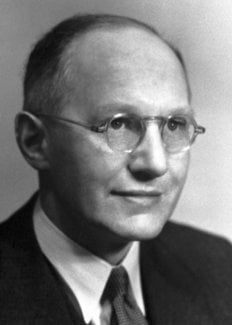
Ernest Thomas Sinton Walton was born at Dungarvan, County Waterford on the south coast of Ireland on October 6th, 1903, the son of a Methodist Minister from County Tipperary. The ministry demanded that his father move from place to place every few years, and he attended day schools in Banbridge (County Down) and Cookstown (County Tyrone). In 1915 he was sent as a boarder to the Methodist College, Belfast, where he excelled in mathematics and science, and in 1922 he entered Trinity College, Dublin , on a scholarship. He read the honours courses in both mathematics and experimental science, specializing in physics, and graduated in 1926 with firstclass honours in both subjects; he received his M.Sc. degree in 1927.
In 1927, he was awarded a Research Scholarship by the Royal Commissioners for the Exhibition of 1851 and he went to Cambridge University to work in the Cavendish Laboratory under Lord Rutherford. He continued at Cambridge after receiving a senior research award of the Department of Scientific and Industrial Research in 1930, and received his Ph.D. in 1931. Walton was Clerk Maxwell Scholar from 1932 to 1934 when he returned to Trinity College, Dublin, as Fellow: he was appointed Erasmus Smith’s Professor of Natural and Experimental Philosophy in 1946, and in 1960 he was elected Senior Fellow of Trinity College.
Prof. Walton’s first researches involved theoretical and experimental studies in hydrodynamics and, at the Cavendish Laboratory, he worked on indirect methods for producing fast particles, working on the linear accelerator and on what was later to become known as the betatron. He followed this with work on the direct method of producing fast particles by the use of high voltages this work being done jointly with J.D. Cokcroft. A suitable apparatus was built which made it possible to show that various light elements could be disintegrated by bombardment with fast protons. They were directly responsible for disintegrating the nucleus of the lithium atom by bombardment with accelerated protons, and for identifying the products as helium nuclei.
Prof. Walton has taken part in many activities outside his academic work, and he has served on committees connected with the Dublin Institute for Advanced Studies, the Institute for Industrial Research and Standards, the Royal City of Dublin Hospital, the Royal Irish Academy, the Royal Dublin Society, Wesley College, Dublin, and many government and church committees. He has had numerous scientific papers published in the journals of learned societies, particularly on the subjects of hydrodynamics, nuclear physics, and microwaves.
He was awarded the Hughes Medal, jointly with Sir John Cockcroft, by the Royal Society of London in 1938, and in 1959 he received an honorary Doctor of Science degree from Queen’s University, Belfast.
E.T.S. Walton married Freda Wilson, daughter of a Methodist Minister and a former pupil of Methodist College, Belfast, in 1934. They have two sons and two daughters, Alan, Marian, Philip, and Jean.
This autobiography/biography was written at the time of the award and first published in the book series Les Prix Nobel. It was later edited and republished in Nobel Lectures. To cite this document, always state the source as shown above.
Ernest T.S. Walton died on June 25, 1995.
Nobel Prizes and laureates
Six prizes were awarded for achievements that have conferred the greatest benefit to humankind. The 14 laureates' work and discoveries range from quantum tunnelling to promoting democratic rights.
See them all presented here.