Maria Goeppert Mayer
Biographical
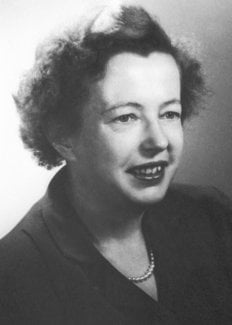
Maria Goeppert Mayer was born on June 28, 1906, in Kattowitz, Upper Silesia, then Germany, the only child of Friedrich Goeppert and his wife Maria, nee Wolff. On her father’s side, she is the seventh straight generation of university professors.
In 1910 her father went as Professor of Pediatrics to Göttingen where she spent most of her life until marriage. She went to private and public schools in Göttingen and had the great fortune to have very good teachers. It somehow was never discussed, but taken for granted by her parents as well as by herself that she would go to the University. Yet, at that time it was not trivially easy for a woman to do so. In Göttingen there was only a privately endowed school which prepared girls for the “abitur”, the entrance examination for the university. This school closed its doors during the inflation, but the teachers continued to give instructions to the pupils. Maria Goeppert finally took the abitur examination in Hannover, in 1924, being examined by teachers she had never seen in her life.
In the spring of 1924 she enrolled at the University at Göttingen, with the intention of becoming a mathematician. But soon she found herself more attracted to physics. This was the time when quantum mechanics was young and exciting.
Except for one term which she spent in Cambridge, England, where her greatest profit was to learn English, her entire university career took place in Göttingen. She is deeply indebted to Max Born, for his kind guidance of her scientific education. She took her doctorate in 1930 in theoretical physics. There were three Nobel Prize winners on the doctoral committee, Born, Franck and Windaus.
Shortly before she had met Joseph Edward Mayer, an American Rockefeller fellow working with James Franck. In 1930 she went with him to the Johns Hopkins University in Baltimore. This was the time of the depression, and no university would think of employing the wife of a professor. But she kept working, just for the fun of doing physics.
Karl F. Herzfeld took an interest in her work, and under his influence and that of her husband, she slowly developed into a chemical physicist. She wrote various papers with Herzfeld and with her husband, and she started to work on the color of organic molecules.
In 1939 they went to Columbia. Dr. Goeppert Mayer taught at Sarah Lawrence College between 1941 and 1945, but she worked mainly at the S. A. M. Laboratory, on the separation of isotopes of uranium, with Harold Urey as director. Urey usually assigned her not to the main line of research of the laboratory, but to side issues, for instance, to the investigation of the possibility of separating isotopes by photochemical reactions. This was nice, clean physics although it did not help in the separation of isotopes.
In 1946 they went to Chicago. This was the first place where she was not considered a nuisance, but greeted with open arms. She was suddenly a Professor in the Physics Department and in the Institute for Nuclear Studies. She was also employed by the Argonne National Laboratory with very little knowledge of Nuclear Physics! It took her some time to find her way in this, for her, new field. But in the atmosphere of Chicago, it was rather easy to learn nuclear physics. She owes a great deal to very many discussions with Edward Teller, and in particular with Enrico Fermi, who was always patient and helpful.
In 1948 she started to work on the magic numbers, but it took her another year to find their explanation, and several years to work out most of the consequences. The fact that Haxel, Jensen and Suess, whom she had never met, gave the same explanation at the same time helped to convince her that it was right. She met Jensen in 1950. A few years later the competitors from both sides of the Atlantic decided to write a book together.
In 1960 they came to La Jolla where Maria Goeppert Mayer is a professor of physics. She is a member of the National Academy of Sciences and a corresponding member of the Akademie der Wissenschaften in Heidelberg. She has received honorary degrees of Doctor of Science from Russel Sage College, Mount Holyoke College and Smith College.
They have two children, both born in Baltimore, Maria Ann Wentzel, now in Ann Arbor, and a son, Peter Conrad, a graduate student of economics in Berkeley.
This autobiography/biography was written at the time of the award and first published in the book series Les Prix Nobel. It was later edited and republished in Nobel Lectures. To cite this document, always state the source as shown above.
Maria Goeppert Mayer died on February 20, 1972.
Nobel Prizes and laureates
Six prizes were awarded for achievements that have conferred the greatest benefit to humankind. The 14 laureates' work and discoveries range from quantum tunnelling to promoting democratic rights.
See them all presented here.