Nicolay G. Basov
Biographical
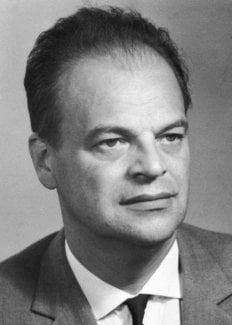
Nikolay Gennadiyevich Basov was born on December, 14, 1922 in the small town of Usman near Voronezh, the son of Gennady Fedorovich Basov and Zinaida Andreevna Molchanova. His father was a professor of the Voronezh Forest Institute and devoted his life to investigation of the influence of forest belts on underground waters and on surface drainage.
After finishing secondary school in 1941 in Voronezh Basov was called up for military service and directed to the Kuibyshev Military Medical Academy. In 1943 he left the Academy with the qualification of a military doctor’s assistant. He served in the Soviet Army and took part in the Second World War in the area of the First Ukrainian Front. In December 1945, he was demobilized and entered the Moscow Institute of Physical Engineers where he studied theoretical and experimental physics.
From 1950 to 1953 he was a postgraduate student of the Moscow Institute of Physical Engineers. At that time, Basov was working on his thesis at the P.N. Lebedev Physical Institute of the Academy of Sciences, U.S.S.R., under the guidance of Professor M.A. Leontovich and Professor A.M. Prochorov.
In 1950 Basov joined the P.N. Lebedev Physical Institute, where at present he is vicedirector and head of the laboratory of quantum radiophysics. He is also a professor of the department of solid-state physics at the Moscow Institute of Physical Engineers.
In 1952 Dr. Basov began to work in the field of quantum radiophysics. He made various attempts (firstly, theoretical and then experimental) to design and build oscillators (together with A.M. Prochorov). In 1956 he defended his doctoral thesis on the theme “A Molecular Oscillator”, which summed up the theoretical and experimental works on creation of a molecular oscillator utilizing an ammonia beam.
In 1955 Basov organized a group for the investigation of the frequency stability of molecular oscillators. Together with his pupils and collaborators A.N. Oraevsky, V.V. Nikitin, G.M. Strakhovsky, V.S. Zuev and others, Dr Basov studied the dependence of the oscillator frequency on different parameters for a series of ammonia spectral lines, proposed methods of increasing the frequency stability by means of slowing down molecules, proposed methods of producing slow molecules, investigated the operation of oscillators with resonators in series, realized phase stabilization of klystron frequency by means of molecular oscillators, studied transition processes in molecular oscillators, and designed an oscillator utilizing a beam of deuterium ammonia. In the result of these investigations the oscillators with a frequency stability of 10-11 have been realized in 1962.
In 1957 Basov started to work on the design and construction of quantum oscillators in the optical range. A group of theorists and research workers began to study the possibilities for realization of quantum oscillators by means of semiconductors, and after A. Javan’s proposal, the possibility of their realization in the gas media was also investigated. In 1958 together with B.M. Vul and Yu.M. Popov he investigated the conditions for production of states with a negative temperature in semiconductors, and suggested utilization of a pulse breakdown for that purpose. In 1961 together with O.N. Krokhin and Yu.M. Popov, Basov proposed three different methods for the obtaining of a negative temperature state in semiconductors in the presence of direct and indirect transitions (optical excitation, utilization of a beam of fast electrons and injection of carriers through a degenerated p-n junction).
As a result of a cooperative effort with B.M. Vul and collaborators the injection semiconductor lasers utilizing crystals of gallium arsenide were made at the beginning of 1963.
In 1964 semiconductor lasers with electronic excitation have been made (together with O.V. Bogdankevich and A.N. Devyatkov); and somewhat later, lasers with optical excitation were constructed (together with A.Z. Grasiuk and V.A. Katulin). For these achievements a group of scientists of Lebedev Physical Institute was awarded the Lenin Prize for 1964.
Beginning from 1961 Dr. Basov (together with V.S. Zuev, P.G. Krinkov, V.S. Lctokhov et al.) carried out theoretical and experimental research in the field of powerful lasers. There have been found the ways of obtaining powerful short laser pulses. The nature of appearance of such pulses in quantum oscillators and their propagation in quantum amplifiers have been investigated. This work resulted in the development of high-power single-pulse Nd-glass lasers with 30 J energy and 2*10-11 sec pulse duration (in 1968 together with P.G. Krinkov, Yu.V. Senatsky et al.) and multichannel lasers with energy 103 J within 10-9 sec (in 1971 in collaboration with G.V. Sklizkov et al.).
In 1962 N. Basov and O.N. Krokhin investigated the possibility of laser radiation usage for the obtaining of thermonuclear plasmas. In 1968 Basov and his associates (P.G. Kriukov, Yu.V. Senatsky, S.D. Zakharov) have succeeded in observing for the first time neutron emission in the laser-produced deuterium plasmas. The spectra of multicharged ions CaXVI, FeXXIII, K XIX and others have also been observed (together with O.N. Krokhin, S.L. Mandelshtam, G.V. Sklizkov). There has been developed a theory of picosecond pulse formation (together with V.S. Letokhov). In the same year Basov and his associate A.N. Oraevsky proposed a method of the thermal laser excitation. Further theoretical considerations of this method by Basov, A.N. Oraevsky and V.A. Sheglov encouraged the development of the socalled gasdynamic lasers.
In 1963 Dr. Basov and his colleagues (V.V. Nikitin, Yu.M. Popov, V.N. Morozov) began to work in the field of optoelectronics. They developed in 1967 a number of fast-operating logic elements on the basis of diode lasers. At present a logic structure of the multichannel optoelectronic systems producing 1010 operations per second for the optical data processing is under the development.
The studies of the radiation of the condensed rare gases under the action of a powerful electron beam have been initiated in 1966 by Basov and his collaborators (V.A. Danilychev, Yu.M. Popov), and they were the first to obtain in 1970 the laser emission in the vacuum ultraviolet range.
In 1968 Basov ( in cooperation with O.V. Bogdankevich and A.S. Nasibov) made a proposal for a laser projection TV. About the same time Dr. Basov (together with V.V. Nikitin) began the studies of the frequency standard in the optical range (on the basis of gas lasers). In 1970 they succeeded in realizing a gas laser stabilized in the methane absorption line with frequency stability 10-11.
In 1969 Basov (together with E.M. Belenov and V.V. Nikitin) hypothe sized that to obtain the frequency standard with the stability 10-12-10-13 a ring laser can be used with a nonlinear absorption cell.
A large contribution has been made by Dr. Basov to the field of chemical lasers. In 1970 under his guidance an original chemical laser was achieved which operates on a mixture of deuterium, F and CO2 at the atmospheric pressure. In the same year Basov (in cooperation with E.M. Belenov, V.A. Danilychev and A.F. Suchkov) proposed and developed experimentally an elion (electrical pumping of ionized compressed gases) method of gaslaser excitation. Using this method for a CO2 and N2 mixture compressed to 25 atm., they achieved a great increase of power of the gas laser volume unit compared to the typical low pressure CO2 lasers.
In the end of 1970 Basov (together with E.P. Markin, A.N. Oraevsky, A.V. Pankratov) presented experimental evidence for the stimulation of chemical reactions by the infrared laser radiation.
In 1959 Dr. Basov was awarded the Lenin Prize together with A. M. Prochorov for the investigation leading to the creation of molecular oscillators and paramagnetic amplifiers. In 1962 Dr. Basov was elected a corresponding member of the Academy of Sciences of the U.S.S.R.; in 1966, a member of the Academy; in 1967, a member of the Presidium of the Academy of Sciences of the U.S.S.R., and a foreign member of the German Academy of Sciences in Berlin; and in 1971, a foreign member of the German Academy “Leopoldina”.
Dr. Basov is Editor-in-chief of the Soviet scientific journals Priroda. (Nature) and “Kvantovaya Elektornika” (Quantum Electronics); he is also a member of the Editorial Board of “Il Nuovo Cimento”.
In 1970 Dr. Basov was awarded the rank of Hero of Socialist Labour. Dr. Basov is a member of the Soviet Committee of the Defence of Peace and a member of the World Peace Council.
Nikolai Basov married in 1950. His wife, Ksenia Tikhonovna Basova, is also a physicist and is with the Department of General Physics of the Moscow Institute of Physical Engineers. They have two sons: Gennady (born 1954) and Dmitry (born 1963).
This autobiography/biography was written at the time of the award and first published in the book series Les Prix Nobel. It was later edited and republished in Nobel Lectures. To cite this document, always state the source as shown above.
Nicolay G. Basov died on July 1, 2001.
Nobel Prizes and laureates
Six prizes were awarded for achievements that have conferred the greatest benefit to humankind. The 14 laureates' work and discoveries range from quantum tunnelling to promoting democratic rights.
See them all presented here.

