Fritz Haber
Biographical
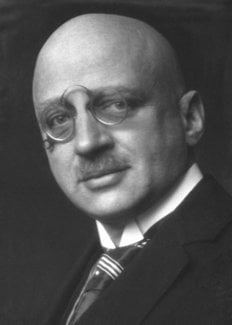
Fritz Haber was born on December 9, 1868 in Breslau, Germany, in one of the oldest families of the town, as the son of Siegfried Haber, a merchant. He went to school at the St. Elizabeth classical school at Breslau and he did, even while he was at school, many chemical experiments.
From 1886 until 1891 he studied chemistry at the University of Heidelberg under Bunsen, at the University of Berlin under A.W. Hoffmann, and at the Technical School at Charlottenburg under Liebermann. After completing his University studies he voluntarily worked for a time in his father’s chemical business and, being interested in chemical technology, he also worked for a while under Professor Georg Lunge at the Institute of Technology at Zurich. He then finally decided to take up a scientific career and went for one and a half years to work with Ludwig Knorr at Jena, publishing with him a joint paper on diacetosuccinic ester. Still uncertain whether to devote himself to chemistry or physics, he was offered in 1894, and accepted, an assistantship at Karlsruhe by the Professor of Chemical Technology there, Hans Bunte. Here he remained until 1911. Bunte was especially interested in combustion chemistry and Carl Engler, who was also there, introduced Haber to the study of petroleum and Haber’s subsequent work was greatly influenced by these two colleagues.
In 1896 Haber qualified as a Privatdozent with a thesis on his experimental studies of the decomposition and combustion of hydrocarbons and in 1906 he was appointed Professor of Physical Chemistry and Electrochemistry and Director of the Institute established at Karlsruhe to study these subjects.
In 1911 he was appointed to succeed Engler as Director of the Institute for Physical and Electrochemistry at Berlin-Dahlem, where he remained until, in 1933, the Nazi race laws compelled nearly all his staff to resign and Haber, rather than agree to this, himself resigned. He was then invited by Sir William Pope to go to Cambridge, England and there he remained for a while. He had, however, been suffering for some time from heart disease and, fearing the English winter, he moved to Switzerland.
Haber’s early work on the decomposition and combustion of hydrocarbons has already been mentioned.
In 1898 Haber published his textbook on Electrochemistry, which was based on the lectures he gave at Karlsruhe. In the preface to his book he expressed his intention to relate chemical research to industrial processes and in the same year he reported the results of his work on electrolytic oxidation and reduction, in which he showed that definite reduction products can result if the potential at the cathode is kept constant. In 1898 he explained the reduction of nitrobenzene in stages at the cathode and this became the model for other similar reduction processes.
There followed, during the next ten years, many other electrochemical researches. Among these was his work on the electrolysis of solid salts (1904), on the establishment of the quinone-hydroquinone equilibrium at the cathode, which laid the foundations for Biilmann’s quinhydrone electrode for determining the acidity of a liquid; but Haber invented, in collaboration with Cremer, the glass electrode for the same purposes which is now widely used. This led Haber to make the first experimental investigations of the potential differences that occur between solid electrolytes and their aqueous solutions, which were of great interest to physiologists.
During this period Haber also studied the loss of energy by steam engines, turbines and motors driven by fuels, and sought methods of limiting their loss by electrochemical means. He did not succeed in finding a solution of this problem that was commercially applicable, but he did succeed in finding a fundamental solution for the laboratory combustion of carbon monoxide and hydrogen.
He then turned to the study of flames and did fundamental researches on the Bunsen flame, showing that, in the luminous inner cone of this flame, a thermodynamic water-gas equilibrium is established and that, in its outer mantle, there is combustion of water-gas. This led to a chemical method of determining flame temperatures.
Haber then undertook the work on the fixation of nitrogen from the air for which he was given the Nobel Prize in Chemistry for 1918 (awarded in 1919).
In 1905 he had published his book on the thermodynamics of technical gas reactions, in which he recorded the production of small amounts of ammonia from N2 and H2 at a temperature of 1000° C with the help of iron as a catalyst. Later he decided to attempt the synthesis of ammonia and this he accomplished after searches for suitable catalysts, by circulating nitrogen and hydrogen over the catalyst at a pressure of 150-200 atmospheres at a temperature of about 500° C. This resulted in the establishment, with the cooperation of Bosch and Mittasch, of the Oppau and Leuna Ammonia Works, which enabled Germany to prolong the First World War when, in 1914, her supplies of nitrates for making explosives had failed. Modifications of this Haber process also provided ammonium sulphate for use as a fertilizer for the soil. The principle used for this process and the subsequent development of the control of catalytic reactions at high pressures and temperatures, led to the synthesis of methyl alcohol by Alwin Mittasch and to the hydrogenation of coal by the method of Bergius and the production of nitric acid.
During the years between the two World Wars Haber produced his firedamp whistle for the protection of miners, his quartz thread manometer for low gas pressures and his observation that adsorption powers can be due to unsaturated valence forces of a solid body, on which Langmuir founded his theory of adsorption. When the First World War broke out he was appointed a consultant to the German War Office and organised gas attacks and defences against them. This and other work undermined his health and for some time he was engaged in administrative work. He helped to create the German Relief Organisation and served on the League of Nations Committee on Chemical Warfare.
From 1920 until 1926 he experimented on the recovery of gold from sea water, his idea being to enable Germany to meet her war reparations. Greatly depressed by the failure of this project, which he attributed to his own deficiency, he devoted himself to the reorganisation of his Institute, to which he appointed sectional directors with complete freedom in their work. Among these were James Franck, Herbert Freundlich, Michael Polanyi and Rudolf Ladenburg; from the Institute came much work on colloid chemistry and atomic physics. Haber himself, at this time, made great efforts to re-establish the scientific relationships of Germany with other countries and the colloquia which he held every fortnight did much to establish the international repute of his Institute. During his last years he worked on chain reactions and on mechanisms of oxidation and on hydrogen peroxide catalysis.
Haber lived for science, both for its own sake and also for the influence it has in moulding human life and human culture and civilization. Versatile in his talents, he possessed an astonishing knowledge of politics, history, economics, science and industry and he might have succeeded equally well in other fields. The hesitation with which he finally decided to be a chemist has already been mentioned. He welcomed administrative responsibilities in addition to research work. Always approachable and courteous, he was interested in every kind of problem. His ability to clarify, in a few sentences, the obscurities of a scientific discussion, was a valuable feature of the colloquia he held at his Institute and his organising talent made him a model Director of a large establishment in which he allowed complete freedom, to the workers under him, maintaining, nevertheless, a remarkable control over the activities of the Institute as a whole. A man of forceful personality, he left a lasting impression on the minds of all his associates.
Apart from the Nobel Prize, Haber received many honours during his life. At Max von Laue’s instigation, the Institute for Physical and Electrochemistry at Berlin-Dahlem was renamed the Fritz Haber Institute after his death.
After a grave illness, Haber died on January 29, 1934, at Basle, on his way from England to convalesce in Switzerland, his spirit broken by his rejection by the Germany he had served so well.
This autobiography/biography was written at the time of the award and first published in the book series Les Prix Nobel. It was later edited and republished in Nobel Lectures. To cite this document, always state the source as shown above.
The Nobel Foundation's copyright has expired.Nobel Prizes and laureates
Six prizes were awarded for achievements that have conferred the greatest benefit to humankind. The 14 laureates' work and discoveries range from quantum tunnelling to promoting democratic rights.
See them all presented here.