Richard Zsigmondy
Biographical
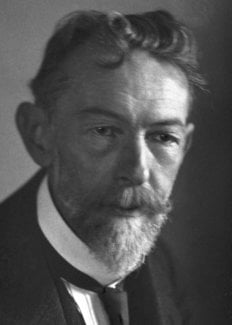
Richard Adolf Zsigmondy was born in Vienna on April 1, 1865. His father, doctor Adolf Zsigmondy, had done a great deal to promote dentistry in Austria, had invented several surgical instruments and devices, and had published several scientific and medical works. He encouraged his four children’s interest in the natural sciences. He died when Zsigmondy was only 15 years old. Zsigmondy’s mother, Irma von Szakmary, encouraged her children to lead an outdoor life, to take an interest in the arts and to follow their own inclinations. Zsigmondy and his brothers spent much of their time climbing, mountaineering, swimming and diving.
Zsigmondy’s interest in chemistry and physics developed at an early age; he studied Stoeckhardt’s textbook Schule der Chemie and carried out many of the experiments mentioned there in his own small laboratory in his home. He was also influenced by Roscoe-Schorlemmer’s and Berzelius’s textbooks on chemistry.
Under the guidance of Professor E. Ludwig of the Medical Faculty in Vienna he learnt the basic facts about quantitative analysis. He then studied at the Technische Hochschule in Vienna and in 1887 went to Munich to read organic chemistry under Professor W. von Miller. After taking his doctorate, he remained as Professor von Miller’s assistant and later accepted a similar position as assistant to the physicist Professor Kundt in Berlin. In 1893 he qualified as lecturer at the Technische Hochschule in Graz and also accepted a teaching post there. His work on lustre colours for glass and china induced him to study more closely the chemistry of colloids, and led to an appointment with the glass works Schott und Genossen in Jena, where he remained until 1900. He left in order to exclusively pursue scientific research. During this period he discovered how to prepare reproducibly gold hydrosols and also developed the slit-ultramicroscope in joint collaboration with Siedentopf.
In 1907 Zsigmondy was appointed Professor and Director of the Institute of Inorganic Chemistry at the University of Göttingen, where he remained until his retirement in February 1929. Following the First World War, especially in 1922 and 1923, the Institute suffered severe shortages of the most simple chemical materials and scientific research work became very difficult. In 1925 Zsigmondy was awarded the Nobel Prize for Chemistry for his work on the heterogeneous nature of colloidal solutions. This made it possible for him to overcome, with deep gratitude, most of the difficulties he had encountered in the previous years. Apart from his Lehrbuch der Kolloidchemie, Zsigmondy published a book Über das kolloide Gold in collaboration with P.A. Thiessen. His son-in-law, Dr. Erich Huckel, who was also one of his co-workers, contributed a book on the theories of adsorption for Zsigmondy’s collected papers Kolloidforschung in Einzeldarstellungen.
Zsigmondy married Laura Luise, née Müller, the daughter of Professor Wilhelm Müller, lecturer in pathological anatomy in Jena, in 1903. Two daughters, Annemarie and Käthe, resulted from this marriage. In 1925 Annemarie married Dr. Erich Huckel of Göttingen, who in Zurich was assistant to Professor Debye, and later became lecturer there.
He died in Göttingen on September 24, 1929.
This autobiography/biography was written at the time of the award and first published in the book series Les Prix Nobel. It was later edited and republished in Nobel Lectures. To cite this document, always state the source as shown above.
The Nobel Foundation's copyright has expired.Nobel Prizes and laureates
Six prizes were awarded for achievements that have conferred the greatest benefit to humankind. The 14 laureates' work and discoveries range from quantum tunnelling to promoting democratic rights.
See them all presented here.