Bruce Merrifield
Biographical
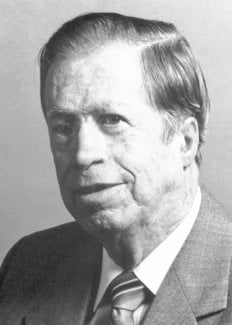
Bruce Merrifield was born in Fort Worth, Texas, July 15, 1921, the only son of George E. and Lorene (Lucas) Merrifield. In the spring of 1923 they drove across the southwest desert to settle in California where they lived in several cities throughout the state. He attended nine grade schools and two high schools before graduating from Montebello High School in 1939. His interest in chemistry began there and he also enjoyed the astronomy club where he ground a mirror and built a small reflecting telescope. As a senior he managed to be runner up in the annual science contest and in the process learned a valuable lesson in the scientific method.
College began at Pasadena Junior College and at the end of two years he transferred to the University of California at Los Angeles (UCLA). After graduation in chemistry he worked for a year at the Philip R. Park Research Foundation taking care of an animal colony and assisting with growth experiments on synthetic amino acid diets. One of these was the experiment by Geiger that first demonstrated that the essential amino acids must be present simultaneously for growth to occur.
It soon became clear that more education was necessary and he returned to graduate school at the UCLA chemistry department with professor of biochemistry M.S. Dunn to develop microbiological methods for the quantitation of the pyrimidines. Graduation was on June 19, 1949, on June 20 he and Elizabeth Furlong were married, and on June 21 they left California for New York City and the Rockefeller Institute for Medical Research.
At the Institute, later Rockefeller University, he worked as an Assistant for Dr. D.W. Woolley who was to have a profound influence on his career. They worked on a dinucleotide growth factor he discovered in graduate school and on peptide growth factors that Woolley had discovered earlier. These studies led to the need for peptide synthesis and, eventually, to the idea for solid phase peptide synthesis in 1959. The development and application of the technique have occupied him and his laboratory up to the present date. He is very proud of the fact that his office was once occupied by the great pioneer peptide chemist, Max Bergmann, and has been inspired by the knowledge that his laboratories were once filled with names like Leonidas Zervas, Joseph Fruton, Klaus Hoffmann, Emil Smith, William Stein, and Stanford Moore.
In the meantime his wife, Libby, who was a biologist by training, stayed home in Cresskill, New Jersey, and raised their six children who now range in age from 19 to 32 years. They have been the great joy in the life of their parents; and now Jim has a daughter, Kelly, who is the pride of the whole family. Three years ago Libby joined the Merrifield laboratory at Rockefeller University.
He was a Nobel Guest Professor at Uppsala University in 1968 and was elected a member of the U.S. National Academy of Sciences in 1972. He has received several awards for his work on peptide chemistry including the Lasker Award for Basic Medical Research (1969), the Gairdner Award (1970), the Intra-Science Award (1970), the American Chemical Society Award for Creative Work in Synthetic Organic Chemistry (1972), the Nichols Medal (1973), the Instrument Specialties Company Award of the University of Nebraska (1977), and the 2nd Alan E. Pierce Award of the American Peptide Symposium (1979).
He has received honorary degrees from the University of Colorado (1969), Uppsala University (1970), Yale University (1971), Newark College of Engineering (1972), the Medical College of Ohio (1972), Colgate University (1977), and Boston College (1984). In 1984 he was appointed the John D. Rockefeller Jr. Professor of the Rockefeller University.
This autobiography/biography was written at the time of the award and later published in the book series Les Prix Nobel/ Nobel Lectures/The Nobel Prizes. The information is sometimes updated with an addendum submitted by the Laureate.
For more updated biographical information, see:
Merrifield, Bruce, Life During a Golden Age of Peptide Chemistry – The Concept and Development of Solid-Phase Peptide Synthesis. Oxford University Press, Oxford, 2001.
Bruce Merrifield died on May 14, 2006.
Nobel Prizes and laureates
Six prizes were awarded for achievements that have conferred the greatest benefit to humankind. The 14 laureates' work and discoveries range from quantum tunnelling to promoting democratic rights.
See them all presented here.