John Pople
Biographical
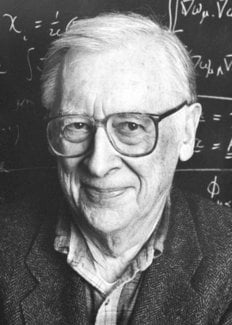
My early life was spent in Burnham-on-Sea, Somerset, a small seaside resort town (population around 5000) on the west coast of England. I was born on October 31, 1925 and lived there with my parents until shortly after the end of the Second World War in 1946. No member of my family was involved in any scientific or technical activity. Indeed, I was the first to attend a university.
My father, Keith Pople, owned the principal men’s clothing store in Burnham. In addition to selling clothes in the shop, he used to drive around the surrounding countryside with a car full of clothes for people in remote farms and villages. He was resourceful and made a fair income, considering the economic difficulties during the depression of the 1930s. My great-grandfather had come to Burnham around 1850 and set up a number of local businesses. He had a large family and these were split up among his children. As a result, I had relatives in many of the other businesses in the town. My grandfather inherited the clothing shop and this passed to my father when he returned from the army at end of the First World War.
My mother, Mary Jones, came from a farming background. Her father had moved from Shropshire as a young man and had farmed near Bath for most of his life. I suspect that he would have preferred to be a teacher, for he had a large collection of books and encyclopedias. He wanted my mother to be a schoolteacher, but this did not happen. Instead, she became a tutor to children in a rich family and, later, a librarian in the army during the first war. Most of her relatives were farmers in various parts of Somerset and Wiltshire so, as small children, my younger brother and I spent much time staying on farms.
Both of my parents were ambitious for their children; from an early age I was told that I was expected to do more than continue to run a small business in this small town. Education was important and seen as a way of moving forward. However, difficulties arose in the choice of school. There was a good preparatory school in Burnham but, as part of the complex English class system, it was not open to children of retail tradesmen, even if they could afford the fees. The available alternative was unsatisfactory and my parents must have agonized over what to do. Eventually, they decided to send us to Bristol Grammar School (BGS) in the nearest big city thirty miles away. BGS was the prime day school for boys, catering mainly to middle class families resident in the city, although it received a government grant for accepting about thirty boys a year from the state elementary schools. I went there in the spring of 1936 at the age of ten. Some arrangement had to be made for boarding and I used to return home by train each weekend. This I found unappealing and eventually I persuaded my parents to allow me to commute daily – two miles by bicycle, twenty-five miles by train and one mile on foot. I continued to do this during the early part of the war, a challenging experience during the many air attacks on Bristol. Often, we had to wend our way past burning buildings and around unexploded bombs on the way to school in the morning. Many classes had to be held in damp concrete shelters under the playing fields. In spite of all these difficulties, the school staff coped well and I received a superb education.
At the age of twelve, I developed an intense interest in mathematics. On exposure to algebra, I was fascinated by simultaneous equations and rapidly read ahead of the class to the end of the book. I found a discarded textbook on calculus in a wastebasket and read it from cover to cover. Within a year, I was familiar with most of the normal school mathematical curriculum. I even started some research projects, formulating the theory of permutations in response to a challenge about the number of possible batting orders of the eleven players in a cricket team. For a very short time, I thought this to be original work but was mortified to find n! described in a textbook. I then attempted to extend n! to fractional numbers by various interpolation schemes. Despite a lot of effort, this project was ultimately unsuccessful; I was angry with myself when I learned of Euler’s solution some years later. However, these early experiences were valuable in formulating an attitude of persistence in research.
All this mathematical activity was kept secret. My parents did not comprehend what I was doing and, in class, I often introduced deliberate errors in my exercises to avoid giving an impression of being too clever. My grades outside of mathematics and science were undistinguished so I usually ended up several places down in the monthly class order. This all changed suddenly three years later when the new senior mathematics teacher, R.C. Lyness, decided to challenge the class with an unusually difficult test. I succumbed to temptation and turned in a perfect paper, with multiple solutions to many of the problems. Shortly afterwards, my parents and I were summoned to a special conference with the headmaster at which it was decided that I should be prepared for a scholarship in mathematics at Cambridge University. During the remaining two years at BGS, I received intense personal coaching from Lyness and the senior physics master, T.A. Morris. Both were outstanding teachers. The school, like many others in Britain, attached great importance to the placement of students at Oxford or Cambridge. Most such awards were in the classics and I think that the mathematics and science staff were very anxious to compete. Ironically, during the last two years at BGS, I abandoned chemistry to concentrate on mathematics and physics. In 1942, I travelled to Cambridge to take the scholarship examination at Trinity College, received an award and entered the university in October 1943.
In the middle of the war, most young men of my age were inducted into the armed forces at the age of seventeen. However, a small group of students in mathematics, science and medicine was permitted to attend university before taking part in wartime research projects such as radar, nuclear explosives, code-breaking and the like. This was a highly successful project and many of my predecessors in earlier years made important contributions to the war effort. The plan was to complete all degree courses in only two years, followed by secondment to a government research establishment. In my case, I completed Part II of the mathematical tripos in May 1945, just as the European war was ending. In fact, it was hard to concentrate on the examinations because of the noisy celebrations going on in the streets outside. The government no longer had need for my services and the university was under great pressure to make room for the deluge of exservicemen as they were demobilized from the armed forces. So, I had to leave Cambridge and take up industrial employment for a period. This was with the Bristol Aeroplane Company, close to where I had attended school. There was little to do there and I had a period of enforced idleness as changing employment was illegal at the time (part of the obsession for a planned economy in postwar Britain).
In 1945, I had little idea of what my future career might be. My interest in pure mathematics began to wane; after toying with several ideas, I finally resolved to use my mathematical skills in some branch of science. The choice of a particular field was postponed, so I devoted much of my time to pestering government offices for permission to return to Cambridge and resume my studies. In the late summer of 1947, I finally received a letter informing me that an unexpectedly large number of students had failed their examinations and a few places were available. So, in October 1947, I returned to Cambridge to begin a career in mathematical science.
Cambridge in 1947 had greatly changed since 1943. The university was crowded with students in their late twenties who had spent many years away at the war. In addition, the lectures were given by the younger generation who had also been away on research projects. There was a general air of excitement as these people turned their attention to new scientific challenges. I remained as a mathematics student but spent the academic year 1947-8 taking courses in as many branches of theoretical science as I could manage. These included quantum mechanics (taught in part by Dirac), fluid dynamics, cosmology and statistical mechanics. Most of the class opted for research in fundamental areas of physics such as quantum electrodynamics which was an active field at the time. I felt that challenging the likes of Einstein and Dirac was overambitious and decided to seek a less crowded (and possibly easier) branch of science. I developed an interest in the theory of liquids, particularly as the statistical mechanics of this phase had received relatively little attention, compared with solids and gases. I approached Fred Hoyle, who was giving the statistical mechanics lectures (following the death of R.H. Fowler). However, his current interests were in the fields of astrophysics and cosmology, which I found rather remote from everyday experience. I next approached Sir John Lennard-Jones (LJ), who had published important papers on a theory of liquids in 1937. He held the chair of theoretical chemistry at Cambridge and was lecturing on molecular orbital theory at the time. When I approached him, he told me that his interests were currently in electronic structure but he would very possibly return to liquid theory at some time. On this basis, we agreed that I would become a research student with him for the following year. Thus, after the examinations in June 1948, I began my career in theoretical chemistry at the beginning of July. I had almost no chemical background, having last taken a chemistry course at BGS at the age of fifteen. Other important events took place in my life at this time. In late 1947, I was attempting to learn to play the piano and rented an instrument for the attic in which I lived in the most remote part of Trinity College. The neighbouring room was occupied by the philosopher Ludwig Wittgenstein, who had retired to live in primitive and undisturbed conditions in the same attic area. There is some evidence that my musical efforts distracted him so much that he left Cambridge shortly thereafter. In the following year, I sought out a professional teacher. The young lady I contacted, Joy Bowers, subsequently became my wife. We were married in Great St. Mary’s Church, Cambridge in 1952, after a long courtship. Like many other Laureates, I have benefit immeasurably from the love and support of my wife and children. Life with a scientist who is often changing jobs and is frequently away at meetings and on lecture tours is not easy. Without a secure home base, I could not have made much progress. The next ten years (1948-1958) were spent in Cambridge. I was a research student until 1951, then a research fellow at Trinity College and finally a lecturer on the Mathematics Faculty from 1954 to 1958. Cambridge was an extraordinarily active place during that decade. I was a close observer of the remarkable developments in molecular biology, leading up to the double helix papers of Watson and Crick. At the same time, the X-ray group of Perutz and Kendrew (introduced to the Cavendish Laboratory by Lawrence Bragg) were achieving the first definitive structures of proteins. Elsewhere, Hoyle, Bondi and Gold were arguing their case for a cosmology of continuous creation, ultimately disproved but vigorously presented. Looking through the list of earlier Nobel laureates, I note a large number with whom I became acquainted and with whom I interacted during those years as they passed through Cambridge.
In the theoretical chemistry department, LJ was professor and Frank Boys started as lecturer in September 1948. I began research with some studies of the water molecule, examining the nature of the lone pairs of electrons. This was an initial step towards a theory of hydrogen bonding between water molecules and a preliminary, rather empirical study of the structure of liquid water. This fulfilled my initial objective of dealing with properties of liquids and gained me a Ph.D. and a research fellowship at Trinity College. This highly competitive stage accomplished, I was able to relax a bit and formulate a more general philosophy for future research in chemistry. The general plan of developing mathematical models for simulating a whole chemistry was formulated, at least in principle, some time late in 1952. It is the progress towards those early objectives that is the subject of my Nobel lecture.
At that early date, of course, computational resources were limited to hand calculators and very limited access to motorized electric machines. So my early notes show attempts to simplify theories enough to turn them into practical possibilities. The work paralleling studies of Pariser and Parr led to what became known as PPP theory. This was not a complete model but rather one applicable to systems with only one significant electron per atom. It did fit the general form of conjugated hydrocarbons and achieved some notoriety. In 1953, Bob Parr came to Cambridge to spend a year with Frank Boys. We shared an office and had many valuable discussions; he was to have a major influence on my future. I talked about PPP theory when I began to speak at international meetings in 1955.
In addition to the PPP work, I started theoretical work on other topics in physical chemistry. I began supervision of research students in 1952, beginning with David Buckingham, who completed a masterly thesis on properties of compressed gases. He was the first of a long list of remarkably able and dedicated students who have worked with me over the years. In 1954, LJ was succeeded as professor of theoretical chemistry by Christopher Longuet-Higgins, who was joined by Leslie Orgel shortly afterwards. I continued to spend a lot of time in the chemistry department, although by then I had undertaken new teaching responsibilities as a lecturer in mathematics. The department was crowded and active in those years. Among the many visitors were Linus Pauling, Robert Mulliken, Jack Kirkwood, Clemens Roothaan and Bill Schneider. Frank Boys was also managing a lively group of students.
At the end of 1955, I developed an interest in nuclear magnetic resonance, which was then emerging as a powerful technique for studying molecular structure. At the urging of Bill Schneider, I agreed to spend two summers (1956 and 1957) at the National Research Council in Ottawa, Canada, working on the theoretical background of NMR. This was extremely stimulating for, at that time, we were measuring the spectra and interpreting the nuclear spin behaviour of many standard chemicals for the first time. My time there with Bill and Harold Bernstein led to a book, High Resolution Nuclear Magnetic Resonance, which was well received. This area was the main emphasis of my research during the final years in Cambridge.
By 1958, I had become dissatisfied with my mathematics teaching position at Cambridge. I had clearly changed from being a mathematician to a practicing scientist. Indeed, I was increasingly embarassed that I could no longer follow some of the more modern branches of pure mathematics, in which my undergraduate students were being examined. I therefore resolved to seek a new job with greater scientific content. After some hesitation, I accepted a position as head of the new Basics Physics Division at the National Physical Laboratory near London. This involved direction of experimental work and a considerable amount of administration. When I took the job, I hoped that the administrative burden would not be large enough to interfere with my research programme. Although I was given plenty of help, this turned out not to be so and I had a rather fallow period while I was there.
In the spring of 1961, I organized an international conference in Oxford, along with Charles Coulson and Christopher Longuet-Higgins. Bob Parr was an invited speaker and, during a break, he urged me to come and spend a sabbatical year at Carnegie Institute of Technology in Pittsburgh. This was an attractive suggestion and I arranged to come for the academic year 1961-2 with my family. By this time, Joy and I had three children and were expecting a fourth. We arrived in September, accompanied by a charming young Swedish au pair, Elisabeth Fahlvik. One of the most delightful side-effects of winning the Nobel Prize is the opportunity to meet her again after a gap of over thirty-six years.
By the time we arrived in Pittsburgh, Bob Parr had decided to leave for Johns Hopkins University and he did, in fact, leave in January. Nevertheless, we had a delightful year, travelling as a family over much of the eastern part of the U.S.A. During this period, I made up my mind to abandon my administrative job and seek an opportunity to devote as much time as possible to chemical research. I was approaching the age of forty, with a substantial publication record, but had not yet held any position in a chemistry department. When we returned to England in June, 1962, it was not clear where we might go for there were opportunities both in the U.K. and the U.S.A. Eventually, after much debate, we decided to return to Pittsburgh in 1964. Leaving England was a painful decision and we still have some regrets about it. However, at that time, the research environment for theoretical chemistry was clearly better in the U.S.
On my return to Pittsburgh, I resolved to go back to the fundamental problems of electronic structure that I had contemplated abstractly many years earlier. Prospects of really implementing model chemistries had improved because of the emerging development of high-speed computers. I was late in recognizing the role that computers, would play in the field – I should not have been, for Frank Boys was continually urging the use of early machines back in Cambridge days. However, by 1964, it was clear that the development of an efficient computer code was one of the major tasks facing a practical theoretician and I learned the trade with enthusiasm. Mellon Institute, where I had an adjunct appointment, acquired a Control Data machine in 1966 and my group was able to make rapid progress in the dingy deep basement of that classic building. In 1967, Carnegie Tech and Mellon Institute merged to become Carnegie-Mellon University (CMU) and I remained on the faculty there until 1993. Almost all of the work honored by the Nobel Foundation was done at CMU. That institution deserves much of the credit for their continuing support and encouragement over many years.
The scientific details of the Pittsburgh work are related, in part, in the accompanying lecture. Over the years, we were able to keep abreast with the rapid developments in computer technology. Around 1971, the work was moved to a Univac 1108 machine and then, in 1978, we were fortunate enough to acquire the first VAX/780 minicomputer from the Digital Equipment Corporation for use entirely within the chemistry department. This became a valuable workhorse as we began to distribute programs to the general chemical community. In more recent years, of course, the techniques have become available on small work stations and personal computers. The astonishing progress made in computer technology has had profound consequences in so many branches of theoretical science.
Our children were mostly brought up and educated in the Churchill suburb east of Pittsburgh. Each summer, we took them back to England for an extended period. By 1979, all had gone away and Joy and I decided to move again to Illinois, where our daughter had settled. In 1981, we set up house in Rogers Park, Chicago and then moved to Wilmette in 1988. Our family is now scattered in Chicago, Houston, Pittsburgh and Cork, Ireland. We have been blessed with ten grandchildren (an eleventh expected), who greatly enrich our lives in many ways.
From 1981 to 1993, I continued to run my research group in Pittsburgh, commuting frequently and communicating with my students by telephone and modem. Northwestern University kindly offered me an adjunct appointment and I became a full member of their faculty in 1993. I am very grateful to them for the opportunity to continue my research programme and interact with other members of the chemistry department.
I have had many opportunities to visit universities all over the world in the past fifty years. Among the most rewarding have been frequent trips to Australia and New Zealand, where Joy and I have wintered no fewer than nine times since 1982. The campus of the Australian National University, where Leo Radom became Professor after spending time with me as a postdoctoral fellow from 1968 to 1972, has become a second academic home – a great place for relaxed contemplation.
Israel and Germany are other countries with which I have become closely associated, having visited and collaborated many times. In the 1980s, I held a von Humboldt Award, which allowed me to spend some time in Erlangen, where I collaborated with Paul Schleyer on a large number of applications of the theory. In Israel, I have visited and lectured at all universities, including a period as Visiting Professor at the Technion, Haifa. In 1992, I was fortunate enough to receive the Wolf Prize in Chemistry at a ceremony in the Knesset.
I must emphasize that my contribution to quantum chemistry has depended hugely on work by others. The international community in our field is a close one, meeting frequently and exchanging ideas freely. I am delighted to have had students, friends and colleagues in so many nations and to have learned so much of what I know from them. This Nobel Award honours them all.
This autobiography/biography was written at the time of the award and later published in the book series Les Prix Nobel/ Nobel Lectures/The Nobel Prizes. The information is sometimes updated with an addendum submitted by the Laureate.
John Pople died on March 15, 2004.
Nobel Prizes and laureates
Six prizes were awarded for achievements that have conferred the greatest benefit to humankind. The 14 laureates' work and discoveries range from quantum tunnelling to promoting democratic rights.
See them all presented here.