Giosuè Carducci
Biographical
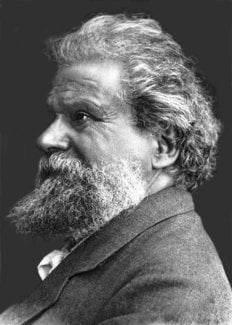
Giosuè Carducci (1835-1907) was born in Val di Castello, a small town near Pisa. He was early attracted to the Greek and Roman authors; in addition, he conscientiously studied the Italian classics: Dante, Tasso, and Alfieri. At the age of twenty he graduated with a degree in philosophy and letters from the University of Pisa. After several difficult years in which he taught in various high schools, he was appointed to the chair of Italian Literature at the University of Bologna, a post that he held until his retirement in 1904.
Inspired both by his own time as well as by his study of the classical and Italian poets, Carducci began writing poetry when he was a child. The first two collections of his poetry were Rime (1857) [Rhymes] and Levia Gravia (1868) [Light and Heavy]. Both reveal his enthusiasm for and imitation of the ancients as well as a strong revolutionary tendency. Inno a Satana (1865) [Hymn to Satan], for which Carducci was considered to be a «notorious praiser of Satan», is the full expression of his free thought and of modern ideas, inventions, and revolutions. Giambi ed epodi (1882) [Iambics and Epodes], a collection of satiric poems of a political nature, expresses Carducci’s indignation with his compatriots. In the Nuove poesie (1873) [New Poems] end the three collections of Odi barbare (1877, 1882, and 1889) [The Barbarian Odes], his poetic forms reach perfection.
Carducci was also an excellent translator, and the lyrics of Goethe and Heine greatly influenced the development of his own poetry.
In addition to his fame as a poet he was a noted literary historian and an eminent orator. He conducted research in every phase of literature and eloquently expressed his findings in Studi letterati (1874) [Literary Studies], Bozetti critici e discorsi letterari (1876) [Critical Sketches and Literary Discussigns], and many other works.
Carducci, moreover, led an active political life. After having been named an honorary citizen of Bologna, he was elected to the Senate in 1890; he served as deputy in the House of Representatives for a short time. Carducci’s poetry inspired his compatriots in the war for Italian independence, and he enjoyed an immense popularity both at home and abroad. Having manifested a scholarly and dynamic personality in all his endeavours, he stands as the greatest Italian literary figure in the latter part of the nineteenth century.
This autobiography/biography was written at the time of the award and first published in the book series Les Prix Nobel. It was later edited and republished in Nobel Lectures. To cite this document, always state the source as shown above.
Giosuè Carducci died on February 16, 1907.
The Nobel Foundation's copyright has expired.Nobel Prizes and laureates
Six prizes were awarded for achievements that have conferred the greatest benefit to humankind. The 14 laureates' work and discoveries range from quantum tunnelling to promoting democratic rights.
See them all presented here.