Kenzaburo Oe
Nobel Prize lecture
English
Swedish
Japanese (pdf)*
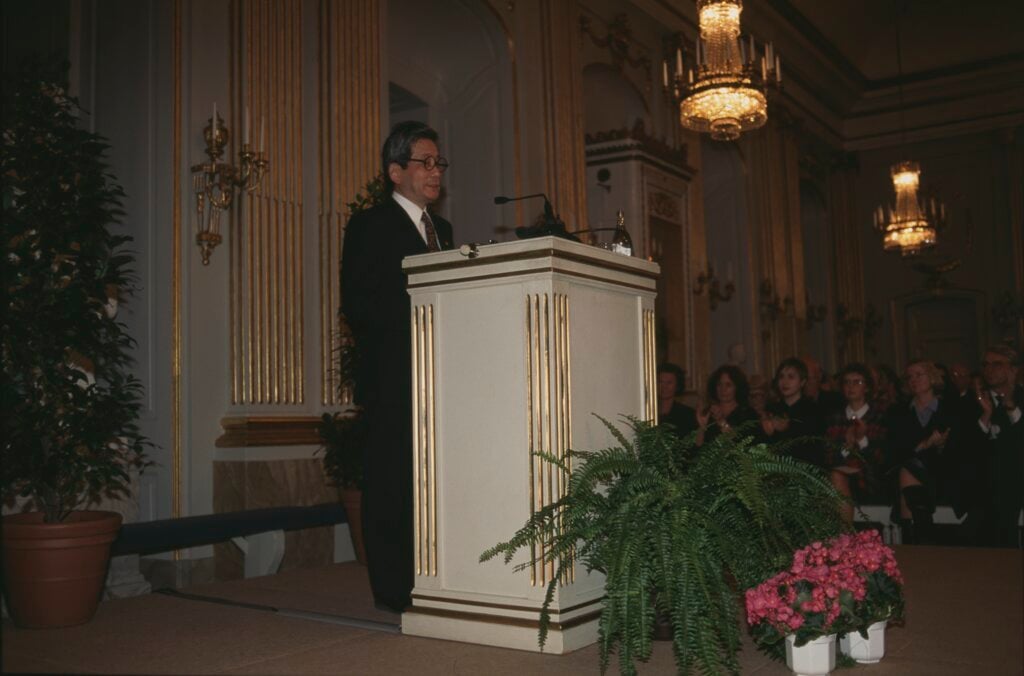
Nobel Lecture, December 7, 1994
Japan, The Ambiguous, and Myself
During the last catastrophic World War I was a little boy and lived in a remote, wooded valley on Shikoku Island in the Japanese Archipelago, thousands of miles away from here. At that time there were two books by which I was really fascinated: The Adventures of Huckleberry Finn and The Wonderful Adventures of Nils. The whole world was then engulfed by waves of horror. By reading Huckleberry Finn I felt I was able to justify my act of going into the mountain forest at night and sleeping among the trees with a sense of security which I could never find indoors. The protagonist of The Adventures of Nils is transformed into a little creature, understands birds’ language and makes an adventurous journey. I derived from the story sensuous pleasures of various kinds. Firstly, living as I was in a deep wood on the Island of Shikoku just as my ancestors had done long ago, I had a revelation that this world and this way of life there were truly liberating. Secondly, I felt sympathetic and identified myself with Nils, a naughty little boy, who while traversing Sweden, collaborating with and fighting for the wild geese, transforms himself into a boy, still innocent, yet full of confidence as well as modesty. On coming home at last, Nils speaks to his parents. I think that the pleasure I derived from the story at its highest level lies in the language, because I felt purified and uplifted by speaking along with Nils. His worlds run as follows (in French and English translation):
“Maman, Papa! Je suis grand, je suis de nouveau un homme!” cria-t-il.
“Mother and father!” he cried. “I’m a big boy. I’m a human being again!”
I was fascinated by the phrase ‘je suis de nouveau un homme!’ in particular. As I grew up, I was continually to suffer hardships in different realms of life – in my family, in my relationship to Japanese society and in my way of living at large in the latter half of the twentieth century. I have survived by representing these sufferings of mine in the form of the novel. In that process I have found myself repeating, almost sighing, ‘je suis de nouveau un homme!’ Speaking like this as regards myself is perhaps inappropriate to this place and to this occasion. However, please allow me to say that the fundamental style of my writing has been to start from my personal matters and then to link it up with society, the state and the world. I hope you will forgive me for talking about my personal matters a little further.
Half a century ago, while living in the depth of that forest, I read The Adventures of Nils and felt within it two prophecies. One was that I might one day become able to understand the language of birds. The other was that I might one day fly off with my beloved wild geese – preferably to Scandinavia.
After I got married, the first child born to us was mentally handicapped. We named him Hikari, meaning ‘Light’ in Japanese. As a baby he responded only to the chirps of wild birds and never to human voices. One summer when he was six years old we were staying at our country cottage. He heard a pair of water rails (Rallus aquaticus) warbling from the lake beyond a grove, and he said with the voice of a commentator on a recording of wild birds: “They are water rails”. This was the first moment my son ever uttered human words. It was from then on that my wife and I began having verbal communication with our son.
Hikari now works at a vocational training centre for the handicapped, an institution based on ideas we learnt from Sweden. In the meantime he has been composing works of music. Birds were the originators that occasioned and mediated his composition of human music. On my behalf Hikari has thus accomplished the prophecy that I might one day understand the language of birds. I must say also that my life would have been impossible but for my wife with her abundant female force and wisdom. She has been the very incarnation of Akka, the leader of Nils’s wild geese. Together with her I have flown to Stockholm and the second of the prophecies has also, to my utmost delight, now been realised.
Kawabata Yasunari, the first Japanese writer who stood on this platform as a winner of the Nobel Prize for Literature, delivered a lecture entitled Japan, the Beautiful, and Myself. It was at once very beautiful and vague. I have used the English word vague as an equivalent of that word in Japanese aimaina. This Japanese adjective could have several alternatives for its English translation. The kind of vagueness that Kawabata adopted deliberately is implied in the title itself of his lecture. It can be transliterated as ‘myself of beautiful Japan’. The vagueness of the whole title derives from the Japanese particle ‘no’ (literally ‘of’) linking ‘Myself’ and ‘Beautiful Japan’.
The vagueness of the title leaves room for various interpretations of its implications. It can imply ‘myself as a part of beautiful Japan’, the particle ‘no’ indicating the relationship of the noun following it to the noun preceding it as one of possession, belonging or attachment. It can also imply ‘beautiful Japan and myself’, the particle in this case linking the two nouns in apposition, as indeed they are in the English title of Kawabata’s lecture translated by one of the most eminent American specialists of Japanese literature. He translates ‘Japan, the beautiful and myself’. In this expert translation the traduttore (translator) is not in the least a traditore (betrayer).
Under that title Kawabata talked about a unique kind of mysticism which is found not only in Japanese thought but also more widely Oriental thought. By ‘unique’ I mean here a tendency towards Zen Buddhism. Even as a twentieth-century writer Kawabata depicts his state of mind in terms of the poems written by medieval Zen monks. Most of these poems are concerned with the linguistic impossibility of telling truth. According to such poems words are confined within their closed shells. The readers can not expect that words will ever come out of these poems and get through to us. One can never understand or feel sympathetic towards these Zen poems except by giving oneself up and willingly penetrating into the closed shells of those words.
Why did Kawabata boldly decide to read those extremely esoteric poems in Japanese before the audience in Stockholm? I look back almost with nostalgia upon the straightforward bravery which he attained towards the end of his distinguished career and with which he made such a confession of his faith. Kawabata had been an artistic pilgrim for decades during which he produced a host of masterpieces. After those years of his pilgrimage, only by making a confession as to how he was fascinated by such inaccessible Japanese poems that baffle any attempt fully to understand them, was he able to talk about ‘Japan, the Beautiful, and Myself’, that is, about the world in which he lived and the literature which he created.
It is noteworthy, furthermore, that Kawabata concluded his lecture as follows:
My works have been described as works of emptiness, but it is not to be taken for the nihilism of the West. The spiritual foundation would seem to be quite different. Dogen entitled his poem about the seasons ‘Innate Reality’, and even as he sang of the beauty of the seasons he was deeply immersed in Zen.
(Translation by Edward Seidensticker)
Here also I detect a brave and straightforward self-assertion. On the one hand Kawabata identifies himself as belonging essentially to the tradition of Zen philosophy and aesthetic sensibilities pervading the classical literature of the Orient. Yet on the other he goes out of his way to differentiate emptiness as an attribute of his works from the nihilism of the West. By doing so he was whole-heartedly addressing the coming generations of mankind with whom Alfred Nobel entrusted his hope and faith.
To tell you the truth, rather than with Kawabata my compatriot who stood here twenty-six years ago, I feel more spiritual affinity with the Irish poet William Butler Yeats who was awarded a Nobel Prize for Literature seventy one years ago when he was at about the same age as me. Of course I would not presume to rank myself with the poetic genius Yeats. I am merely a humble follower living in a country far removed from his. As William Blake, whose work Yeats revalued and restored to the high place it holds in this century, once wrote: ‘Across Europe & Asia to China & Japan like lightnings’.
During the last few years I have been engaged in writing a trilogy which I wish to be the culmination of my literary activities. So far the first two parts have been published and I have recently finished writing the third and final part. It is entitled in Japanese A Flaming Green Tree. I am indebted for this title to a stanza from Yeats’s poem Vacillation:
A tree there is that from its topmost bough
Is half all glittering flame and half all green
Abounding foliage moistened with the dew …
(‘Vacillation’, 11-13)
In fact my trilogy is so soaked in the overflowing influence of Yeats’s poems as a whole. On the occasion of Yeat’s winning the Nobel Prize the Irish Senate proposed a motion to congratulate him, which contained the following sentences:
… the recognition which the nation has gained, as a prominent contributor to the world’s culture, through his success.”
… a race that hitherto had not been accepted into the comity of nations.
… Our civilization will be assesed on the name of Senator Yeats.
… there will always be the danger that there may be a stampeding of people who are sufficiently removed from insanity in enthusiasm for destruction.
(The Nobel Prize: Congratulations to Senator Yeats)
Yeats is the writer in whose wake I would like to follow. I would like to do so for the sake of another nation that has now been ‘accepted into the comity of nations’ but rather on account of the technology in electrical engineering and its manufacture of automobiles. Also I would like to do so as a citizen of such a nation which was stamped into ‘insanity in enthusiasm of destruction’ both on its own soil and on that of the neighbouring nations.
As someone living in the present would such as this one and sharing bitter memories of the past imprinted on my mind, I cannot utter in unison with Kawabata the phrase ‘Japan, the Beautiful and Myself’. A moment ago I touched upon the ‘vagueness’ of the title and content of Kawabata’s lecture. In the rest of my lecture I would like to use the word ‘ambiguous’ in accordance with the distinction made by the eminent British poet Kathleen Raine; she once said of William Blake that he was not so much vague as ambiguous. I cannot talk about myself otherwise than by saying ‘Japan, the Ambiguous, and Myself’.
My observation is that after one hundred and twenty years of modernisation since the opening of the country, present-day Japan is split between two opposite poles of ambiguity. I too am living as a writer with this polarisation imprinted on me like a deep scar.
This ambiguity which is so powerful and penetrating that it splits both the state and its people is evident in various ways. The modernisation of Japan has been orientated toward learning from and imitating the West. Yet Japan is situated in Asia and has firmly maintained its traditional culture. The ambiguous orientation of Japan drove the country into the position of an invader in Asia. On the other hand, the culture of modern Japan, which implied being thoroughly open to the West or at least that impeded understanding by the West. What was more, Japan was driven into isolation from other Asian countries, not only politically but also socially and culturally.
In the history of modern Japan literature the writers most sincere and aware of their mission were those ‘post-war writers’ who came onto the literary scene immediately after the last War, deeply wounded by the catastrophe yet full of hope for a rebirth. They tried with great pains to make up for the inhuman atrocities committed by Japanese military forces in Asian countries, as well as to bridge the profound gaps that existed not only between the developed countries of the West and Japan but also between African and Latin American countries and Japan. Only by doing so did they think that they could seek with some humility reconciliation with the rest of the world. It has always been my aspiration to cling to the very end of the line of that literary tradition inherited from those writers.
The contemporary state of Japan and its people in their post – modern phase cannot but be ambivalent. Right in the middle of the history of Japan’s modernisation came the Second World War, a war which was brought about by the very aberration of the modernisation itself. The defeat in this War fifty years ago occasioned an opportunity for Japan and the Japanese as the very agent of the War to attempt a rebirth out of the great misery and sufferings that were depicted by the ‘Post-war School’ of Japanese writers. The moral props for Japanese aspiring to such a rebirth were the idea of democracy and their determination never to wage a war again. Paradoxically, the people and state of Japan living on such moral props were not innocent but had been stained by their own past history of invading other Asian countries. Those moral props mattered also to the deceased victims of the nuclear weapons that were used for the first time in Hiroshima and Nagasaki, and for the survivors and their off-spring affected by radioactivity (including tens of thousands of those whose mother tongue is Korean).
In the recent years there have been criticisms levelled against Japan suggesting that she should offer more military forces to the United Nations forces and thereby play a more active role in the keeping and restoration of peace in various parts of the world. Our heart sinks whenever we hear these criticisms. After the end of the Second World War it was a categorical imperative for us to declare that we renounced war forever in a central article of the new Constitution. The Japanese chose the principle of eternal peace as the basis of morality for our rebirth after the War.
I trust that the principle can best be understood in the West with its long tradition of tolerance for conscientious rejection of military service. In Japan itself there have all along been attempts by some to obliterate the article about renunciation of war from the Constitution and for this purpose they have taken every opportunity to make use of pressures from abroad. But to obliterate from the Constitution the principle of eternal peace will be nothing but an act of betrayal against the peoples of Asia and the victims of the Atom Bombs in Hiroshima and Nagasaki. It is not difficult for me as a writer to imagine what would be the outcome of that betrayal.
The pre-war Japanese Constitution that posited an absolute power transcending the principle of democracy had sustained some support from the populace. Even though we now have the half-century-old new Constitution, there is a popular sentiment of support for the old one that lives on in reality in some quarters. If Japan were to institutionalise a principle other than the one to which we have adhered for the last fifty years, the determination we made in the post-war ruins of our collapsed effort at modernisation – that determination of ours to establish the concept of universal humanity would come to nothing. This is the spectre that rises before me, speaking as an ordinary individual.
What I call Japan’s ‘ambiguity’ in my lecture is a kind of chronic disease that has been prevalent throughout the modern age. Japan’s economic prosperity is not free from it either, accompanied as it is by all kinds of potential dangers in the light of the structure of world economy and environmental conservation. The ‘ambiguity’ in this respect seems to be accelerating. It may be more obvious to the critical eyes of the world at large than to us within the country. At the nadir of the post-war economic poverty we found a resilience to endure it, never losing our hope for recovery. It may sound curious to say so, but we seem to have no less resilience to endure our anxiety about the ominous consequence emerging out of the present prosperity. From another point of view, a new situation now seems to be arising in which Japan’s prosperity is going to be incorporated into the expanding potential power of both production and consumption in Asia at large.
I am one of the writers who wish to create serious works of literature which dissociate themselves from those novels which are mere reflections of the vast consumer cultures of Tokyo and the subcultures of the world at large. What kind of identity as a Japanese should I seek? W.H. Auden once defined the novelist as follows:
…, among the dust
Be just, among the Filthy filthy too,
And in his own weak person, if he can,
Must suffer dully all the wrongs of Man.
(‘The Novelist’, 11-14)
This is what has become my ‘habit of life’ (in Flannery O’Connor’s words) through being a writer as my profession.
To define a desirable Japanese identity I would like to pick out the word ‘decent’ which is among the adjectives that George Orwell often used, along with words like ‘humane’, ‘sane’ and ‘comely’, for the character types that he favoured. This deceptively simple epithet may starkly set off and contrast with the word ‘ambiguous’ used for my identification in ‘Japan, the Ambiguous, and Myself’. There is a wide and ironical discrepancy between what the Japanese seem like when viewed from outside and what they wish to look like.
I hope Orwell would not raise an objection if I used the word ‘decent’ as a synonym of ‘humanist’ or ‘humaniste’ in French, because both words share in common qualities such as tolerance and humanity. Among our ancestors were some pioneers who made painstaking efforts to build up the Japanese identity as ‘decent’ or ‘humanist’.
One such person was the late Professor Kazuo Watanabe, a scholar of French Renaissance literature and thought. Surrounded by the insane ardour of patriotism on the eve and in the middle of the Second World War, Watanabe had a lonely dream of grafting the humanist view of man on to the traditional Japanese sense of beauty and sensitivity to Nature, which fortunately had not been entirely eradicated. I must hasten to add that Professor Watanabe had a conception of beauty and Nature different from that conceived of by Kawabata in his ‘Japan, the Beautiful, and Myself. ‘
The way Japan had tried to build up a modern state modelled on the West was cataclysmic. In ways different from, yet partly corresponding to, that process Japanese intellectuals had tried to bridge the gap between the West and their own country at its deepest level. It must have been a laborious task or travail but it was also one that brimmed with joy. Professor Watanabe’s study of François Rabelais was thus one of the most distinguished and rewarding scholarly achievements of the Japanese intellectual world.
Watanabe studied in Paris before the Second World War. When he told his academic supervisor about his ambition to translate Rabelais into Japanese, the eminent elderly French scholar answered the aspiring young Japanese student with the phrase: “L’entreprise inouie de la traduction de l’intraduisible Rabelais” (the unprecedented enterprise of translating into Japanese untranslatable Rabelais). Another French scholar answered with blunt astonishment: “Belle entreprise Pantagruélique” (an admirably Pantagruel-like enterprise). In spite of all this not only did Watanabe accomplish his great enterprise in a poverty-stricken environment during the War and the American Occupation, but he also did his best to transplant into the confused and disorientated Japan of that time the life and thought of those French humanists who were the forerunners, contemporaries and followers of François Rabelais.
In both my life and writing I have been a pupil of Professor Watanabe’s. I was influenced by him in two crucial ways. One was in my method of writing novels. I learnt concretely from his translation of Rabelais what Mikhail Bakhtin formulated as ‘the image system of grotesque realism or the culture of popular laughter’; the importance of material and physical principles; the correspondence between the cosmic, social and physical elements; the overlapping of death and passions for rebirth; and the laughter that subverts hierarchical relationships.
The image system made it possible to seek literary methods of attaining the universal for someone like me born and brought up in a peripheral, marginal, off-centre region of the peripheral, marginal, off-centre country, Japan. Starting from such a background I do not represent Asia as a new economic power but an Asia impregnated with ever-lasting poverty and a mixed-up fertility. By sharing old, familiar yet living metaphors I align myself with writers like Kim Ji-ha of Korea, Chon I and Mu Jen, both of China. For me the brotherhood of world literature consists in such relationships in concrete terms. I once took part in a hunger strike for the political freedom of a gifted Korean poet. I am now deeply worried about the destiny of those gifted Chinese novelists who have been deprived of their freedom since the Tienanmen Square incident.
Another way in which Professor Watanabe has influenced me is in his idea of humanism. I take it to be the quintessence of Europe as a living totality. It is an idea which is also perceptible in Milan Kundera’s definition of the spirit of the novel. Based on his accurate reading of historical sources Watanabe wrote critical biographies, with Rabelais at their centre, of people from Erasmus to Sébastien Castellion, and of women connected with Henri IV from Queen Marguerite to Gabrielle Destré. By doing so Watanabe intended to teach the Japanese about humanism, about the importance of tolerance, about man’s vulnerability to his preconceptions or machines of his own making. His sincerity led him to quote the remark by the Danish philologist Kristoffer Nyrop: “Those who do not protest against war are accomplices of war.” In his attempt to transplant into Japan humanism as the very basis of Western thought Watanabe was bravely venturing on both “l’entreprise inouïe” and the “belle entreprise Pantagruélique”.
As someone influenced by Watanabe’s humanism I wish my task as a novelist to enable both those who express themselves with words and their readers to recover from their own sufferings and the sufferings of their time, and to cure their souls of the wounds. I have said I am split between the opposite poles of ambiguity characteristic of the Japanese. I have been making efforts to be cured of and restored from those pains and wounds by means of literature. I have made my efforts also to pray for the cure and recovery off my fellow Japanese.
If you will allow me to mention him again, my mentally handicapped son Hikari was awakened by the voices of birds to the music of Bach and Mozart, eventually composing his own works. The little pieces that he first composed were full of fresh splendour and delight. They seemed like dew glittering on grass leaves. The word innocence is composed of in – ‘not’ and nocere – ‘hurt’, that is, ‘not to hurt’. Hikari’s music was in this sense a natural effusion of the composer’s own innocence.
As Hikari went on to compose more works, I could not but hear in his music also ‘the voice of a crying and dark soul’. Mentally handicapped as he was, his strenuous effort furnished his act of composing or his ‘habit of life’ with the growth of compositional techniques and a deepening of his conception. That in turn enabled him to discover in the depth of his heart a mass of dark sorrow which he had hitherto been unable to identify with words.
‘The voice of a crying and dark soul’ is beautiful, and his act of expressing it in music cures him of his dark sorrow in an act of recovery. Furthermore, his music has been accepted as one that cures and restores his contemporary listeners as well. Herein I find the grounds for believing in the exquisite healing power of art.
This belief of mine has not been fully proved. ‘Weak person’ though I am, with the aid of this unverifiable belief, I would like to ‘suffer dully all the wrongs’ accumulated throughout the twentieth century as a result of the monstrous development of technology and transport. As one with a peripheral, marginal and off-centre existence in the world I would like to seek how – with what I hope is a modest decent and humanist contribution – I can be of some use in a cure and reconciliation of mankind.
* Manuscript version.
Nobel Prizes and laureates
Six prizes were awarded for achievements that have conferred the greatest benefit to humankind. The 14 laureates' work and discoveries range from quantum tunnelling to promoting democratic rights.
See them all presented here.