Award ceremony speech
Presentation Speech by Dr. Horace Engdahl of the Swedish Academy, December 10, 1999.
Translation of the Swedish text.
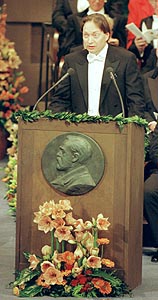
Photo: Hans Mehlin,
Nobelprize.org
Your Majesties, Your Royal Highness, Ladies and Gentlemen,
These days, we often hear talk of the diminishing importance of literature. We are told that it has been reduced to entertainment or to a hobby for an isolated elite. But just as a philosopher in ancient Greece, wishing to reject the Eleatic theory that motion is impossible, simply walked about in front of the Eleatics meeting place in the hall of pillars, so having Günter Grass present is enough to make us realize that literature will not easily be pushed to the margin.
Publication of The Tin Drum meant a second birth for the German novel of the twentieth century. Not since Thomas Mann‘s Buddenbrooks had a first book caused such a stir. This kind of attention has its price. Just like Mann, Grass later met with the reproach that, after being so loved by readers and critics, he had the audacity to write … differently. In Thomas Mann’s case, this reproach turned up even in the Swedish Academy’s citation for his Nobel Prize in 1929. The 1999 citation contains no such reservation.
To the merits of Günter Grass belong not only his creation of a narrative carnival like The Tin Drum, but also the fact that he hasn’t spent his life trying to repeat this feat. Time and again, he has left behind the established critical measures of his greatness and ventured with astonishing liberty into new undertakings. He has set himself above prohibitions and expectations, esthetical as well as political. He continues to do in the newest texts that have come from his workshop.
It’s often said that, with The Tin Drum, Grass saved a vanished world from oblivion – the town of Danzig as it existed before the Nazis and the war. But readers intent on a magical time tour should perhaps rather read Cat and Mouse, the short story in which the friendships of boyhood are recalled with the keenness of loss and guilt. The Tin Drum, however, is something else. It seems to stage the very march of history with a formidable array of characters and tall stories. But everything is viewed from an unusually low position a yard above the ground. The Tin Drum has its temper from a first person narrator who resembles nothing in literature or on earth. Regardless of all the tricksters of folklore, regardless of mythical infants equipped with the wisdom of old men, regardless of Shakespeare’s Puck and Hoffmann’s Kleinzach, Oskar Matzerath is a completely original creation: an infernal intelligence in the body of a three-year old, a monster who victoriously approaches mankind with the aid of a tin drum, an intellectual with infantility as his critical method. If, as one voice in the novel suggests, our time could wear the motto “Mysticism, barbarism, gloom,” then Oskar is its sworn enemy. From Dadaism and another cheerfully destructive avant-garde groups of the beginning of our century, he has inherited the creative irreverence, but, unlike them, hasn’t jettisoned reason.
Other German writers – I’m thinking of Arno Schmidt and Heinrich Böll – portrayed the collapse of human values as apocalypse or tragedy. Grass preferred a literary method more akin to the one adopted by the anonymous parodist who, sometime after Homer, depicted martial heroism as the battle between the frogs and the mice. Grass broke the spell that lay over the German past and sabotaged the German sublime, the taste for the somberly blazing magnificence of foredoomed destruction. This was an achievement far more radical than all the ideological criticism directed against Nazism. Grass’s novels strip their characters of grand words and emphasize the solidity of the flesh by bringing human forms close to the animal world. We all have a place in his menagerie of cat and mouse, dog, snail, flounder, frog and scarecrow.
The different books that followed – the feverish Dog Years, the patiently arguing diary novels from the period when the author was engaged in party politics, the great fables of the seventies and eighties and so on – taught us to read in a new way, with our ears and stomachs just as much as with our eyes and brains. Günter Grass in his expansive phrases brings together not only the high and the low but also the subject and its distorted representation in general opinion, that spiteful mutter for which no one is responsible and of which no one is innocent. His text displays not the homophony of letters but the polyphony of orality, like a noisy inn where a voice is raised without necessarily silencing friends and opponents. His irony has as many shades as his graphic prints.
The major codes of his work – animals and food – meet in The Flounder, a great novel of the formation and malformation of civilization. The author musters the courage to engage in a dialogue with feminism, and attempts a new version of the history of progress, here told as the story of how eminent female cooks taught the people to feed on appetizing and wholesome dishes. With the serious motto that you mustn’t cook without historical consciousness, Grass develops a mode of thinking one would like to call gastrosophy.
In his much-debated Ein weites Feld – Grass takes the daring step of giving an undramatic view of the relationship between the henchmen of totalitarianism and its victims. He plays off the eternal humanist against the eternal police informer, sympathetic understanding against the endless inquisition that keeps prying into old mistakes even beyond the grave. Of the two main characters he says: “Seen from the front, they looked very ill-matched, from behind however, as fitting to each other as two pieces of a jigsaw puzzle.” There is something so hilariously insolent, independent and relativistic in Grass’s rendering of life in Berlin around the Fall of the Wall, that he was bound to infuriate many readers of his home country.
Günter Grass! Your sense of proportion has done mankind a genuine service. Your new book has the title Mein Jahrhundert – My Century. The fact that you are receiving the twentieth century’s last Nobel Literature Prize is confirmation of the reasonableness of such a title. In your cavalcade of the past hundred years, you give ample proof of your uncanny ability to impersonate the voices of the thoughtless: all those bewitched by the hopes of politics and technology, rendered stupid by the great perspectives. The core of thoughtlessness is enthusiasm. I read Mein Jahrhundert as a critique of enthusiasm and a celebration of its opposite, a good memory. Your style, with its repetitions and specifications and stratification of different voices, tells us that we shall not be in a hurry either when dealing with the past or when dealing with the future. You have shown that as long as literature remembers what people hasten to forget, it remains a power to be reckoned with.
I would like to express the warm congratulations of the Swedish Academy as I now request you to receive the Nobel Prize for Literature from the hands of His Majesty the King.
Nobel Prizes and laureates
Six prizes were awarded for achievements that have conferred the greatest benefit to humankind. The 14 laureates' work and discoveries range from quantum tunnelling to promoting democratic rights.
See them all presented here.