Hans Spemann
Biographical
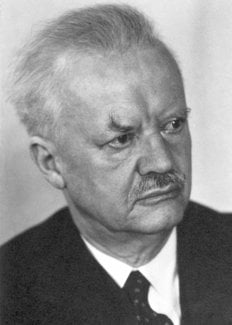
Hans Spemann was born on June 27, 1869, at Stuttgart. He was the eldest son of the publisher, Wilhelm Spemann. From 1878 until 1888 he went to the Eberhard-Ludwig School at Stuttgart and when he left school in 1888 he spent a year in his father’s publishing business.
From 1889-1890 he did his military service and then, after a period as a retail bookseller, he entered, in 1891, the University of Heidelberg. There, until he took his preliminary examination in 1893, he studied medicine, and was especially attracted by the work of the comparative anatomist there, Carl Gegenbaur.
During the winter of 1893-1894 he studied at the University of Munich, where he became more closely acquainted with August Pauly – a fact of great importance to him. From the spring of 1894 to the end of 1908, he worked in the Zoological Institute at the University of Würzburg. In 1895 he took his degree in zoology, botany, and physics (subjects to serve his anatomical studies), having worked under Theodor Boveri, Julius Sachs, and Wilhelm Röntgen, all of whom had the greatest influence on his scientific development.
In 1898 he qualified as a lecturer in zoology at the University of Würzburg, and in 1908 he was asked to become Professor of Zoology and Comparative Anatomy at Rostock, and in 1914 he became Associate Director of the Kaiser Wilhelm Institute of Biology at Berlin-Dahlem. In 1919 he was appointed Professor of Zoology at the University of Freiburg-im-Breisgau, in succession to Hans Doflein, a post which he held until he retired and became Emeritus Professor in 1935.
Spemann’s name will always be associated with his work on experimental embryology. He made himself a master of micro-surgical technique and, working on the relatively large eggs of amphibians he discovered in 1924, together with Hilde Mangold, the existence of an area in the embryo, the portions of which, upon transplantation into an indifferent part of a second embryo there organized (induced) secondary embryonic primordia. The name «organizer centre» or «organizer» was therefore given by him to those parts. For this discovery of the organizer effect in embryonic development, he was awarded the Nobel Prize in 1935.
Later Spemann showed that different parts of the organization centre produce different parts of the embryo. The anterior parts of it tend to produce parts of the head, and the posterior parts of it parts of the tail. Further, tail organizers, when they are grafted into the head region of another embryo, may produce heads instead of tails, the reason being that they are influenced by the head organizer in their new environment.
Earlier Spemann had transplanted the optic cups of new embryos into the outermost layer of the region of the abdomen and had found that they induced the production, in this new situation, of a lens of the eye. This was interpreted as being evidence of the existence of secondary organizers which operate after the induction exerted by the primary organizer has been completed.
By these and other experiments of a similar kind Spemann laid the foundations of the theory of embryonic induction by organizers, which led later to biochemical studies of this process and the ultimate development of the modern science of experimental morphogenesis. He described his researches in his book Embryonic Development and Induction (1938).
Spemann died at Freiburg on September 9, 1941.
This autobiography/biography was written at the time of the award and first published in the book series Les Prix Nobel. It was later edited and republished in Nobel Lectures. To cite this document, always state the source as shown above.
The Nobel Foundation's copyright has expired.Nobel Prizes and laureates
Six prizes were awarded for achievements that have conferred the greatest benefit to humankind. The 14 laureates' work and discoveries range from quantum tunnelling to promoting democratic rights.
See them all presented here.