Press release

KAROLINSKA INSTITUTET
October 1971
Karolinska Institutet has decided to award the Nobel Prize in Physiology or Medicine for 1971 to
Earl Sutherland
for his discoveries concerning “the mechanisms of the action of hormones”.
Sutherland has started his investigations already some twenty years ago. In collaboration with the Nobel Laureate Carl Cori he studied the mechanism by which epinephrine regulates the degradation of glycogen to glucose in the liver. Epinephrine is secreted into the blood stream from the adrenals under the conditions of “stress” and constitutes the signal that adapts the individual to the new situation. This implies that the organism requires more energy, which is obtained by the epinephrine mobilizing the blood sugar. In an analogous manner many other hormones act as specific signals for the adaptation of the individual to the varied requirements of his surroundings.
The mechanism by which various hormones exert their extremely important functions has until recently been a complete enigma. Because of the work of Sutherland we can today understand the general mode of action of many of them.
Sutherland first discovered that epinephrine acts by activating the enzyme (phosphorylase) which leads to the formation of glucose from glycogen. Later he found that this activation took place by means of a hitherto unknown substance which occurs as an intermediate during the process. The discovery and chemical characterization of the intermediate, which has been termed “the second messenger” by Sutherland (the hormone itself is the first messenger) was of crucial importance for an understanding of the mechanism of action of epinephrine and of many other hormones. The newly identified substance proved to be a so called nucleotide, and was named cyclic adenosine phosphate or cyclic AMP.
Sutherland’s discovery implies that epinephrine induces a formation of cyclic AMP in the liver cells and the nucleotide then converts the inactive phosphorylase to the active enzyme.
The enzyme finally leads to the formation of glucose. The important question then arose as to the manner by which the hormone stimulates the cell to the formation of cyclic AMP. Sutherland found that this took place by way of a newly discovered enzyme called adenyl cyclase.
The whole chain of reactions is shown in the following scheme:
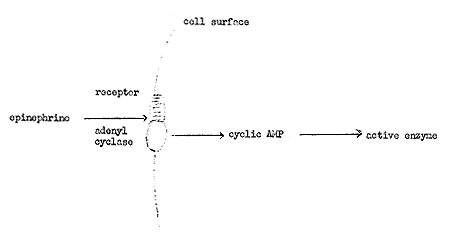 |
According to the scheme the epinephrine is attached to a receptor on the surface of the cell. This leads to stimulation of adenyl cyclase which also is located on the cell surface. This enzyme forms cyclic AMP which then exerts its effect in the cell by the activation of phosphorylase. Surtherland originally used this schematic picture to explain the results of his investigations on the effect of epinephrine. However, as early as about 1960 he suggested that the effects of many other hormones could be explained on essentially similar lines. The principal idea in Sutherland’s scheme is that the various hormones do not enter the cell but are caught on to the surface of the latter. This leads to an activation of the formation of cyclic AMP which in the cell then activates or inhibits various metabolic processes.
This general hypothesis at first met with strong criticism by scientists since it seemed to be impossible that a single substance (i.e. cyclic AMP) could lead to the numerous more or less specific effects that are known to be caused by different hormones. During the latter part of the l960’s decisive proof has, however, been obtained for the correctness of Sutherland’s point of view. His own investigations have contributed greatly to this development and today it has been convincingly shown that besides epinephrine a large number of so called polypeptide hormones exert their effects by way of the cellular surface in accordance with the scheme postulated by Sutherland. The specificity of the individual hormone is dependent on the presence of different receptors in the cellular wall, and on the occurrence of different chemical reactions influenced by cyclic AMP in the cell itself.
Cyclic AMP was discovered as the “second messenger” in relation to hormonal effects. It therefore came as no surprise when Sutherland in 1965 found that the substance also occurred in bacteria. The latter were held to have no need for hormonal effects. The discovery of cyclic AMP in bacteria and similar findings in other unicellular organisms have already opened up new wide biological perspectives. Work during the past few years has show that cyclic AMP exerts several regulatory functions of vital importance in unicellular organisms, functions governing the adaptation of the cell to its surroundings. In these instances cyclic AMP may be regarded as an original “primitive hormone”.
Nobel Prizes and laureates
Six prizes were awarded for achievements that have conferred the greatest benefit to humankind. The 14 laureates' work and discoveries range from quantum tunnelling to promoting democratic rights.
See them all presented here.