Press release
NOBELFÖRSAMLINGEN KAROLINSKA INSTITUTET
THE NOBEL ASSEMBLY AT THE KAROLINSKA INSTITUTE
11 October 1982
The Nobel Assembly of Karolinska Institutet has today decided to award the Nobel Prize in Physiology or Medicine for 1982 jointly to
Sune K. Bergström, Bengt I. Samuelsson and John R. Vane
for their discoveries concerning “prostaglandins and related biologically active substances”.
Summary
Prostaglandins and related substances constitute part of a new biological system. They are formed from unsaturated fatty acids, primarily arachidonic acid. Arachidonic acid is present in the cellular membrane, which also has the enzymatic capacity to form prostaglandins. A release of these compounds takes place when the function of the tissue is pertubed by trauma, disease or stress, thereby maintaining or reconstituting the normal function. The prostaglandins and their related substances, which include the so-called stable prostaglandins as well as thromboxane and prostacyclin, can therefore best be characterized as local tissue hormones. They function in the defense of cells against sudden changes.
The latest members of the prostaglandin family, the leukotrienes, are formed only in a few tissues and cells, chiefly in the lung and white blood cells. Release of leukotrienes in allergic and inflammatory conditions is probably responsible for the symptoms which characterize these diseases.
Prostaglandins are widely used in clinical medicine, particularly in obstetrics and gynecology. Prostaglandins and their analogues have also been successfully used in the treatment of patients with circulatory disturbances and peptic ulcer. Compounds inhibiting the formation of prostaglandins effectively relieve pains provoked by menstruation, gall-stones or kidney-stones.
Sune Bergström is responsible for a crucial breakthrough in prostaglandin research. He has purified several prostaglandins and determined their chemical structure. He also showed that prostaglandins are formed from unsaturated fatty acids. Through this discovery the metabolism of unsaturated fatty acids became of major interest in future research. Bengt Samuelsson has given us a detailed picture of arachidonic acid and prostaglandin metabolism and clarified the chemical processes involved in the formation and breakdown of the various compounds in the system. Samuelsson’s discoveries of the endoperoxides, thromboxanes and leukotrienes were crucial for our present understanding of the biological significance of this system. John Vane has discovered prostacyclin and has carried out detailed analyses of its biological effects and function. In addition, Vane has made the fundamental discovery that antiinflammatory compounds such as aspirin act by blocking the formation of prostaglandins and thromboxanes.
Biological processes in cells and tissues of living organisms are regulated by a number of mechanisms in order to maintain a steady state even when large changes occur in the environment. For instance, the blood pressure and body temperature normally vary within a very limited range. The organism also has a large capacity to adjust to various needs, e.g. the blood flow is in each situation well adjusted to the local need for energy. Prostaglandins and related substances play an essential role in this connection by forming a biological system with important regulatory functions.
The prostaglandin research started almost 50 years ago, when U. von Euler and M. Goldblatt independently found that seminal fluid and seminal vesicles from most animals including man contain a substance which causes contraction of the smooth muscle of the uterus. Von Euler, Nobel Laureate in 1970, called the new factor Prostaglandin.
The main breakthrough in the prostaglandin research was made in the 1950ies when Sune Bergström and his associates succeeded in the purification of two important prostaglandins, PGE and PGF, and in identifying their chemical structure. They found that the prostaglandins are formed by conversion of unsaturated fatty acids, primarily arachidonic acid. The presence of these fatty acids in most cells in the body provided the basis for a new biological system of fundamental importance for several processes in the healthy and diseased body. Bergström’s discoveries thereby focused the scientific interest on unsaturated fatty acids.
Bengt Samuelsson, a co-worker of Bergström already in the beginning of the 1960ies, has been the leading scientist in the biochemistry of prostaglandins since 1965. The credit for our present knowledge of the prostaglandin tree with all its branches (see Figure) goes to him. Samuelsson and associates have also clarified the biochemical processes by which the various prostaglandins are formed and metabolized. It is now possible to separate two distinct branches in this tree. In one of them the cyclic endoperoxides constitute an important branching point from which the stable prostaglandins as well as the more unstable thromboxanes and prostacyclin are formed. The other branch consists of the leukotrienes, where the very short-living leukotriene A constitutes the basis for the leukotrienes B, C and D.
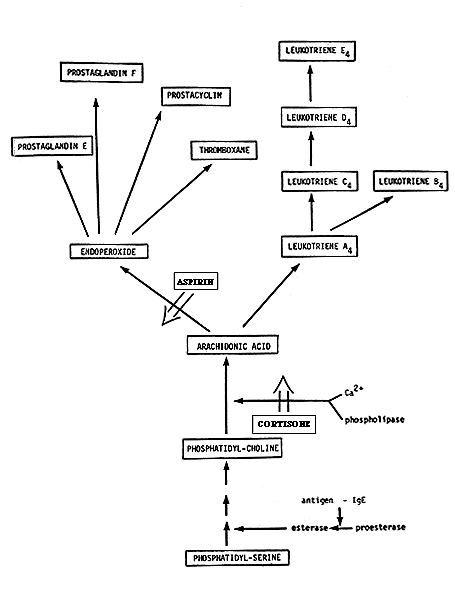 |
John Vane has made fundamental contributions to the elucidation of the system by the discovery of prostacyclin and its biological significance. Furthermore, Vane has, shown that aspirin and allied anti-inflammatory drugs block the synthesis of the prostaglandins. Steroid hormones were found to have similar properties. As illustrated in the figure steroids inhibit the formation of both endoperoxides and leukotrienes from arachidonic acid, while aspirin only blocks the formation of endoperoxides. Thanks to this important discovery the mode of action of aspirin, the most frequently used drug all over the world, was clarified. It also provided the prostaglandin researchers with a useful tool in their analyses of the role of these compounds in various biological processes.
The prostaglandins are involved in a large number of biochemical processes, often in extremely low concentrations. The mode of action of the different substances of the prostaglandin tree is, however, completely different. The metabolites of the endoperoxides (the stable prostaglandins, the thromboxanes and prostacyclin) have been called defense hormones. Their task is primarily to protect the integrity of the organism and they are released when homeostasis is jeopardized by trauma, disease or various stress factors. Thus, for instance prostaglandins are continuously formed in the stomach, where they prevent the tissue from being damaged by the hydrochloric acid. If the formation of prostaglandins is blocked a peptic ulcer can rapidly be formed.
When the kidney is exposed to stress either by a decrease in the supply of oxygen or by hypotension, certain hormones (renin, angiotensin) are released, which contribute to a restitution of the blood pressure. These hormones in turn release prostaglandin PGE which modulates the action of angiotensin. If the release of PGE in the kidney is blocked, the renal function rapidly deteriorates due to an uncontrolled action of the hormone.
A continuous blood flow is a prerequisite for a steady energy supply to the cells. A damage to the wall of the blood vessel will immediately affect the blood cells, thereby initiating the process of blood coagulatlon. This is of vital importance for the protection against loss of substantial amounts of blood. However, the formation of a thrombosis can also severely damage the organ and cause death. In order to protect the organism against the formation of thrombosis, a complicated mechanism has evolved, in which the prostaglandins are essential factors. Thus, a continuous production of prostaglandins takes place in the platelets as well as in the walls of the blood vessels. The thromboxanes in the platelets initiate an aggregation of blood cells while the prostacyclin in the vessel wall effectively inhibits such a process. Normally there is a balance between the release of these two antagonistic prostaglandins. A disturbance of this balance initiates the coagulation process. In the last few years compounds have been developed, which effectively and selectively block the formation of thromboxanes in the platelets. These compounds are the most effective anti-thrombotic drugs known today.
In contrast to the prostaglandins as well as thromboxanes and prostacyclin the leukotrienes do primarily not act as defense hormones. Furthermore, the leukotrienes are formed in only a few tissues and cells, i.e. in the lungs and white blood cells, where they evidently play an important role for the development of allergic and inflammatory manifestations. It has recently been shown that leukotrienes are formed and released in lung tissue obtained from asthmatic patients and exposed to allergy provoking agents. They induce contraction of the bronchi and cause an accumulation of liquid in the lung, thus eliciting changes which characteristic of the asthmatic attack. No doubt the discovery of the leukotrienes constitutes a breakthrough in the research on asthma. Compounds which block the formation of leukotrienes are also supposed to become effective anti-asthmatic drugs.
It is well known that the white cells in the blood play an important role in the inflammatory process, the mechanism however being unknown. It has recently been shown that leukotrienes have the ability to accumulate and aggregate white cells in the inflammatory tissue, and also to increase the content of fluid in such tissue and to release agents which destroy the tissue. Thus, the leukotrienes are important factors in the initiation of the inflammatory process, and it can be expected that compounds which selectively block the formation of leukotrienes will be used against inflammatory symptoms.
Clinical use of prostaglandins
Prostaglandins are now widely used in obstetrics and gynecology. Thus, naturally occurring prostaglandins as well as their analogues are used in the treatment of obstetric complications, to initiate delivery and to interrupt a pregnancy. The ability of prostaglandins to soften the cervix of the uterus has been successfully used in order to prepare a surgical abortion or a delivery. This effect is rather unique since it has previously not been possible to widen the cervix by pharmacological means.
An early interruption of a pregnancy has until now been performed by surgical intervention. A simple pharmacological method to be used by the woman herself would mean a significant progress. Intravaginal application of prostaglandin analogues is now possible and early abortions have already been performed by this technique. Undoubtedly this technique constitutes a considerable step forward especially in developing countries where there is a lack of doctors.
The cause of the often very severe pain during the menstruation periods has so far been unknown. However, it now seems as if this pain is due to an over production of prostaglandins in the uterus. Various compounds blocking the synthesis of prostaglandins have therefore been used and found to effectively reduce this pain. Similarly, these compounds are also superior in reducing pains induced by stones in the gallbladder and kidney. Thus, a completely new type of treatment against severe pain has been established.
Prostaglandins have also been tried against other diseases. Thus, in patients with arteriosclerotic stenosis of the arteries of the legs, the severe pain is often relieved or abolished by prostaglandins. In patients with peptic ulcers prostaglandin analogues significantly reduce the acid secretion and often heal the ulcer.
Nobel Prizes and laureates
Six prizes were awarded for achievements that have conferred the greatest benefit to humankind. The 14 laureates' work and discoveries range from quantum tunnelling to promoting democratic rights.
See them all presented here.